The M7 schools received 48,829 applications for the MBA Class of 2027, up 0.6%, and collectively enrolled 4,866 students, the largest combined M7 intake in six years. Overall selectivity held near 18.6% acceptance, with Stanford (6.8%) and Harvard (~11.3%) the most selective and highest-yielding programs. Academic credentials remained elite (median GMAT ~732; average GPA ~3.68), even as gender and international shares shifted modestly and several schools changed diversity reporting. Costs continued to rise: average tuition is about $89,150 and the typical one-year cost nears $137,000, with MIT Sloan now the most expensive at $146,432 annually.
M7 By the Numbers 2026: What It Takes To Get Into HBS, Stanford, Wharton & The Rest
M7 business schools
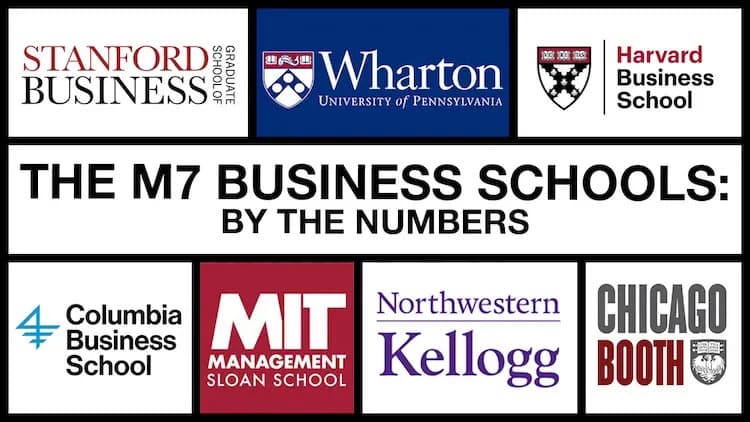
After a strong rebound the year before, application volume to the seven top U.S. business schools largely flattened for the cohort enrolling in fall 2025. The so-called Magnificent Seven — Harvard Business School, Stanford Graduate School of Business, Wharton, Columbia Business School, Chicago Booth, Northwestern Kellogg and MIT Sloan — collectively received 48,829 applications for the MBA Class of 2027, a modest rise of 0.6% following a 22% surge in the prior cycle.
Enrollment: Largest M7 Intake In Six Years
Though applications were nearly flat overall, the M7 admitted and enrolled slightly more students than the year before. The seven programs matriculated 4,866 students, 85 more than the prior entering class — the largest combined M7 cohort since the class that started in fall 2020.
School-level moves varied: Chicago Booth posted the biggest application gain (about +14.7% to 5,876), Wharton and Kellogg grew modestly, Harvard fell by 447 applications (-4.5) but still received the most at 9,409, and MIT Sloan saw applications drop by more than 8%. Every M7 program increased its entering class size for 2027, though most gains were modest (Wharton +22, MIT +17, Harvard +13).
Selectivity And Yield
Aggregate selectivity barely shifted: the average acceptance rate edged down from 18.7% to about 18.6%. Stanford remained the most selective, with an admit rate of 6.8%, followed by Harvard at an estimated 11.3%. Those two schools also post the highest yields: Harvard and Stanford convert nearly nine out of 10 admits into matriculants (estimated yields of 88.7% and 87.9%, respectively).
By contrast, MIT Sloan’s admit rate rose sharply — from 14.1% to about 18.8% — after the school extended roughly 195 more offers than in the prior cycle. Wharton and Columbia became more selective and strengthened yields, while Kellogg and Booth recorded smaller acceptance-rate declines.
Academic Profile: Tests And Grades
Incoming academic credentials remain elite. Across the M7, the median GMAT slipped one point to 732 and the average undergraduate GPA edged down to 3.68. Among schools reporting GRE results, the average combined GRE rose to 326.
Notable school-level GMAT moves: Booth led with a +7 jump to 736; Wharton rose to 735 (+3); Columbia to 734 (+2); Stanford held at 738 (highest); Kellogg at 733; Harvard and MIT Sloan each reported 10-point declines to 730 and 720, respectively. Harvard and Stanford led GRE reporting with combined scores of 328.

Gender, International Students And Reporting Changes
Gender and international representation shifted slightly but unevenly. Across six schools that published gender data, women comprised an average 45% of incoming students (down from 46%). Kellogg — which achieved parity a year earlier — did not publish its female percentage for the Class of 2027 but told Poets&Quants the share fell. Wharton’s female share fell to 44% after the school left the Forté network; Columbia (46%) and Stanford (45%) gained, and MIT Sloan remained closest to parity at 47% (down from 49%).
International representation dipped modestly, from 38% to 37% overall. Wharton posted the steepest drop (to 26%), Columbia fell to 41%, Kellogg to 37% and Stanford to 38%. Harvard, Booth and MIT Sloan increased international shares, with MIT reaching the highest reported share at 42%.
Reporting on U.S. students of color became harder to interpret: the reported average fell from 46% to 34%, but several schools changed which metrics they publish or how they calculate them. Kellogg removed several diversity data points from its class profile, and Booth, MIT Sloan and Wharton reported declines large enough to suggest definitional or methodological shifts rather than pure enrollment changes. These omissions complicate apples-to-apples comparisons over time.
Cost Of Attendance
The cost of an M7 MBA continues to climb. Average tuition across the seven schools rose nearly 3% to about $89,150. When living expenses, fees and other costs are included, the average one-year price of attendance rose 3.2% to nearly $137,000.
By school: Columbia reported the highest tuition at $93,908; Booth $89,976; MIT Sloan $89,692. MIT Sloan now has the highest annual total cost at $146,432 (up 5.9% year over year and 34.1% since 2023), followed by Columbia ($143,030) and Stanford ($140,940). Even Kellogg, the least expensive on this measure, estimates one year at just over $130,000.
What This Means For Applicants
Overall, the M7 market remains fiercely competitive: application volume is near its post-pandemic high, class sizes are slightly larger, and academic standards remain exceptionally high. Applicants should expect that strong test scores and GPAs are necessary but not sufficient — schools remain highly selective and are paying close attention to fit, leadership, and diversity of experience. Prospective students must also factor rising costs into decisions about where to apply and how to finance an MBA.
Sources: Poets&Quants analysis of M7 class profiles, school reporting, and U.S. News & World Report data.
Help us improve.