De-orbiting satellites burn up and convert aluminium components into alumina aerosols that can remain in the upper atmosphere. With roughly 14,000 active LEO satellites as of February 2026 and many thousands more planned, cumulative alumina deposition could rise substantially. A 2025 modeling study found potential effects on polar winds and mesosphere heating and suggested alumina may linger in the stratosphere for years. Observational data on alumina's impact on ozone are currently limited, prompting calls for targeted research and mitigation measures.
Burning Satellites Could Threaten Earth's Ozone Layer — Rising Alumina Raises New Atmospheric Risks
Petrovich9/Getty Images
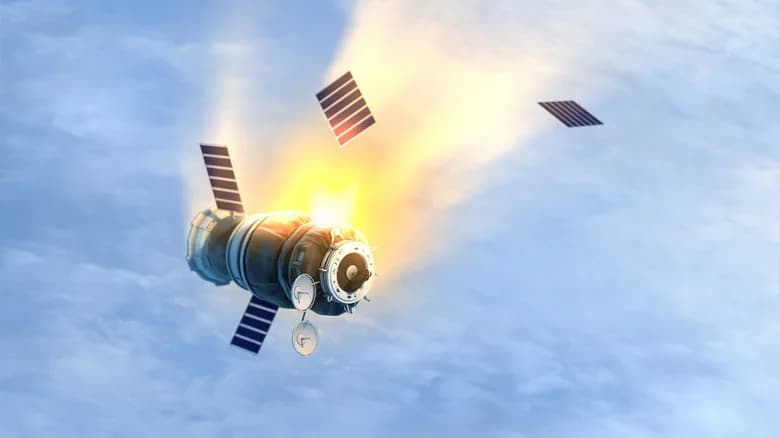
Most satellites placed in low Earth orbit (LEO) follow a decaying orbit: once a spacecraft finishes its mission its orbit gradually degrades and the object eventually re-enters Earth's atmosphere. While the immediate concern is ground impact, the vast majority of defunct satellites either burn up during re-entry or fall into uninhabited areas such as oceans. However, the materials released during re-entry do not simply vanish — they can remain suspended in the upper atmosphere and may have environmental consequences.
How Re-Entry Produces Alumina
Many satellites are constructed largely from aluminium and aluminium alloys. During high-temperature re-entry these metals oxidize into microscopic aerosol particles, commonly called alumina (aluminium oxide, Al2O3). Individual re-entries produce only small amounts of alumina, but as launch rates increase, the cumulative concentration of these particles in the mesosphere and stratosphere could grow.
Why Scientists Are Concerned
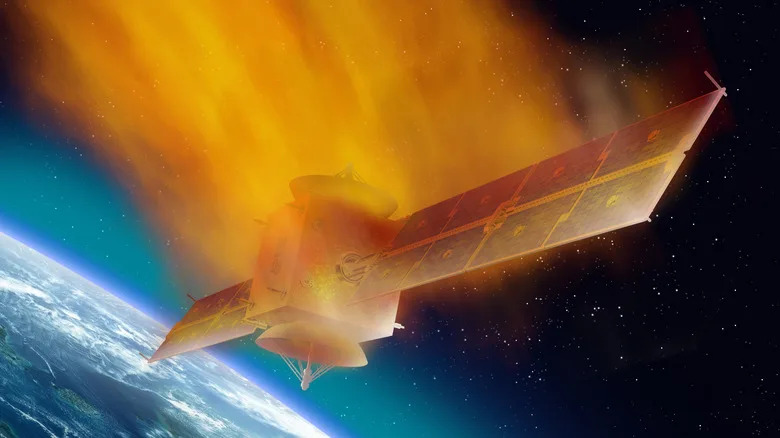
As of February 2026 there were roughly 14,000 active satellites in low Earth orbit, including large constellations such as Starlink. A 2022 estimate from the U.S. Government Accountability Office projected that, under current plans, there could be well over 60,000 satellites in LEO by 2040; many of these craft may have operational lifetimes as short as five years. If many satellites re-enter within similar time windows, atmospheric deposition of alumina could become frequent and sustained.
Paulfleet/Getty Images
A 2025 modeling study published in Journal of Geophysical Research: Atmospheres explored high-alumina scenarios and found possible effects on atmospheric dynamics, including alterations to polar wind patterns and localized heating in parts of the mesosphere. The study also indicated that alumina particles could persist in the stratosphere for several years, meaning any chemical or radiative effects could be prolonged.
Unknowns and the Ozone Question
Crucially, empirical data on how alumina aerosols affect stratospheric chemistry — and specifically ozone concentration — are limited. Laboratory studies and models provide potential pathways by which alumina could interact with radiative transfer and heterogeneous chemistry, but observations are sparse. Because ozone protects life on Earth from harmful ultraviolet radiation, even uncertain risks merit careful attention.
Paths Forward: Research and Mitigation
Experts urge targeted observations, coordinated measurements during and after re-entry events, and laboratory experiments to determine how alumina influences stratospheric chemistry. Policy and engineering responses could include accelerating research into low-emission materials (for example, experimental non-metallic or wooden satellites), improving end-of-life disposal practices beyond the informal “25-year rule,” and designing spacecraft to minimize high-temperature aerosol production during de-orbit.
Bottom line: Current models suggest that increased alumina from frequent satellite re-entries could alter atmospheric dynamics and persist for years, but observational evidence on impacts to ozone is limited. More measurements, experiments, and proactive design and policy changes are needed to assess and mitigate potential risks.
Help us improve.