Archaeologists at Ulucak Mound in western Turkey have discovered fingerprints on pottery dated to about 6000–5840 BC, providing rare, direct evidence of who worked in an early ceramics workshop. Excavations led by Professor Özlem Çevik since 2009 show impressions made by adults and children (some as young as ~11), suggesting craft roles were shared across ages and genders. The six-room complex contained tools, pigments and unfinished coil-built vessels; researchers will use imaging and further analysis to distinguish workshop practices from household pottery production.
8,000-Year-Old Fingerprints in Turkey Reveal Men, Women and Children Worked Together on Early Pottery
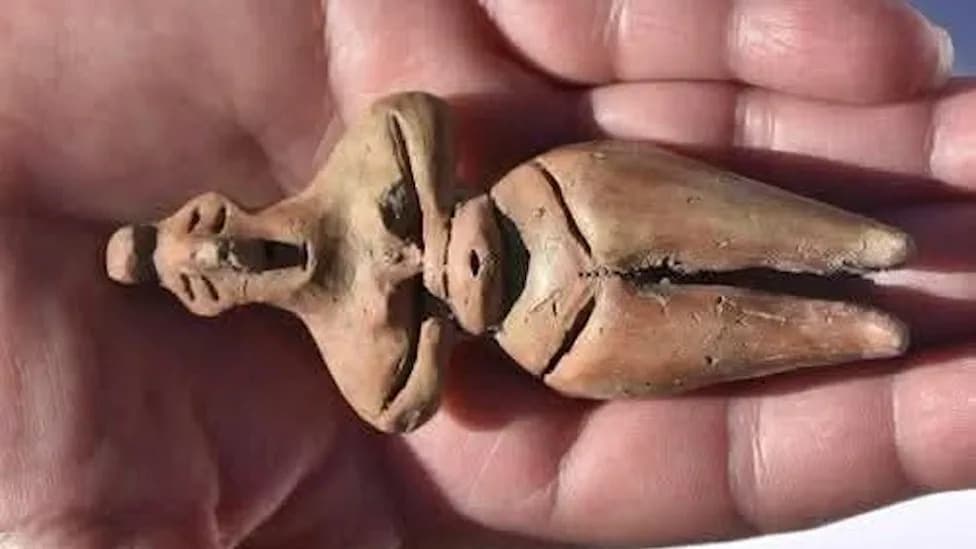
Photo Credit: X
About 8,000 years ago, someone pressed a fingertip into wet clay in what is now western Turkey — and that tiny impression has survived to the present day. Archaeologists working at Ulucak Mound in the Kemalpaşa district of İzmir province have identified multiple such fingerprints on clay loaves and ceramic fragments from a dedicated pottery workshop dated to roughly 6000–5840 BC.
What Was Found
The fingerprints were recovered from a six-room complex that contained tools, pigments, unfinished vessels and other craft supplies. The assemblage includes unfinished coil-built vessels, polishing stones, bone tools used to smooth surfaces, grindstones for preparing colorants, and red pigment lumps that may be hematite.
People Behind the Prints
Excavations at Ulucak have been led by Trakya University professor Özlem Çevik since 2009. Several of the impressions have been attributed to children up to about 11 years old. Other prints appear to belong to adults of different sexes. As a result, researchers say the evidence points to a mixed-age, mixed-gender workforce involved in early stages of ceramic production (reports cited by The Daily Galaxy and Newsweek).
“The case of Ulucak suggests that no gender differentiation has been evidenced during the initial steps for specialized pottery production,” said Professor Özlem Çevik.
Why This Matters
A fingerprint is direct physical evidence of a person’s presence, work and touch. These impressions challenge older models that placed pottery only in domestic contexts or restricted production to a narrow social group. Instead, the Ulucak evidence suggests craft knowledge was shared across ages and between sexes, even while some individuals may have developed greater skill.
Long before industrial factories, communities were organizing production by designating dedicated spaces, using specialized tools and repeating techniques to make useful goods. The Ulucak workshop offers a rare glimpse of how those processes may have operated in the early Neolithic Aegean.
Next Steps for Research
Researchers are continuing analyses of the prints and associated tools to reconstruct workshop practices. Modern imaging methods may reveal ridge detail in better-preserved impressions, though results depend on each print’s state of preservation. Further study will also investigate how workshop production differed from household pottery making — whether differences lie in clay preparation, shaping techniques, division of labor, or levels of training.
Sources: Excavation reports and interviews with Professor Özlem Çevik, and coverage in The Daily Galaxy and Newsweek.
Help us improve.