On July 28, a drone off New South Wales recorded what may be only the fourth fully filmed humpback whale birth and the first captured in full by drone. Pilot Alexander Forrest and ORRCA observers documented the water clouding with blood before a calf surfaced to breathe, then monitored the pair for hours. Researchers say the footage could provide rare scientific insight into whale reproduction and early calf behavior, and highlights how drones enable safer, less intrusive study of marine mammals.
Drone Films Rare Humpback Whale Birth Off New South Wales — Believed Only Fourth Full Recording
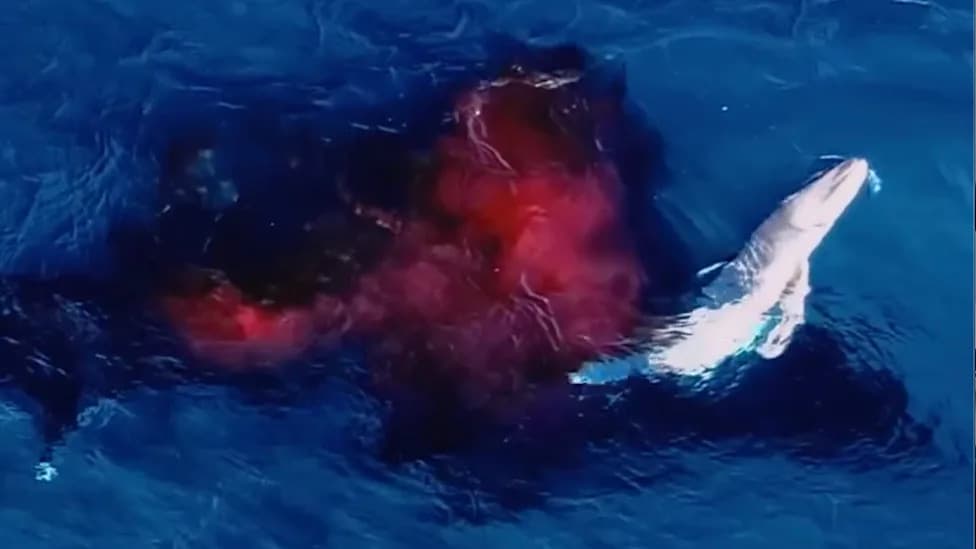
Photo Credit: Instagram
On July 28, a drone operating off the coast of New South Wales captured an extraordinarily rare event: a humpback whale giving birth in the open ocean. The footage, released publicly after the flight, is believed to be only the fourth complete recording of a humpback birth and the first to be filmed in full by a drone.
Drone pilot Alexander Forrest was filming migrating whales when he noticed an adult female behaving differently from others in the group. Working with ORRCA, the rescue and research nonprofit, Forrest focused on the animal and recorded the sudden ascent that preceded the birth.
The video shows the water clouding with blood before a calf appears and rises to the surface to take its first breaths. Forrest later wrote that he had been unaware of how rare the moment would be: "The whale suddenly rose toward the surface, so I hit record — any breath is [a] chance to capture a unique behavior. In this instance she didn't rise for an exhale, but to birth her new calf."
Members of the ORRCA team were present during the event and remained in the area for several hours afterward to observe and document mother and newborn behavior. ORRCA said on social media that the adult whale had been "displaying unusual behavior" prior to the birth.
Why the Footage Matters
Complete humpback births are extremely difficult to witness and even harder to record. This sequence could offer scientists rare insights into humpback reproduction, maternal behavior around parturition, and the earliest actions of a newborn calf. As ORRCA noted: "Every observation like this has the potential to expand our understanding of humpback whale reproduction, maternal behavior, and the earliest stages of a calf's life."
Advances in drone technology are making it easier to observe marine mammals from a safe distance with minimal disturbance, allowing researchers to capture behaviors that would be difficult or impossible to see from boats. In this case, aerial observation permitted several hours of continuous monitoring without direct interference.
The footage also arrives amid the long recovery of humpback populations following commercial whaling. While humpbacks have benefited from decades of conservation work and protections, continued monitoring, rescue efforts and habitat safeguards remain essential to address ongoing threats and to inform management of marine ecosystems that support biodiversity and coastal communities.
"It's a privilege to have witnessed such a remarkable moment, and even more rewarding to know it may contribute to marine mammal science for years to come," Forrest said.
ORRCA added: "We hope this remarkable encounter will make a valuable contribution to the international understanding of these incredible animals."
Help us improve.