New York City’s pied‑à‑terre surcharge targets owners who do not live full‑time in single‑family homes over $5 million and condos/co‑ops over $1 million. The city mailed about 17,000 notices and published a roll of roughly 960,000 potentially liable owners, drawing privacy complaints and political backlash. Officials project $500M in annual revenue, while the city comptroller estimated a plausible range of $340M–$380M; more than 9,600 exemption applications were started and the exemption deadline was extended to Sept 18.
New York’s Pied‑à‑Terre Tax Sparks Backlash and Praise — What You Need to Know
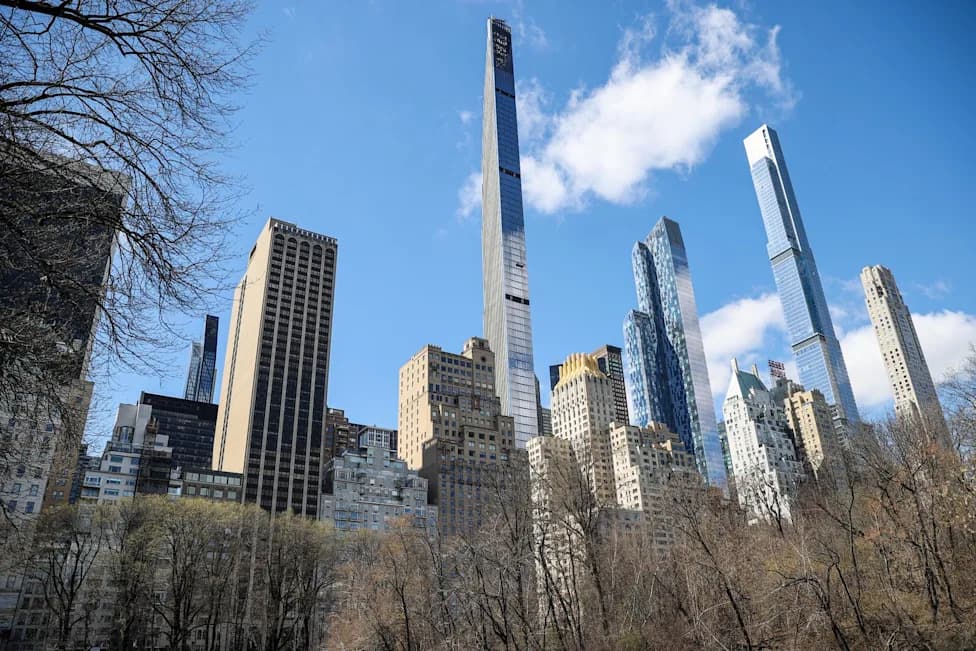
Steinway Tower, the world's skinniest skyscraper, in Manhattan.Photograph: Tayfun Coskun/Anadolu via Getty Images
New York City's new pied‑à‑terre surcharge — a levy on owners who do not live full‑time in very expensive properties — has provoked sharp debate. Critics say Mayor Zohran Mamdani is singling out the wealthy, while policy experts welcome the measure as a pragmatic way to raise revenue and ease housing pressure in a city with deep inequality and low homeownership.
What the Tax Covers
The surcharge applies to owners who do not occupy as a primary residence: single‑family homes valued above $5 million, and condominium or cooperative units worth at least $1 million. City officials say the tax is intended to help close a budget shortfall and encourage fuller use of housing stock.
Rollout And Public Reaction
As part of the initial enforcement effort the city mailed notices to about 17,000 addresses it suspected were second homes and published a tax roll listing roughly 960,000 owners who could be subject to the surcharge. That public roll included property addresses and market valuations — a step that many residents described as jarring or invasive.
Some recipients were upset to receive letters suggesting they might owe the tax even though the properties are their primary residences. Others said the publication amounted to shaming wealthy owners. Several residents and elected officials called the approach heavy‑handed and voiced privacy concerns.
Expert Views
Many public policy analysts view the surcharge as an equitable and efficient revenue tool. Emily Eisner, executive director and chief economist at the Fiscal Policy Institute, argued the levy "places a tax on high earners, people with a lot of resources who can contribute more to the economy." She added that fears of wealthy residents leaving are likely overstated and that the main challenge is accurate implementation and assessment of many properties.
"I don't think a lot of the typical concerns about migration are concerns when it comes to the pied‑à‑terre tax. I'm not concerned about dampening real estate markets … The largest concern is a matter of implementation and making sure that the city is able to appropriately assess many of these properties," Eisner said.
Other experts point out that second homes represent concentrated, largely immobile luxury wealth and that taxing them addresses negative externalities created by underused units. James DeFilippis, professor of planning and public policy at Rutgers, said taxing a property that imposes costs on others is an economically efficient remedy.
Political And Market Fallout
The measure drew public criticism from high‑profile figures. Billionaire Ken Griffin accused Mamdani of making New York unfriendly to success and threatened to expand operations elsewhere, though a developer later confirmed Griffin would remain a partner in a planned $4.5 billion Manhattan tower.
Despite the political noise, the luxury market has shown resilience: Compass reported Manhattan sales in the $10 million–$20 million range rose 38.6% year‑on‑year in the second quarter.
Administration Response And Next Steps
The mayor and Governor Kathy Hochul projected the tax could generate $500 million annually. The city comptroller’s analysis suggested a plausible revenue range of $340 million–$380 million, depending on exclusions (for rented units) and behavioral responses to the surcharge.
By midrollout more than 9,600 people had started applications for the primary‑residence exemption. The city extended the exemption deadline to September 18, hired 24 additional staff to handle inquiries and complaints, and scheduled a City Council hearing for August 18 to review the rollout and implementation.
Officials maintain that the data in the published roll were already part of public property assessment records, but critics say publishing the consolidated list heightened privacy concerns and political tensions.
Bottom Line
The pied‑à‑terre surcharge is likely to remain a polarizing but consequential policy. It aims to raise substantial revenue and encourage fuller use of housing in a city with acute affordability and homeownership challenges, but its ultimate fiscal yield and political impact will depend on how well the city manages exemptions, assessments and public communication.
Help us improve.