Researchers at UC Berkeley used operando Raman microscopy to watch atmospheric CO2 being converted into solid carbon during molten-salt electrolysis at ~500 °C. The team identified a peroxide intermediate that grows alongside carbon deposition, confirming a two-step reaction pathway. Cathode material strongly influences the resulting carbon morphology — nanotubes, platelets, amorphous clumps or nano-onions — suggesting the process can be tuned for applications like battery graphite. When powered by low-carbon electricity, the method could produce carbon materials with net negative CO2-equivalents.
Scientists Watch CO2 Turn Into Graphite in Real Time — Peroxide Step Confirmed
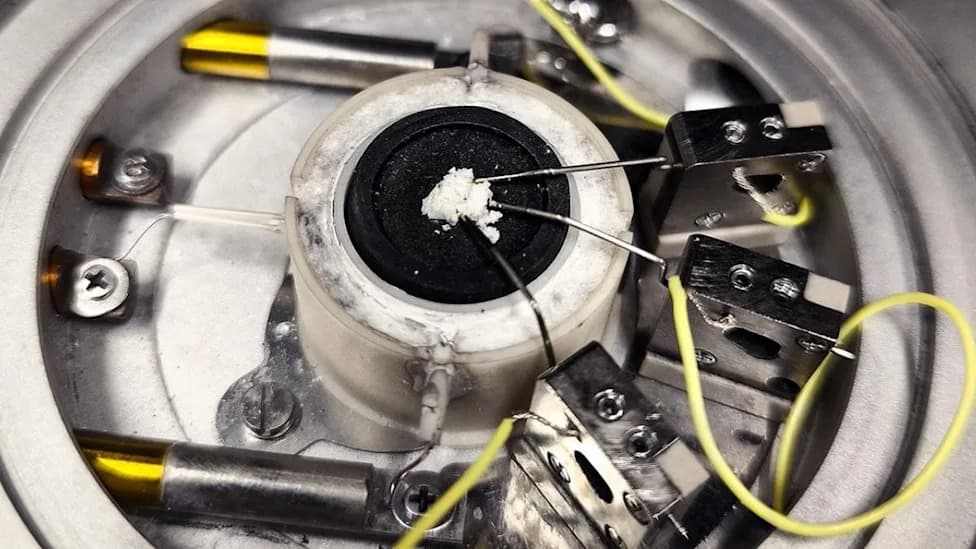
(Sander Ratso/National Institute of Chemical Physics and Biophysics)
Researchers have directly observed atmospheric carbon dioxide being converted into solid carbon — including graphite-like forms — using high-temperature molten-salt electrolysis. The team, led by chemical physicist Sander Ratso at the University of California, Berkeley, used operando Raman microscopy to monitor the reaction as it happened and identify a reactive intermediate that drives the transformation.
How the process works
Molten-salt electrolysis heats a salt bath to roughly 500 °C (about 932 °F) and runs an electrical current through electrodes immersed in the molten medium. Under those conditions, CO2 from the gas phase is reduced at the cathode: the CO2 molecules lose oxygen and the freed carbon atoms become locked into solid forms such as graphite.
New real-time evidence: a peroxide intermediate
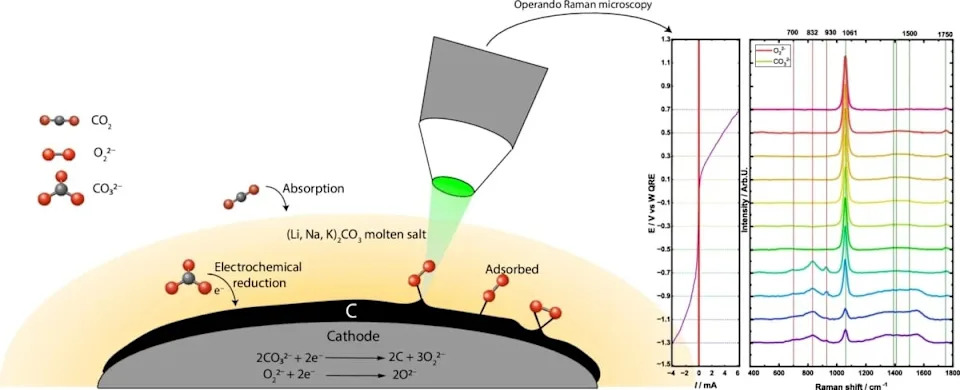
Operando Raman microscopy has revealed new details about CO2electrolysis in molten salts. (Ratso et al.,Nat. Commun.,2026)
Using operando Raman spectroscopy, the researchers observed optical bands that indicate the formation of a carbon-adsorbed peroxide species emerging and growing in step with carbon deposition on the cathode. Peroxide had been proposed as an intermediate decades earlier, but these measurements provide direct, reproducible evidence that a peroxide-like species is mechanistically involved in the CO2-to-carbon pathway under the study conditions.
"Very simply put, when before we were cooking with a closed oven, we put a window in it," Ratso said, explaining how observing the reaction in real time changes what scientists can learn and control.
Cathode material controls the carbon form
The team discovered that the same basic reaction pathway produces different carbon morphologies depending on the cathode metal. Observed deposits included:
- Carbon nanotubes and platelet-like structures on pure nickel cathodes
- Mainly platelets on Inconel 600 alloy cathodes
- Amorphous clumps on gold electrodes
- Amorphous carbon plus 'carbon nano-onions' on tungsten electrodes
These material-specific outcomes imply the process can be tuned to produce particular carbon allotropes for specific applications, such as battery anodes, electronics, or industrial uses.
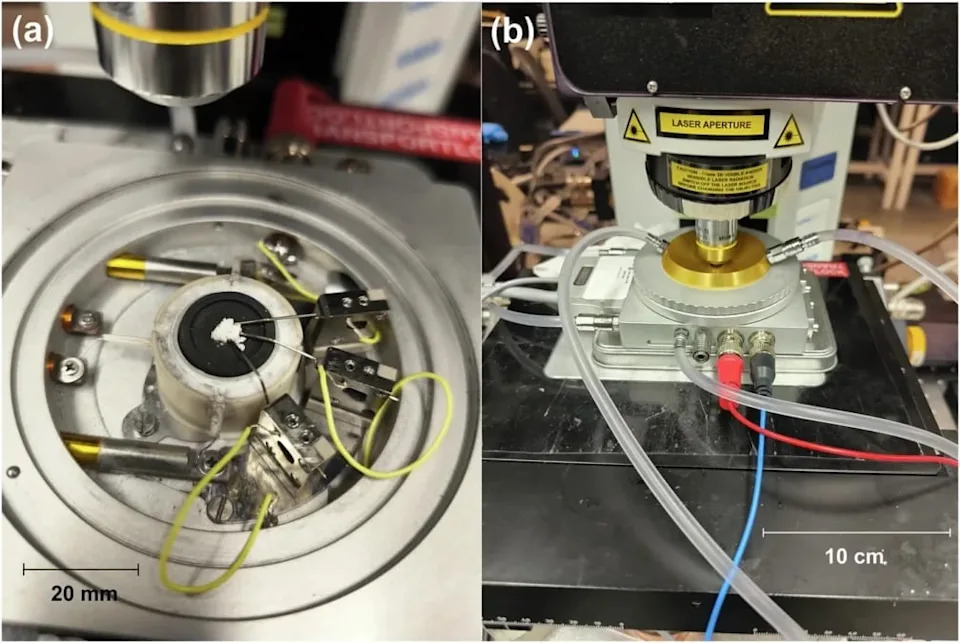
a) View of the internals of the Linkam Stage, and b) View of the setup connected to the confocal Raman microscope. (Ratso et al.,Nat. Commun.,2026)
Implications for climate and industry
Producing graphite and related carbons from atmospheric CO2 could reduce the carbon footprint of materials that currently have large CO2-equivalent costs. When the electrolysis is powered by low-carbon electricity (wind, solar or nuclear), the method has the potential to yield carbon products with net negative CO2-equivalents, meaning it could remove more CO2 from the atmosphere than the process emits.
Commercial context and next steps
A handful of companies already use related molten-salt CO2 electrolysis methods at industrial scale to produce carbon products in kilogram-to-ton quantities; Ratso is a co-founder of one such firm. Many current operations optimize by ex situ trial-and-error — synthesize, analyze, adjust — which is slow and costly. The operando Raman approach can accelerate optimization, broaden the range of obtainable carbon materials, and reduce development time and expense.

Subscribe to ScienceAlert's free fact-checked newsletter
The work was published in Nature Communications and is a key step toward controlling the structure of carbon materials produced by electrochemical conversion of CO2.
Limitations and perspective
Experts caution that carbon capture, utilization and storage (CCUS) alone will not solve climate change. However, converting CO2 into durable, valuable materials that displace conventionally produced carbon could make a meaningful contribution, particularly if deployed at scale and paired with low-carbon electricity.
Citation: Ratso et al., Nature Communications (2026). Operando Raman microscopy revealed a peroxide intermediate during molten-salt CO2 electrolysis and showed cathode-dependent carbon morphologies.
Help us improve.