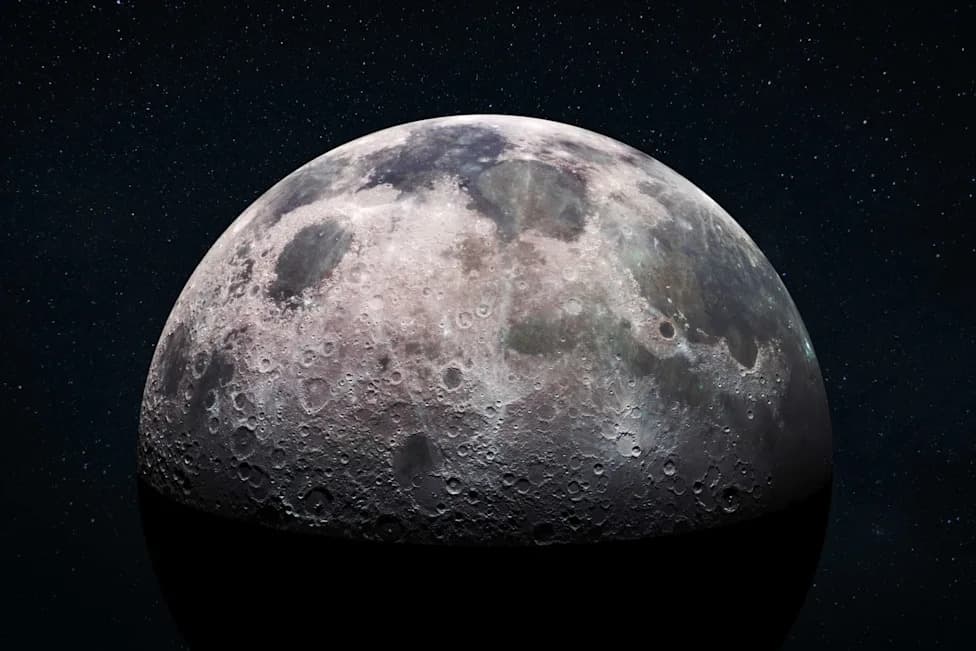
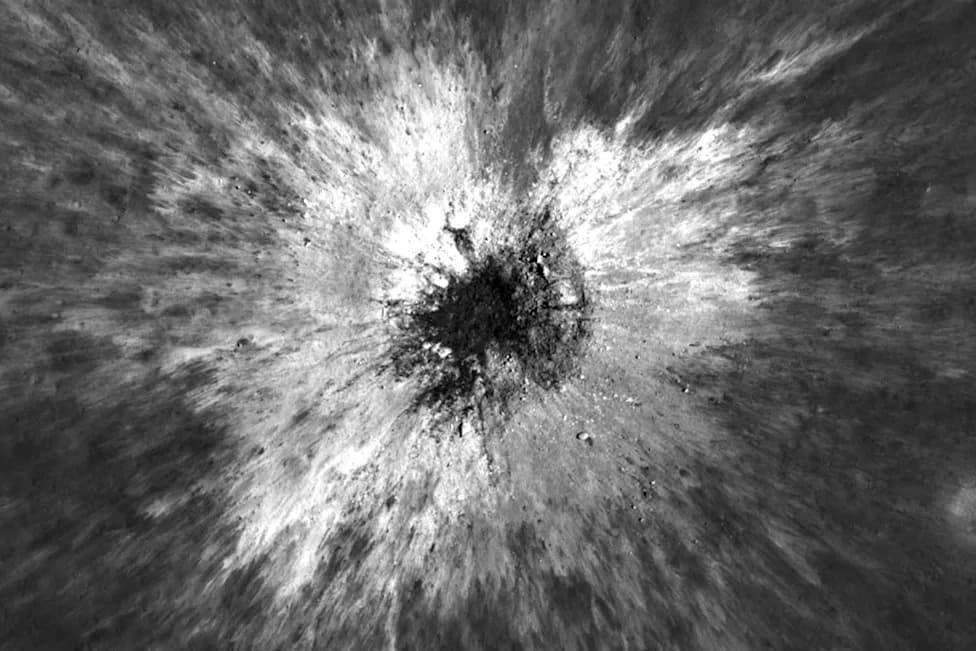
On Jan. 15, 2025, a SpaceX Falcon 9 upper stage that failed to reenter Earth's atmosphere struck the Moon, creating a fresh crater and a dust plume visible for several minutes. South Korea's Danuri orbiter captured before-and-after imagery, while ESO's Very Large Telescope detected sodium and lithium in the plume. Researchers will combine Danuri and NASA LRO data to study crater formation, ejecta patterns, and interactions between artificial objects and lunar soil. The incident highlights gaps in end-of-life planning for space hardware and the need for better disposal strategies.
SpaceX Rocket Stage Crashes Into Moon — Fresh Crater and Visible Dust Plume Provide Rare Research Opportunity
Photo Credit: iStock
Scientists observed a SpaceX Falcon 9 upper stage collide with the Moon on Jan. 15, 2025, producing a newly formed crater and a visible dust plume that was tracked for minutes. The event gave researchers an unusual, real-time case study of an artificial impact on the lunar surface.
What Happened
SpaceX launched a Falcon 9 carrying Firefly Aerospace's Blue Ghost-1 and ispace's Resilience lander. The rocket's upper stage failed to reenter Earth's atmosphere as planned and later struck the lunar surface. South Korea's Korea Aerospace Research Institute estimated the upper stage was roughly the size of a school bus and weighed about four tons. The impact speed was nearly 5,400 mph (about 2.4 km/s).
Observations and Findings
Because researchers began monitoring the target area roughly 30 minutes before impact, South Korea's Danuri lunar orbiter captured high-resolution images of the site before and after the collision. Those images show altered terrain and ejecta patterns produced by material flung outward from the strike.
The dust plume remained visible for about five to 10 minutes. The European Southern Observatory's Very Large Telescope (VLT) detected sodium and lithium in the plume; the ESO suggested the sodium likely originated from lunar material while the lithium may have come from the rocket hardware. Reuters also reported that the impact briefly reflected sunlight, though that glint was only detectable with specialized instruments.
Scientific Opportunity
Researchers plan to combine data from Danuri and NASA's Lunar Reconnaissance Orbiter (LRO) to study crater formation, dust dynamics, and how large artificial objects interact with the lunar regolith. Impacts of this size can help refine models of ejecta distribution, subsurface disturbance, and the chemical signatures produced by artificial materials on the Moon.
Policy and Safety Implications
SpaceX has said the upper stage was not intended to hit the Moon. After the stage failed to reenter Earth's atmosphere, effects from solar radiation pressure and gravitational interactions altered its trajectory, ultimately leading to the unintended lunar impact. The episode underscores how human space activity can leave hardware on unpredictable trajectories and highlights the need for robust end-of-life planning and disposal strategies for orbital and deep-space hardware.
Experts warn that normalizing weak disposal practices could shift costs and risks to the public, and increase hazards for future lunar missions and potential bases. SpaceX is reported to be coordinating with NASA on improved disposal methods while it develops reusable systems such as Starship.
Context
Unintended impacts are not entirely unprecedented — intentional impacts and experiments were conducted during the Apollo era to study seismic responses and crater formation. Scientists hope to treat this accidental collision as a research opportunity to improve understanding of both natural and artificial impacts on the Moon.
Help us improve.