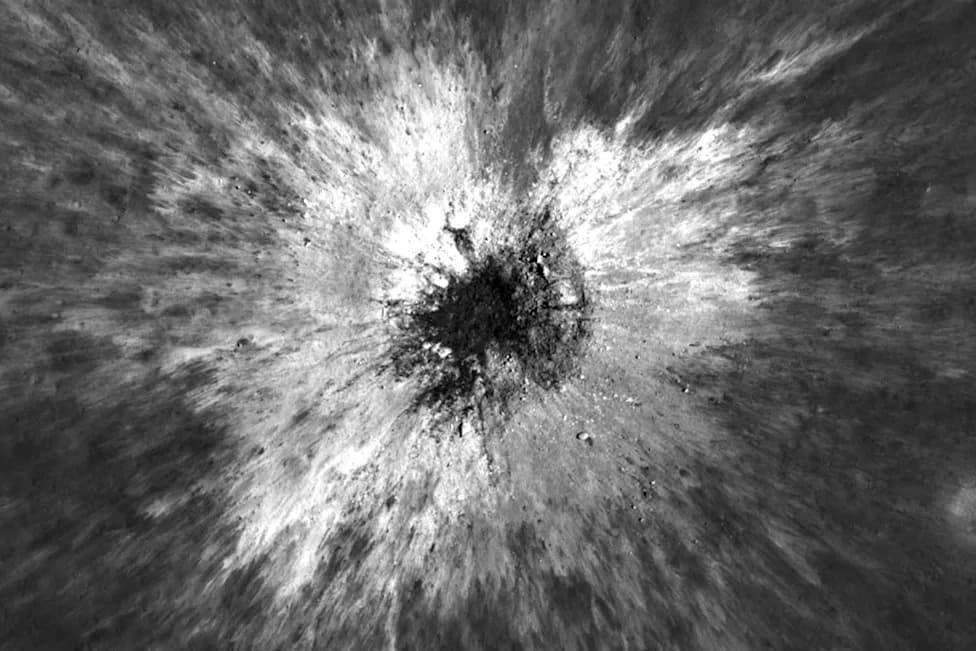
NASA’s Lunar Reconnaissance Orbiter photographed a fresh crater roughly 60 feet across that formed when a spent SpaceX Falcon 9 upper stage hit the Moon on Aug. 5 at about 5,400 mph. The 4.4‑ton stage had launched two lunar landers in January 2025 and failed to reenter as planned, instead impacting the lunar surface. European and South Korean observatories confirmed ejecta signatures, while amateur observers had tracked the fragment beforehand. The incident highlights the growing challenge of managing human‑made debris beyond Earth and the need for stronger end‑of‑mission disposal practices.
NASA Images Reveal 60‑Foot Lunar Crater From SpaceX Falcon 9 Upper Stage Impact
Photo Credit: iStock
NASA’s Lunar Reconnaissance Orbiter (LRO) captured images of a fresh crater on the Moon created when a spent SpaceX Falcon 9 upper stage slammed into the lunar surface on Aug. 5. The strike left a roughly 60‑foot (about 18 meters) wide depression, less than 10 feet deep, and bright rays of ejected material radiating from the rim.
What the Images Show
LRO photographed the impact site on Aug. 11 and 12 from an altitude of about 60 miles above the surface, clearly showing the crater and streaks of brighter material spreading outward. Scientists interpret those rays as subsurface material excavated and scattered by the high‑speed collision.
Object, Speed and Origin
NASA identified the object as a 4.4‑ton (4‑metric‑ton) Falcon 9 upper stage that had launched two lunar landers in January 2025. The stage struck the Moon at an estimated speed of roughly 5,400 miles per hour. It had been expected to reenter Earth’s atmosphere and burn up after the mission, but instead remained in an orbit that extended near the Moon and eventually impacted the surface.
Independent Confirmations
The impact was observed by multiple teams and instruments. The European Southern Observatory reported that its Very Large Telescope detected sodium and lithium in the impact ejecta cloud, and a South Korean lunar orbiter independently imaged the new crater. Amateur astronomer Bill Gray first identified the errant rocket fragment in September 2025; observers continued to track it as the collision approached.
Why This Matters
Moon impacts are common, but this event is notable because it was caused by human‑made hardware that was never intended to strike the surface. The incident highlights gaps in end‑of‑mission disposal and the broader challenge of artificial debris beyond Earth orbit. Space debris increases risks for active missions and raises tracking and operational costs for navigation, communications, weather forecasting, and science satellites.
Monitoring and Prevention
International monitoring — from LRO to ground‑based observatories and foreign lunar orbiters — helped confirm the impact and provided data on how artificial objects behave outside Earth orbit. Agencies such as NASA’s Center for Near Earth Object Studies (CNEOS) and the U.S. Space Surveillance Network track asteroids and larger spacecraft, but small fragments remain difficult to follow. Experts emphasize that robust end‑of‑mission disposal plans and stronger safeguards by mission planners and launch providers are far more practical than attempting to remove debris after the fact.
Bottom line: The new crater is a clear, visible reminder that spacecraft that aren’t properly disposed of can create lasting, avoidable hazards beyond Earth.
Help us improve.