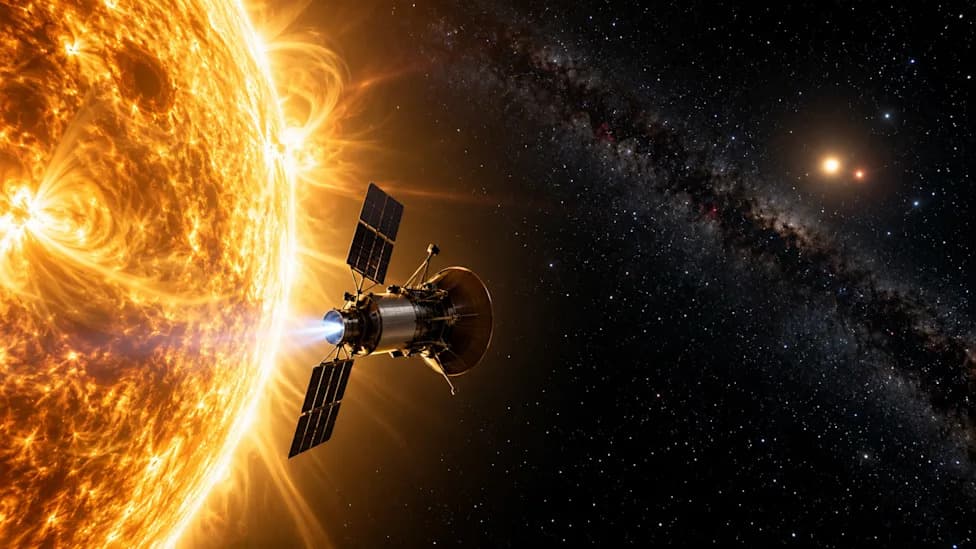
Independent researcher Gabriel Harry proposes a provocative engineering framework to extend Earth's surface habitability far beyond the commonly cited ~1 billion-year limit. The plan centers on two radical interventions: a large sunshade at L1 to offset the Sun's steady brightening and a speculative program to harvest and deliver oxygen (or other atmospheric gases) from Jupiter using L2 relay stations. Grounded in orbital mechanics and stellar-evolution models, the proposal is an ambitious thought experiment that highlights what might be physically possible, while also depending on highly uncertain and technically daunting steps.
Could Earth Be Saved From a Billion-Year Deadline? A Bold Plan to Prolong Habitability for Quadrillions of Years

Earth faces cosmic deadline in a billion years. A researcher has a plan to keep us alive.
Earth has roughly one billion years of comfortable surface habitability left if current stellar evolution models are correct — not because of climate change or asteroids, but because the Sun is gradually brightening as it converts hydrogen to helium. That slow increase in solar output will eventually trigger a runaway greenhouse effect that vaporizes the oceans and strips the atmosphere long before the Sun expands into a red giant.
The Basic Threat
Over the next ~1 billion years, rising solar luminosity will raise surface temperatures enough to destabilize Earth's climate system. Oceans will begin to evaporate, water vapor — a strong greenhouse gas — will build in the atmosphere, and atmospheric escape processes will accelerate. The result is a long, slow thermal extinction rather than a sudden cataclysm.
Gabriel Harry's Proposal
Independent researcher Gabriel Harry has published a speculative engineering framework in the Journal of the British Interplanetary Society arguing that humanity could, in principle, extend Earth's surface habitability enormously — to roughly 9.1 quadrillion years (about 9.1 × 10¹⁵ years) — by actively managing incoming sunlight and replenishing lost atmospheric gases.
1. A Sunshade at L1
Harry's first intervention is a large sunshade placed near the Sun–Earth Lagrange Point 1 (L1). A sufficiently large and well-positioned shade would intercept a small fraction of incoming solar radiation, compensating for the Sun's gradual brightening and helping to hold global temperatures within a habitable range for many millions to billions of years.
2. Atmospheric Replenishment (Highly Speculative)
To address long-term atmospheric loss, Harry proposes harvesting oxygen from Jupiter's upper atmosphere and sending it inward. Shipments would be intercepted by relay infrastructure around Earth's Lagrange Point 2 (L2) and directed to Earth to replenish gases lost to escape processes. This step is presented as the most speculative and technically demanding element of the plan; the presence, abundance, and accessibility of molecular oxygen in Jupiter's upper atmosphere remain subjects of scientific debate, and the logistics of extracting and transporting planetary-scale quantities of gas are extraordinary.
How Does 9.1 Quadrillion Years Arise?
The 9.1 quadrillion–year figure comes from modeling the combined effects of active solar shading and atmospheric maintenance as the Sun ages, exhausts its core hydrogen, becomes a white dwarf, and then cools slowly. White dwarfs can emit residual heat for extremely long timescales (trillions of years), and with engineered interventions, Harry's calculations suggest Earth's surface conditions could, in theory, be preserved long after the Sun's main-sequence lifetime ends.
Credibility, Limits, and Context
This work is best read as speculative, large-scale engineering rather than an immediate construction blueprint. Gabriel Harry is an independent researcher with an MSc in Applied Mathematics; his paper outlines a physically grounded framework using orbital mechanics, stellar-evolution models, and atmospheric science, but it does not solve the immense engineering, economic, political, and ethical challenges involved.
Key uncertainties include whether Jupiter contains extractable molecular oxygen in the required amounts, the feasibility of building and maintaining megastructures at the Lagrange points for geological timescales, and the sociotechnical capacity to sustain such projects over millennia or longer. The proposal is valuable as a long-range thought experiment that highlights what physics allows in principle, not as a near-term plan.
Note: One quadrillion = 1,000,000,000,000,000 (1015). For scale, the universe is ~13.8 billion years old — Harry's figure represents an unimaginably long extension of habitability compared with the current age of the cosmos.
Bottom line: The idea combines plausible physics with highly speculative engineering. It reframes the Sun-driven habitability deadline as a potential engineering problem, but turning that concept into reality would require breakthroughs and commitments on scales far beyond current capabilities.
Help us improve.