The first fully preserved bathing complex at Tell Nasser, near Port Said, has been uncovered, revealing an integrated private and public bathing installation with a complete water supply and drainage system. Excavations show continuous occupation from the late fourth–early third centuries BCE through the Ptolemaic and Roman periods, supported by Cypriot, Greek and Rhodian pottery and later Gaza amphorae. Key features include a 2.5 m private basin, two 5 m tholoi with footbaths, slip-resistant hydraulic mortar floors, and a six-meter red-brick supply channel with vaulted covering.
Egypt Uncovers Fully Preserved Hellenistic–Roman Bath Complex and Hydraulic System at Tell Nasser
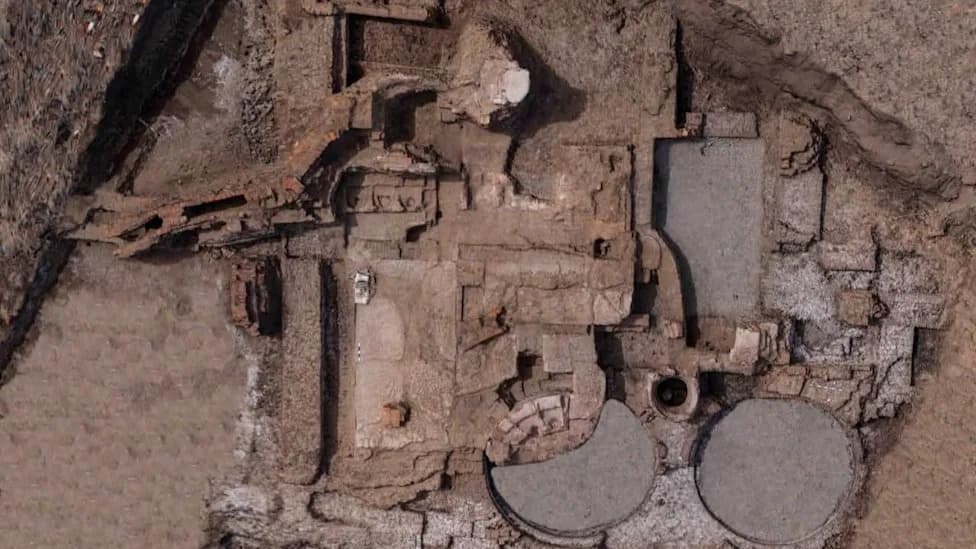
Aerial footage of ancient bathing complex found at Tell Nasser archaeological site, August 7, 2026. (photo credit: EGYPTIAN TOURISM AND ANTIQUITIES MINISTRY)
Archaeologists have uncovered the first fully preserved bathing complex at the Tell Nasser archaeological site near Port Said, revealing an integrated private and public bathwork with an intact water supply and drainage system. The discovery, made during the mission's initial excavation season, offers new insight into settlement and public-service architecture in Egypt's eastern Nile Delta from the Hellenistic into the Roman period.
Location and Dating
The site lies about 40 km south of Port Said and roughly 1.5 km north of the Suez Canal. Preliminary stratigraphic analysis indicates continuous occupation beginning in the late fourth to early third centuries BCE. Finds from successive layers show a Ptolemaic phase in the second and first centuries BCE and continued use through the Roman era.
Pottery and Chronology
Dr. Hisham El-Leithy, Secretary-General of the Supreme Council of Antiquities, noted that the earliest occupation layer contained Cypriot pottery sherds and Greek amphora fragments, demonstrating settlement before the bathing complex was built. Rhodian amphora stamps and a mix of local and imported ceramics mark a Ptolemaic phase, while Gaza amphorae in later fills suggest reuse of parts of the complex during the late Roman period.
Bathing Complex Layout and Features
The Tell Nasser complex uniquely combines a private bathing unit with a public bath and a complete hydraulic system. The private unit centers on a circular basin about 2.5 meters in diameter, constructed of red brick and lined with moisture-resistant pink mortar. Nearby, archaeologists identified a low structure interpreted as a water-heating installation.
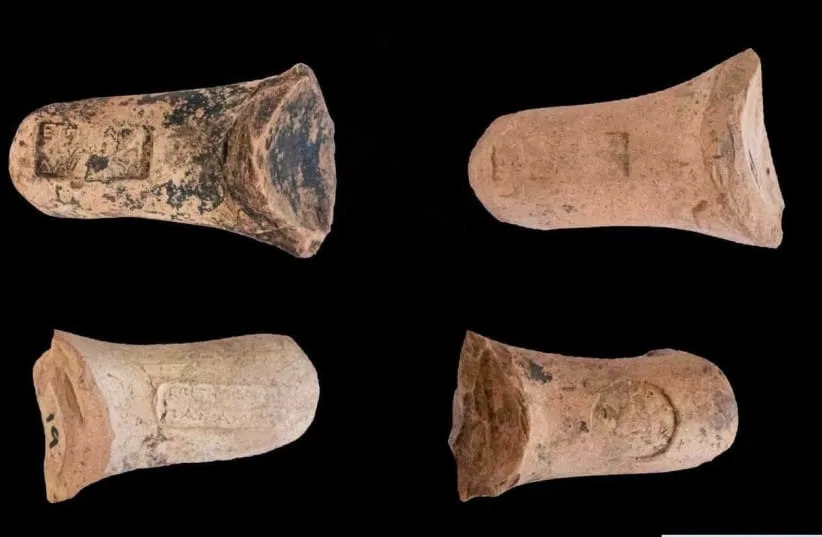
Pottery fragments found at Tell Nasser archaeological site in Egypt, August 7, 2026. (credit: EGYPTIAN TOURISM AND ANTIQUITIES MINISTRY)
The public component comprises two circular tholoi, each roughly five meters across. One tholos contained five footbaths, three of which survive in good condition. Each footbath includes a backrest, side armrests and a rounded recess for the feet. The complex also preserved three rectangular basins and a quarter-circular basin used to collect and distribute water.
Hydraulic Engineering
Khaled Farid, director of the Port Said Antiquities Zone and leader of the excavation, described a complete hydraulic system including a six-meter-long red-brick water supply channel, part of which was roofed by a vaulted brick cover. Excavation revealed an older conduit underneath the channel and a network of drainage openings tied to internal drains. Floors were finished in slip-resistant hydraulic mortar to control water flow and prevent damage.
Use, Modification, and Reuse
Mohamed Abdel Badi, Head of the Egyptian Antiquities Sector, said architectural evidence points to an original construction date in the late first century BCE, followed by successive modifications during Roman times. In the later Roman period, sections appear to have been repurposed for storage, consistent with the presence of Gaza amphorae in fill layers.
Tourism and Antiquities Minister Sherif Fathy praised the mission's scientific results, saying the find provides new insight into settlement history and the development of architecture and public services in the eastern Delta during the Ptolemaic and Roman periods.
Significance
The Tell Nasser baths furnish a rare, well-preserved example of Hellenistic and Roman bathing architecture and hydraulic engineering in the eastern Nile Delta. Their combination of private and public facilities, along with a complete water supply and drainage system, makes the complex particularly valuable for understanding daily life, public hygiene, and local engineering practices in antiquity. Comparisons have been made with other Hellenistic baths recently found in Egypt, including a bath at Tell el-Herr in northern Sinai.
Ongoing Work: Archaeologists will continue study and conservation of the complex and associated occupation layers to refine the chronology and to document construction techniques and later adaptive reuse.
Help us improve.