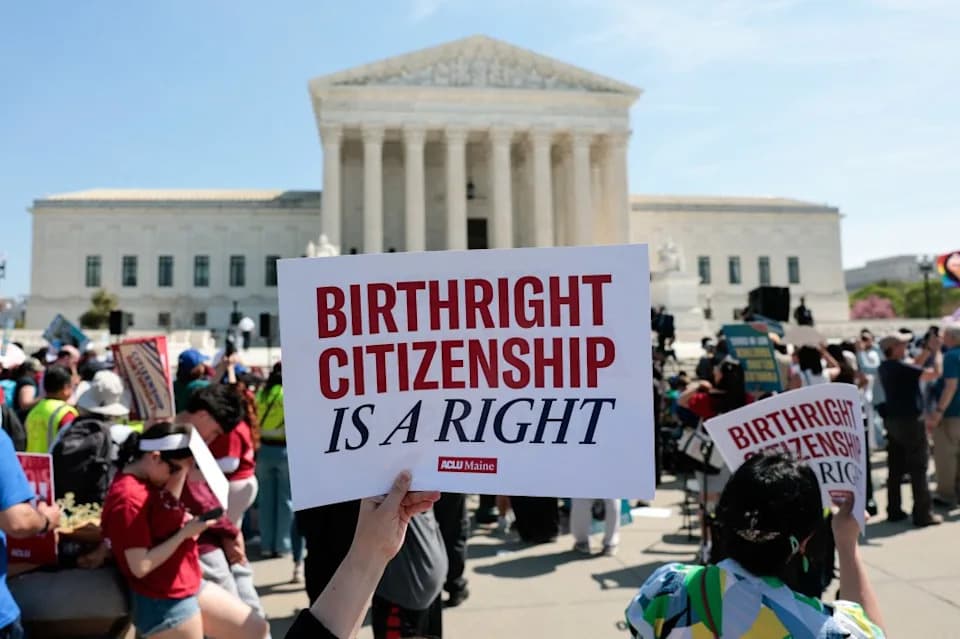
President Trump signed two executive orders aimed at restricting 'birth tourism' after the Supreme Court in June struck down his prior attempt to limit birthright citizenship in Trump v. Barbara. One order would deny recognition of a child's citizenship if a parent engaged in fraud; the other would block visas for suspected birth tourists. Legal scholars say the measures face major constitutional hurdles because the Supreme Court reaffirmed broad protections under the 14th Amendment, though some narrower exceptions could be litigated. Observers expect rapid legal challenges focused on implementation and statutory boundaries.
Trump Signs New Orders Targeting 'Birth Tourism,' but Legal Roadblocks Loom After Supreme Court Ruling
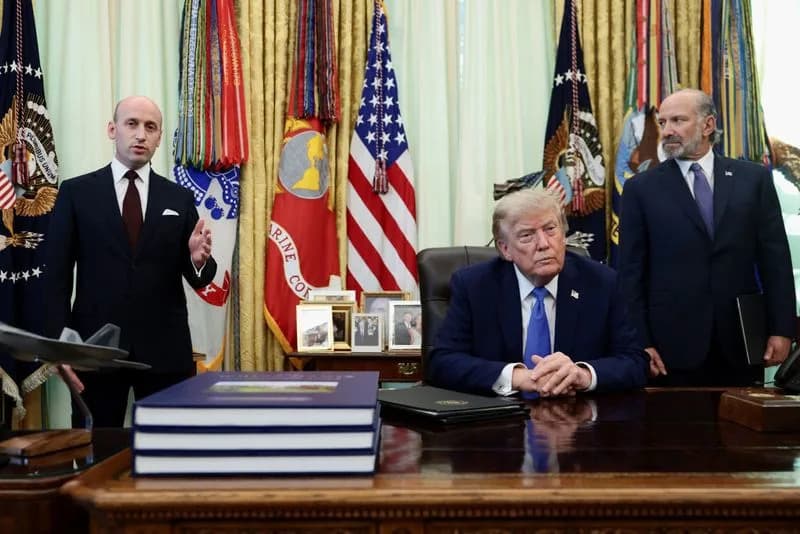
White House Deputy Chief of Staff Stephen Miller speaks while U.S. President Donald Trump and U.S. Secretary of Commerce Howard Lutnick listen during an event to sign executive orders related to birthright citizenship and the polysilicon industry, in the Oval Office at the White House in Washington, D.C., U.S., August 6, 2026. REUTERS/Evelyn Hockstein
By Andrew Chung
President Donald Trump on Thursday signed two executive orders aimed at curbing so-called 'birth tourism' after the U.S. Supreme Court in June rejected his prior effort to limit birthright citizenship. Legal experts say the new measures are likely to spark vigorous court challenges because the high court has already addressed the central question in Trump v. Barbara.
What the Orders Do
One order directs federal agencies not to recognize a child's U.S. citizenship if either parent is found to have 'engaged in fraudulent activity to obtain citizenship.' A second seeks to block visas for foreigners suspected of traveling to the United States primarily to give birth. The administration did not provide full details on enforcement, and existing federal rules already bar using some temporary visas solely for this purpose.
Legal Obstacles and Expert Views
Many immigration scholars say the broad exclusions face an uphill battle because the Supreme Court's June decision reaffirmed broad birthright protections. The June 30 ruling in Trump v. Barbara held that the 14th Amendment confers citizenship on those born in the United States who are 'subject to the jurisdiction thereof.' University of Virginia law professor Amanda Frost said, 'These children are citizens based on their birth on U.S. soil. Illegal conduct by their parent can have no bearing on their status.'
Justice Samuel Alito, dissenting from the 6-3 decision, warned that the majority's approach could cover 'women who come here solely for the purpose of giving birth.' Alito called the ruling a mistake that could have serious consequences for the country's future.
Broader Exemptions and Uncertain Boundaries
Beyond measures aimed at birth tourism, one of the orders seeks to expand longstanding exceptions to automatic birthright citizenship. Current exceptions include children of diplomatic representatives and hostile occupying forces; the new order would reportedly extend exemptions to certain foreign government employees and to people designated as foreign terrorists or 'alien enemies.'
Scholars are divided on whether narrower expansions could survive judicial review. Amanda Frost said expanding the diplomatic exception could be legally feasible depending on how it is structured, though it would likely require granting substantial immunity to those individuals. John Yoo, a Berkeley law professor who served in the Justice Department during the George W. Bush administration, argued that attempts to classify hostile forces to include terrorist organizations 'will eventually pass constitutional muster.'
Others cautioned such changes could be extreme in practice. University of Michigan law professor Sam Erman pointed to historical precedents, noting that Japanese immigrants were classified as enemy aliens during World War II; under a broad new rule, their U.S.-born children might have been denied citizenship. UCLA immigration expert Hiroshi Motomura warned that vague terms like 'alien enemy' or the 'purpose' of a stay create wide discretion and risks of arbitrary enforcement.
Political Reaction
Speaking from the Oval Office, President Trump renewed his criticism of the Supreme Court ruling and asserted that businesses have grown around birth tourism, claiming 'hundreds of thousands' benefit improperly — a figure many researchers consider far too high. Penn State scholars estimate roughly 5,000 to 10,000 births annually linked to birth tourism from 2014 through 2024.
White House Staff Secretary Will Scharf defended the orders, saying they do not conflict with the Supreme Court's opinions. Several law professors, including John Yoo and Northeastern's Rachel Rosenbloom, disagreed about the scope of what could pass legal muster, with Rosenbloom calling some of the proposed exclusions 'clearly unconstitutional.'
What Comes Next
Legal challenges are expected quickly. Courts will likely scrutinize the orders' compatibility with the 14th Amendment and the Supreme Court's guidance in Trump v. Barbara. Much may ultimately hinge on how federal agencies interpret and implement elastic terms in the orders and how lower courts balance deference to executive policy against constitutional protections.
(Reporting by Andrew Chung; Editing by Amy Stevens and Sanjeev Miglani)
Help us improve.