Collective Fermi Estimation—not simple averaging—explains why groups often outperform individuals on numerical estimation tasks. Across three experiments with 900 participants, groups that broke problems into smaller parts and reasoned through those pieces arrived at more accurate answers than groups that pooled initial guesses. Even when individuals used the Fermi method, groups still did better, suggesting interaction and mutual checking add unique value. The study appears in Nature Communications and is limited to numerical tasks.
When Two Heads Are Better Than One: How Collective Fermi Estimation Lets Groups Outperform Individuals

(Mauricio Graiki/iStock/Getty Images Plus)
Two heads are often better than one—but not for the reason you might expect. A new study in Nature Communications led by neuroscientist Federico Barrera-Lemarchand at Torcuato Di Tella University (Argentina) finds that groups improve numerical estimates not by averaging guesses, but by breaking hard problems into smaller parts and reasoning those parts through together. The authors call this approach Collective Fermi Estimation.
What the Researchers Did
The team recruited 900 participants across three experiments to examine how small groups reach a consensus on general-knowledge numerical estimation tasks. Their goal was to test whether groups simply combine initial guesses or whether deliberation produces genuinely new, more accurate answers.

YouTube Thumbnail
Experiment 1: Natural Deliberation
Groups of four entered chatrooms and discussed estimation questions without any process instructions. Researchers reviewed transcripts and found that groups that spontaneously decomposed problems into manageable subparts and reasoned through those components produced substantially more accurate final estimates than groups that mostly exchanged and averaged initial guesses. Accuracy gains were not driven by one dominant speaker; participation was typically balanced across members.
Experiment 2: Teaching the Strategy
Groups were split into two conditions. One group type was instructed to share initial estimates and compute an average; the other was taught the Fermi decomposition method—divide the question into subproblems, estimate each, then combine. Groups taught to decompose consistently outperformed the averaging groups, demonstrating that the strategy can be learned and applied in group settings.
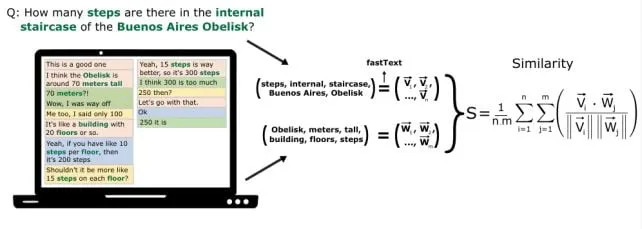
Successful groups broke the problems into bite-sized pieces. (Barrera-Lemarchand et al.,Nat. Commun., 2026)
Experiment 3: Individuals vs. Groups Using Fermi
Everyone received instructions to use the Fermi method, but half worked alone while the other half worked in groups. Individuals improved when using the technique, but group performance remained superior. That gap suggests that interaction—sharing, checking, and refining component estimates—adds value beyond the method itself.
Language and Problem Decomposition
The researchers conducted linguistic analyses of the chat transcripts. High-performing groups used words closely tied to the target problem (for example, "staircase," "building," and "floors" when estimating steps in a monument), indicating focused decomposition into plausible sub-elements. This linguistic focus correlated with higher accuracy, implying that explicit problem-structure talk helps group reasoning.

Subscribe to ScienceAlert's free fact-checked newsletter
"This work shows that collective reasoning, and in particular reasoning by approximation, underlies enhanced collective accuracy during deliberation, and offers tools to detect and foster such processes..."
Limitations and Practical Implications
The authors note an important boundary condition: the experiments tested only numerical estimation tasks, so it remains an open question whether the same collective-decomposition advantage applies to other decision types. Still, the findings suggest a practical pathway to improve group judgments: teach teams to decompose complex problems and encourage collective checking of component estimates. The approach could inform better practices for crowdsourcing, forecasting, and collaborative problem-solving.
Publication: Barrera-Lemarchand et al., Nature Communications, 2026.
Help us improve.