On July 2, 2026, NASA's Perseverance rover recorded Earth briefly disappearing behind Phobos, marking the first time Earth has been seen vanishing from the surface of another planet. The team produced a nine‑image composite and a seven‑frame animation (with color adjustments) that show Earth as a pixel‑sized dot. Phobos is roughly 17 miles wide and orbits about 4,850 miles above Mars; Earth was about 195 million miles away during the observation. The capture required careful planning by the Mastcam‑Z team and showcases the rover's precise imaging capabilities.
Perseverance Watches Earth Vanish Behind Mars Moon Phobos — A First‑of‑Its‑Kind View
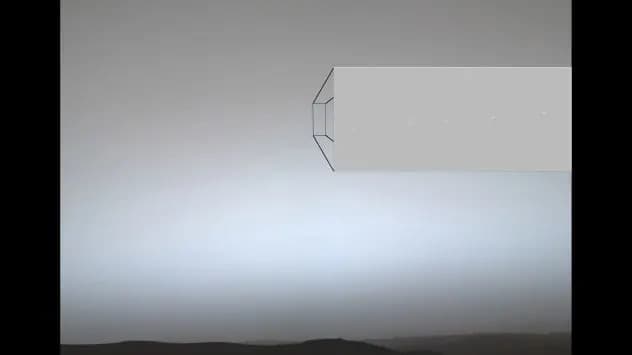
This annotated composite of nine images taken by Perseverance on July 2, 2026, shows Earth passing behind the Martian moon Phobos. The images in the inset were captured from the same rectangular patch of sky outlined in black. (NASA/JPL-Caltech/ASU/MSSS/SSI)
NASA's Perseverance rover captured a remarkable sight on July 2, 2026: Earth briefly disappeared behind Phobos, one of Mars' two moons, producing the first recorded view of our planet vanishing from the surface of another world.
Images taken by the rover's Mastcam‑Z instrument show Earth as a tiny, pixel‑sized point of light in the Martian sky while the larger Martian moon, Phobos, crossed directly in front of it. NASA and the mission team say this is the first time observers on another planet have recorded Earth being occulted by a nearer object.
What the images show
An annotated composite assembled from nine images traces the brief event, and the team also created a seven‑frame animation that follows Earth as it slips behind Phobos. The animation frames had their colors adjusted to remove stray light and enhance subtle detail so the tiny dot of Earth and the moon's motion are clearer.
About Phobos and the geometry
Phobos is an irregular, potato‑shaped moon roughly 17 miles (about 27 kilometers) across at its widest dimension and orbits only about 4,850 miles (7,800 kilometers) above Mars. At the time of the observation, Earth was roughly 195 million miles (about 314 million kilometers) away and appeared as a single pixel in Perseverance's field of view.

This animation, consisting of seven images of Earth passing behind the Martian moon Phobos, was created from data taken on July 2, 2026. The colors were edited to remove extraneous light and to enhance detail. (NASA/JPL-Caltech/ASU/MSSS/SSI)
How it was planned
Events like this — known as occultations, when one body blocks another from an observer's perspective — require careful planning. "Phobos crosses the Martian sky three times a day, and Earth is visible for months at a stretch, but catching one directly behind the other takes planning and a little luck," said Mark Lemmon, a Mastcam‑Z co‑investigator at the Space Science Institute in Boulder, Colorado, who planned the observation and assembled the composite.
"The composite image makes for a unique Earth self‑portrait, taken from the surface of another planet, with a Phobos photobomb," said Justin Maki, Mastcam‑Z deputy principal investigator and imaging scientist for Perseverance at NASA's Jet Propulsion Laboratory in Southern California.
Why it matters
Beyond the novelty of the image, the observation demonstrates the precision of planetary imaging and mission planning. Perseverance has previously recorded solar eclipses on Mars — when one of Mars' small moons crosses the sun — but Phobos and Deimos are too small to fully eclipse the sun as seen from the Martian surface. Capturing Earth briefly disappearing behind Phobos adds a new, striking example to the rover's catalog of celestial observations.
Image credits
NASA/JPL‑Caltech/ASU/MSSS/SSI
Help us improve.