Astronomers have detected a Jupiter-sized object orbiting a 37-Jupiter-mass brown dwarf in the CD-35 2722 system, about 73 light-years away. The companion completes an orbit every ~170 days and has a minimum mass near 0.9 Jupiter masses. The discovery — reported in Nature using CRIRES+ on ESO's VLT and radial velocity measurements — is a strong exomoon candidate, but classification is uncertain and confirmation requires more observations. Next-generation telescopes like the ESO ELT (expected ~2029) could provide decisive evidence.
Jupiter-Sized Object Detected Orbiting a Brown Dwarf in CD-35 2722 — A Strong Candidate Exomoon
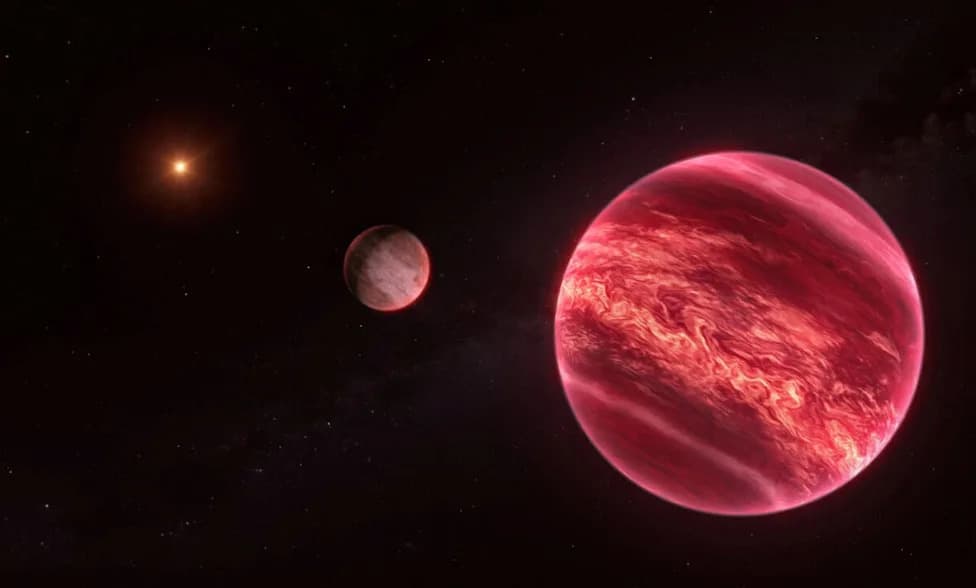
Artist’s impression of the CD-35 2722 system, with the newly discovered exosatellite (left) orbiting a brown dwarf that itself circles the red-dwarf primary star (right) | ©Image Credit: ESO/M. Kornmesser
A team of astronomers reports the detection of a Jupiter-mass object orbiting a brown dwarf in the CD-35 2722 system — a discovery that may represent the first confirmed moon (exomoon) beyond our Solar System, though researchers remain cautious about labeling it definitively.
System Details
CD-35 2722 lies about 73 light-years away in the constellation Columba. The system's primary star has roughly half the Sun's mass and is orbited by a brown dwarf with an estimated mass of ~37 Jupiter masses — too heavy to be classified as a planet but too light to sustain hydrogen fusion like a star. The newly detected companion circles this brown dwarf every ~170 days and has a minimum mass near 0.9 Jupiter masses.
Why The Classification Is Tricky
The object's size and orbital arrangement blur conventional Solar-System-based labels. As lead author Kevin Hoy (ESO) notes, the companion is massive enough to qualify as a planet in isolation, yet it does not orbit a star directly — it orbits a substellar companion that itself orbits a star. That three-body configuration complicates whether to call the body a moon, a planet, or an exosatellite.
"This system is somewhat hard to define using Solar-System-based words like 'planet' and 'moon'," said Kevin Hoy. "Being the third wheel in this system makes us want to call it a moon, even if it is nothing like the small, rocky moons we have in our system."
How It Was Detected
The detection used CRIRES+ (the Cryogenic High-Resolution InfraRed Echelle Spectrograph) on the European Southern Observatory's Very Large Telescope (VLT) in Chile. The team applied high-precision radial velocity measurements to the brown dwarf, searching for the tiny wobble in its motion induced by an orbiting companion — the same general technique that produced the first exoplanet discovery around a Sun-like star in 1995.
"The satellite we report is a giant gaseous body orbiting a highly massive companion, itself several times the mass of Jupiter," said Alice Zurlo (Universidad Diego Portales), emphasizing how the system blurs the lines between stars, planets, and moons.
Context And Next Steps
Although more than 6,000 exoplanets have now been confirmed, no exomoon has yet been universally accepted. Several candidates have been proposed previously — for example, a putative satellite in HD 206893 — but follow-up observations have not provided definitive confirmation. The authors stress that additional observations and independent confirmation are required before the object can be declared an exomoon.
Planned next-generation facilities should help resolve such ambiguities. The ESO Extremely Large Telescope (ELT), expected to begin operations around 2029, will have roughly 20 times the light-collecting power of the VLT and could provide the sensitivity needed to confirm or refute candidates like the one in CD-35 2722.
Why It Matters
Confirming an exomoon would open a new category of worlds for study: large satellites around brown dwarfs or planets, with potential implications for formation theories and atmospheric characterization. Whether this object will be named the first exomoon or reclassified as a planetary companion to a brown dwarf depends on future observations and on how astronomers choose to extend classification schemes beyond our Solar System.
Sources: Nature, European Southern Observatory (ESO), arXiv, Wired.
Help us improve.