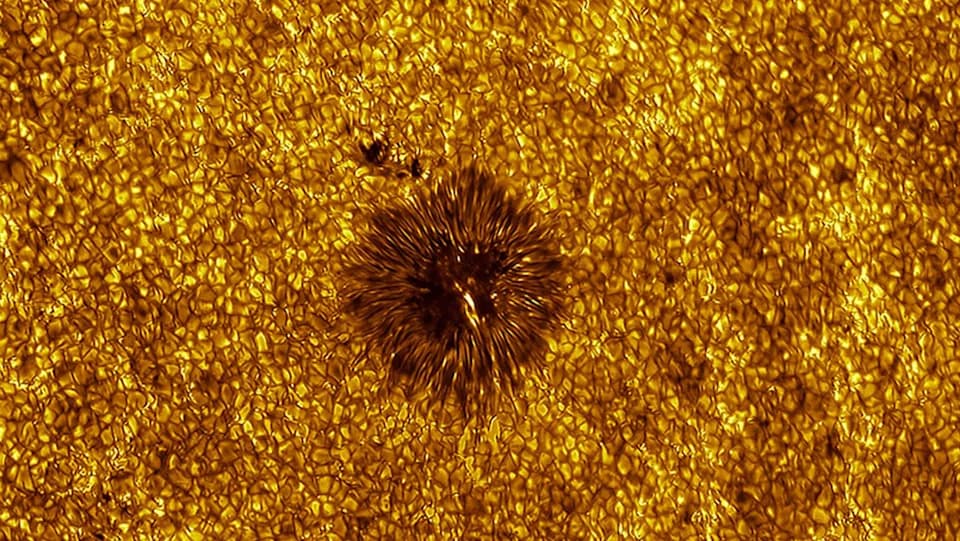
The Daniel K. Inouye Solar Telescope captured the sharpest images yet of the Sun's photosphere and revealed widespread tiny whirlpools consistent with Kelvin-Helmholtz instabilities (KHI). Researchers combined the images with simulations to show KHI can cascade energy to microscopic scales, helping heat the corona and braid magnetic fields. These small magnetic vortices may trigger flares and coronal mass ejections and improve predictions of space weather.
Tiny Solar Whirlpools Revealed: Inouye Telescope Finds Kelvin-Helmholtz Instabilities Powering Solar Activity
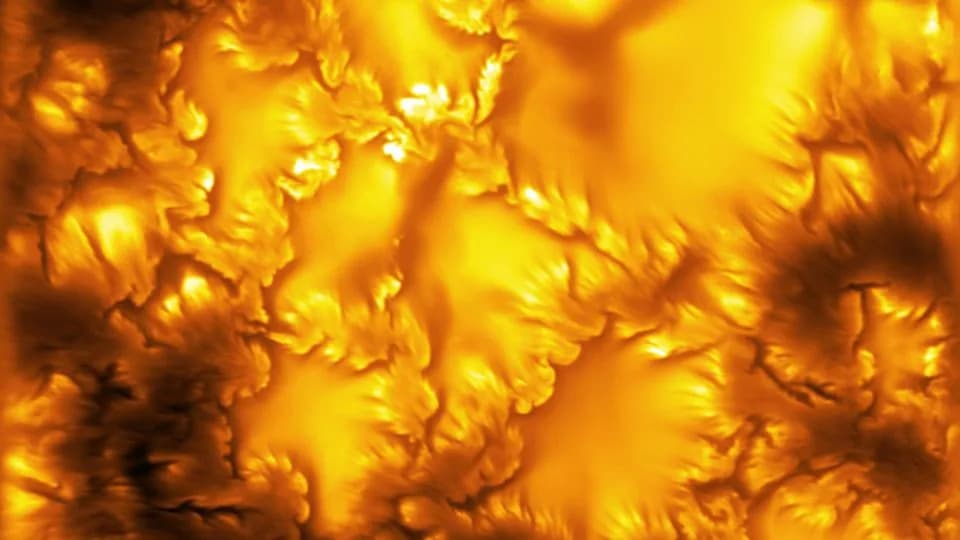
The highest resolution image of the sun's surface was captured by a powerful telescope. - NSF/NSO/AURA/MPS
Researchers using the National Science Foundation's Daniel K. Inouye Solar Telescope on Maui have captured the highest-resolution views yet of the Sun's visible surface and uncovered a widespread, previously hidden process that helps drive solar activity.
The team focused the 4-meter (13-foot) telescope on a magnetically active region adjacent to a sunspot. High-resolution images and time-lapse sequences expose the photosphere's complex structure — a thin, visible layer shaped by magnetic fields and flowing plasma.
Small Vortices, Big Consequences
By combining these observations with advanced computer simulations, the researchers identified the unmistakable signature of tiny whirlpools known as Kelvin-Helmholtz instabilities (KHI). KHI occurs when neighboring streams of plasma move at different speeds and roll up into vortices. Although KHI has been seen in oceans, clouds and on gas giants, this is the first time these vortices have been observed so widely across the solar photosphere.
“Seeing these structures widespread across the surface was still a huge surprise,” wrote lead author Dr. David Kuridze of the National Solar Observatory. “For the first time, we have identified both their origin and their driving mechanism.”
The researchers propose that these small-scale swirls act like miniature engines across the Sun's surface: breaking large plasma flows into smaller motions, cascading energy to microscopic scales, heating the outer atmosphere (the corona), and braiding magnetic field lines. When braided fields snap and reconnect, they can release energy as flares or coronal mass ejections that drive space weather at Earth.
Why This Matters
This discovery helps address long-standing puzzles in solar physics. One key mystery is why the corona is millions of degrees hotter than the visible surface below. KHI provides an efficient mechanism to shuttle mechanical energy from the photosphere to micro-scales where it can dissipate as heat. The vortices also offer a plausible trigger for the magnetic tangling that precedes reconnection and eruptive events.
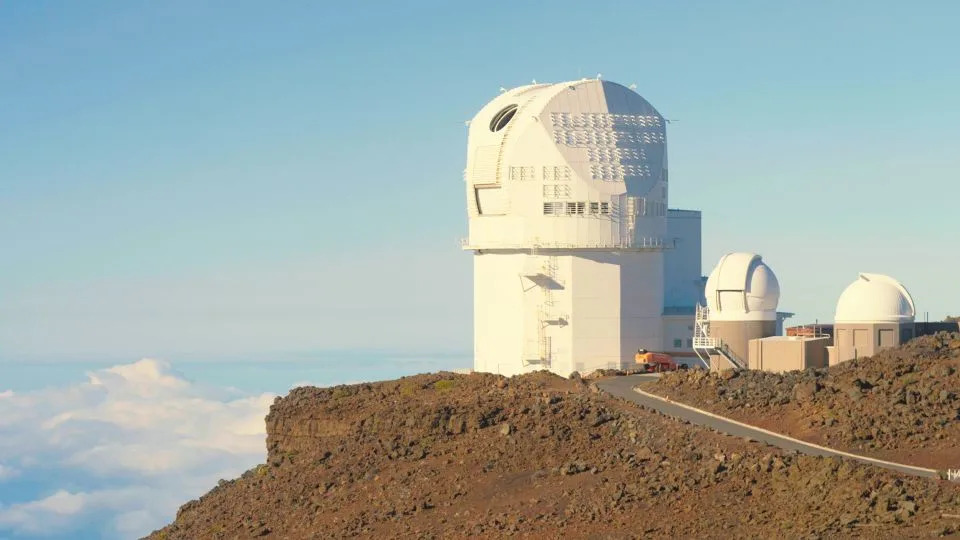
The Daniel K. Inouye Solar Telescope is located in Maui. - NSF/NSO/AURA
Independent experts praised the result. Dr. Maria Weber, associate professor of physics at Delta State University, noted that vortex structures are common in planetary atmospheres and called the solar observations “a valuable advance.” Dr. Nour Rawafi, project scientist for NASA's Parker Solar Probe, said the finding is a breakthrough for understanding how energy from the Sun's lower atmosphere is transformed and transferred upward.
The study, published in Nature, also reports close agreement between Inouye observations and the team's numerical simulations. That match allowed researchers to interpret fine details that imaging alone cannot resolve and strengthened the identification of KHI as the driving process for the observed swirls.
Tools and Future Work
The Daniel K. Inouye Solar Telescope's large primary mirror, adaptive optics (which corrects for atmospheric blurring), and multi-layer instrumentation made these observations possible. Coauthor Dr. Friedrich Wöger of the National Solar Observatory called Inouye “a one-of-its-kind, world-class facility” that will likely produce many more transformative discoveries.
Future coordinated observations and modeling should map the physical links between these small vortices and larger eruptive events, improving forecasts of major flares and geomagnetic storms that can disrupt satellites, power grids and communications.
Publication: The results were published in the journal Nature. Location: Daniel K. Inouye Solar Telescope, Haleakalä, Maui.
Help us improve.