Researchers combining six years of observations with genetic analysis at Fiji's Shark Reef Marine Reserve report that bull sharks display a modest preference for associating with relatives. The study introduces the term "kinfluence" to describe kinship's subtle role in shaping social networks, with effects strongest among male pairs. Social behaviour was measured by proximity (within one body length) and directed interactions such as parallel swimming and lead-follow formations. High juvenile mortality—largely from illegal fishing—reduces the number of kin that reach adulthood and may limit detectable kinship patterns.
Bull Sharks Prefer Their Kin: Study Coins ‘Kinfluence’ in Shark Social Networks
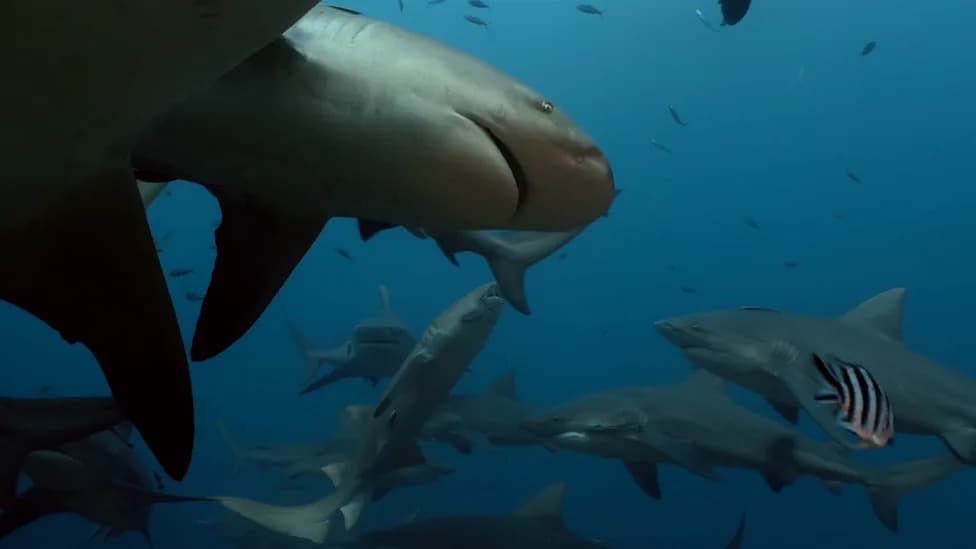
Bull sharks at Shark Reef Marine Reserve. (Natasha D. Marosi via SWNS)
New research suggests bull sharks show a modest but detectable tendency to spend time with relatives, revealing an unexpected social dimension in these large predators.

New research shows that sharks prefer to hang out with their relatives, suggests a new study. (Natasha D. Marosi via SWNS)
What the Study Found
Combining genetic analyses with six years of field observations at Shark Reef Marine Reserve in Fiji, scientists found that individual bull sharks were slightly more likely to associate and interact with kin than with unrelated sharks. Although most adults in the aggregation are not closely related, the team detected a subtle kinship effect on social behaviour—especially in male pairs.

Researchers found that bull sharks have a slight preference for spending time with relatives. (Natasha D. Marosi via SWNS)
How Social Behaviour Was Measured
The researchers measured social preferences two ways. First, they recorded proximity-based associations when sharks were within one body length of each other. Second, they logged directed social interactions such as parallel swimming, lead-follow formations and joining events when one shark actively synchronised its movement with another. Genetic data were used to determine relatedness between individuals.

A research team used genetic data and six years of observations at Shark Reef Marine Reserve in Fiji, where adult bull sharks regularly gather. (Natasha D. Marosi via SWNS)
"Large sharks are often seen as solitary, but our previous research showed that bull sharks actively choose their social partners," said lead author Natasha Marosi. "This new study reveals another dimension of their social lives: the 'kinfluence' effect we have uncovered—while not as strong as other factors—is nonetheless extraordinary."
Term and Implications
The team—researchers from the University of Exeter, Lancaster University and Fiji Shark Lab—coined the term "kinfluence" to describe how kinship subtly shapes social structure. Evolutionary theory predicts that behaviours favouring relatives can help pass shared genes to future generations; the authors suggest early-life familiarity may help sharks recognise kin later in life.
Conservation Context
Detecting kin-based structure in adult aggregations is challenging because juvenile bull sharks face high mortality in rivers and coastal habitats, largely due to illegal fishing. Fewer surviving relatives reach adulthood, which reduces the number of kin available in adult social groups and may weaken observable kinship patterns.
The study was published in the journal Ecology and Evolution. Natasha Marosi is a Ph.D. candidate at the University of Exeter and founder of Fiji Shark Lab. The research provides new insight into shark social complexity and highlights how conservation pressures could alter social structure in apex predators.
Help us improve.