The columnist argues that Rep. Max Miller should resign amid serious domestic and child abuse allegations brought by his ex-wife, Emily Moreno, and corroborated in part by a memoir from Stephanie Grisham. Miller denies the claims and has invited a House Ethics Committee investigation, which is now underway. With a sitting Republican senator publicly calling for Miller to step down, the piece urges GOP leaders to apply the same standards to their members that they demand of opponents.
Opinion: Republicans Should Call on Rep. Max Miller to Resign Over Abuse Allegations

Rep. Max Miller (R-OH) leaves a House Republican Caucus meeting on Capitol Hill on Nov. 19, 2024 in Washington, DC. Rep. Max Miller recently said he'll continue in his reelection bid, despitecalls for him to resignbecause of domestic abuse allegations.(Andrew Harnik, Getty Images)
Opinion: Rep. Max Miller (R-Ohio) is facing serious allegations of domestic and child abuse from his ex-wife, Emily Moreno, and a separate accusation from former White House press secretary Stephanie Grisham. The claims—set out in court filings and a memoir—have intensified calls from some Republicans for Miller to step down and prompted a House ethics inquiry. Given the severity of the allegations and the party's past rhetoric on similar cases, GOP leaders must act consistently and swiftly.
What Has Been Alleged
Court filings filed amid a lengthy post-divorce custody dispute allege that Miller once pressed a gun to Emily Moreno's head, scalded her with hot water and caused their daughter's fractured collarbone. Grisham, in a memoir, described being in a physically abusive relationship with a White House official and has since identified Miller as that person.
Miller's Response and the Ongoing Probe
Miller has denied the allegations, called his ex-wife's mental health a factor and pointed to the couple's continued joint custody as inconsistent with her claims. He has invited a House Ethics Committee investigation, writing on X:
"I have absolutely nothing to hide."The Ethics Committee has opened a review of the matter.
Political Reactions
Sen. Bernie Moreno, whose daughter is the accuser, publicly called on Miller to resign, saying Miller "fails" basic standards of character for elected office. Most House Republicans initially urged patience, with House Speaker Mike Johnson emphasizing that these are allegations and pointing to the Ethics Committee process. After Sen. Moreno's statement, a few GOP senators—including Roger Marshall and Shelley Moore Capito—joined calls for Miller to step down.
Why This Matters
The controversy raises questions about consistency and priorities for both parties. Republicans previously pressed Democrats to drop candidates accused of sexual misconduct (notably the Graham Platner episode); if the GOP is to maintain credibility on character standards, it should apply the same expectations to members of its own caucus. If the Ethics Committee substantiates the allegations, party leaders should be prepared to demand resignation or pursue appropriate disciplinary action.
Conclusion
Allegations of this nature demand a thorough, transparent investigation. While due process is essential, political parties also have a responsibility to uphold consistent ethical standards. If the probe corroborates the accusations, Republicans should act decisively. Anything less risks the appearance that political convenience outweighs a genuine commitment to accountability.
By Dace Potas, USA TODAY Opinion Columnist

Max Millerarrives with White House Press Secretary Stephanie Grisham for a State Dinner for Australia’s Prime Minister Scott Morrison at the White House in Washington, Sept. 20, 2019. Miller was a political appointee during the first Trump administration.(ERIN SCOTT, REUTERS)

Republican U.S. Representative candidate Max Miller arrives to speak before the arrival of former President Donald Trump at a rally at the Dayton International Airport on Nov. 7, 2022 in Vandalia, Ohio.(Drew Angerer, Getty Images)

Max Miller, candidate for Ohio’s 16th congressional district, addresses the crowd at former President Donald Trump’s rally at the Lorain County Fairgrounds in Wellington, Ohio, June 26, 2021.(GAELEN MORSE, REUTERS)

Former President Donald Trump listens to Max Miller, a former Trump aide and current republican candidate for Ohio's 7th congressional district, during rally at the Delaware County Fairgrounds on Apr 23, 2022.(Adam Cairns, Columbus Dispatch via USA TODAY Network)

Republican congressional candidate Max Miller attends former U.S. president Donald Trump's rally in Youngstown, Ohio, Sept. 17, 2022.(GAELEN MORSE, REUTERS)

Representative-elect Max Miller (R-OH) speaks at the Republican Jewish Coalition Annual Leadership Meeting in Las Vegas on Nov. 19, 2022.(WADE VANDERVORT, AFP via Getty Images)

Rep. Max Miller (R-OH) speaks to reporters as he leaves a House Republican caucus meeting where the conference voted on a Speaker of House nominee in the Longworth House Office Building on Oct. 11, 2023 in Washington, DC.(Joe Raedle, Getty Images)
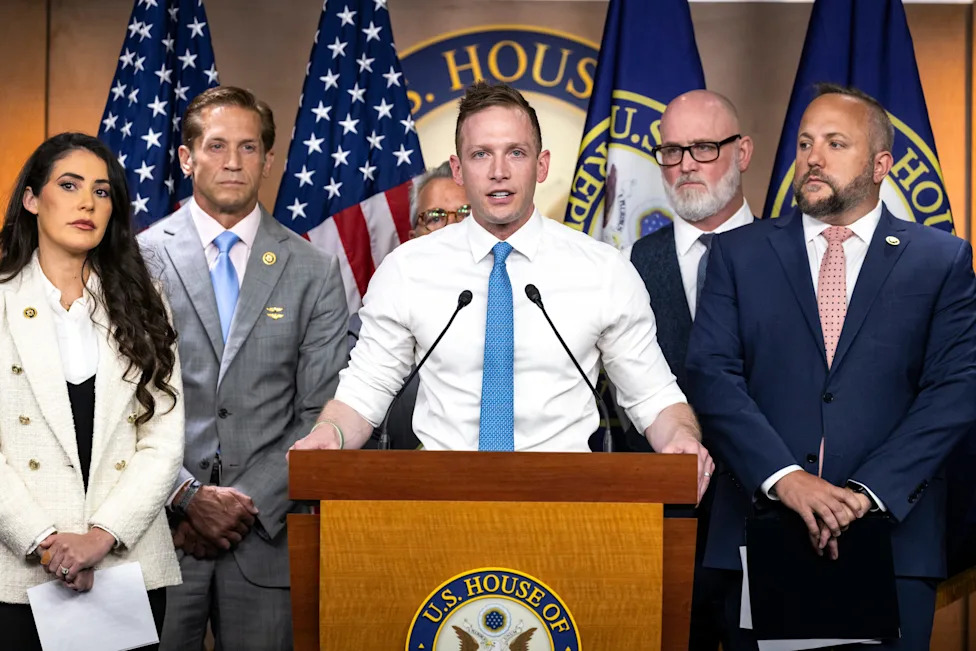
Rep. Max Miller (R-OH) speaks during a press conference on Capitol Hill on June 26, 2024 in Washington, DC.(Samuel Corum, Getty Images)
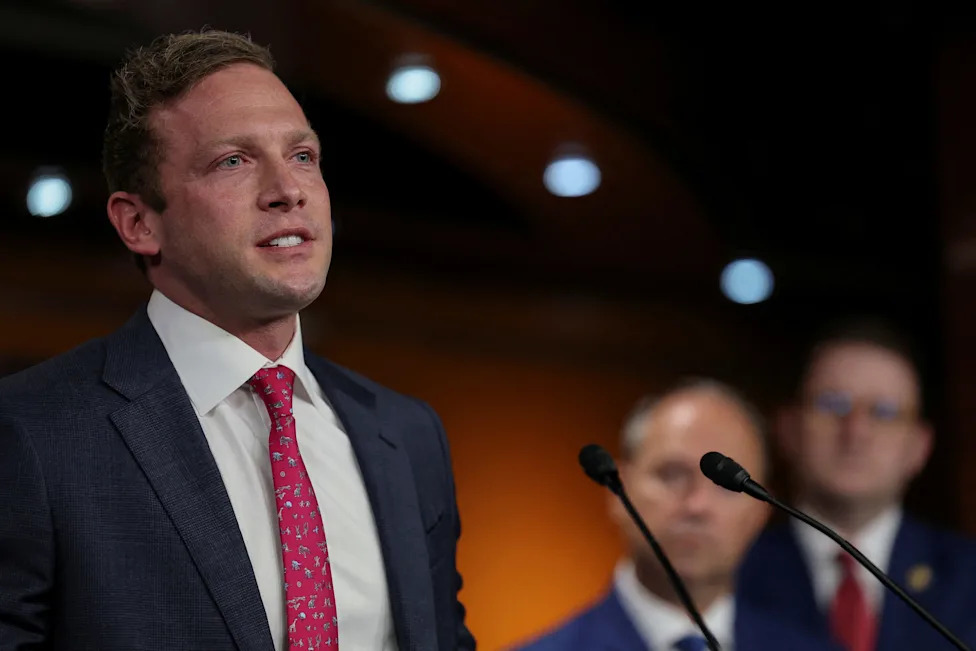
Representative Max Miller (R-OH) joins House Republican Study Committee members as they hold a press conference to discuss their resolution against hateful political rhetoric on the one-year anniversary of the Butler, Pa., shooting of then-candidate Donald Trump, on Capitol Hill in Washington, D.C., July 14, 2025.(Jonathan Ernst, REUTERS)

Emily Moreno listens as her then fiancé, Republican congressional candidate Max Miller, campaigns with former President Donald Trump on April 23, 2022, in Delaware, Ohio. On Aug. 2, 2026, U.S. Rep. Max Miller, R-Michigan, says he'll continue his reelection bid despite mounting scrutiny involving allegations of domestic abuse involving Moreno and their 2-year-old daughter.
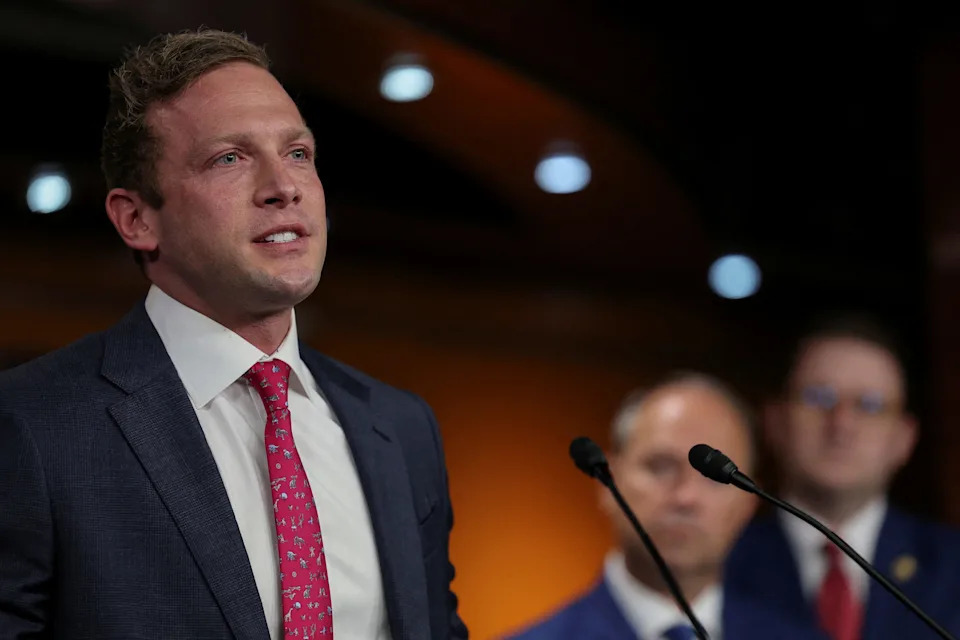
U.S. Rep. Max Miller, R-Ohio, and fellow House Republicans hold a news conference on Capitol Hill in Washington, DC, on July 14, 2025.

U.S. Senate candidate from Maine Graham Platner speaks during a campaign townhall event on May 2, 2026 in Appleton, Maine.Platner said he was "taking time to reflect"on his campaign to unseat Republican Sen. Susan Collins amid a new allegation from a Maine woman who said he sexually assaulted her nearly five years ago.(Graeme Sloan, Getty Images)

U.S. Senate candidate Graham Platner, a Democrat running to replace Republican Sen. Susan Collins, gives a television interview after a campaign event on May 1, 2026, in Portland, Maine.After months of defending Graham Platner's scandal-plagued Senate campaign,prominent Democratsquickly turned on the oyster farmerfollowing a new sexual assault allegation.(Graeme Sloan/Getty Images)

U.S. Senate candidate from Maine Graham Platner speaks during a campaign event with the Maine AFL-CIO, on May 1, 2026 in Portland, Maine.(Graeme Sloan, Getty Images)

U.S. Senate candidate Graham Platner, a Democrat running to replace Republican Sen. Susan Collins, campaigns on May 2, 2026, in Appleton, Maine.(Graeme Sloan/Getty Images)

Democratic U.S. Senate candidate Graham Platner (C) speaks with supporters during a campaign event near the entrance to the Portsmouth Naval Shipyard on May 19, 2026, in Kittery, Maine. Platner received endorsements from a coalition of labor unions at the event.(Joe Raedle, Getty Images)

Democratic U.S. Senate candidate Graham Platner greets audience members at a campaign town hall meeting in Ogunquit, Maine, U.S., October 22, 2025.(Brian Snyder, REUTERS)
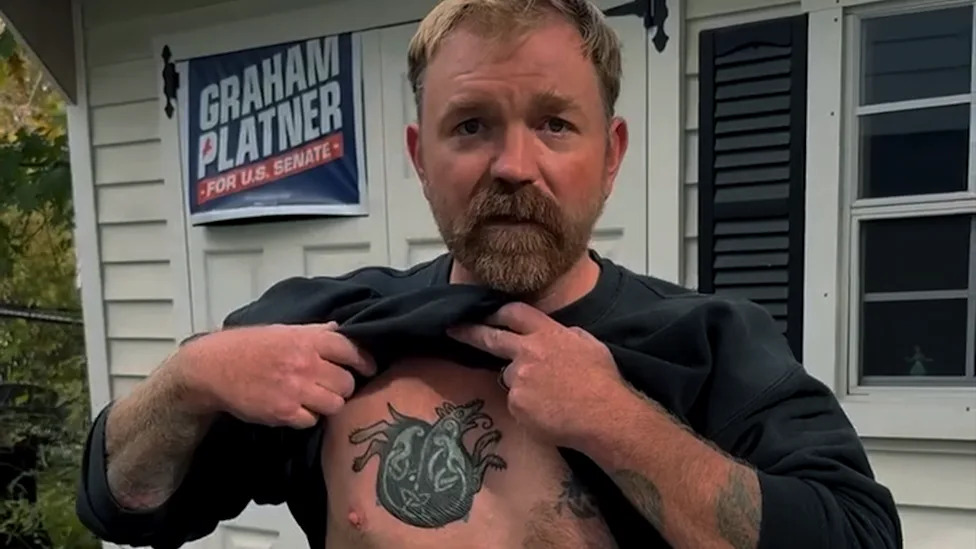
A Democratic Senate candidate from Maine, Graham Platner, said he covered up a tattoo resembling a Nazi symbol that he got nearly two decades ago.(Graham Platner via Storyful)

Democratic U.S. Senate candidate Graham Platner speaks at a “Fighting Oligarchy” tour stop held by Sen. Bernie Sanders (I-VT) at the Collins Center for the Arts on the University of Maine campus on May 24, 2026 in Orono, Maine.(Joe Raedle, Getty Images)

Sen. Bernie Sanders (I-VT) and Democratic U.S. Senate candidate Graham Platner stand together during a “Fighting Oligarchy” tour stop at the Collins Center for the Arts on the University of Maine campus on May 24, 2026 in Orono, Maine.(Joe Raedle, Getty Images)

Democratic candidate for U.S. Senate Graham Platner reacts as an audience member gives him a handmade card reading “We Are your Grahamily And We’ve Got Your Back” during a campaign town hall meeting in Portland, Maine, June 7, 2026.(Brian Snyder, REUTERS)

Democratic U.S. Senate candidate Graham Platner and his wife Amy Gertner wave to supporters as they arrive to Platner's Primary Election event on June 9, 2026 in Blue Hill, Maine.(CJ Gunther, Getty Images)

Democratic U.S. Senate candidate Graham Platner speaks at his Primary Election event on June 9, 2026 in Blue Hill, Maine.(CJ Gunther, Getty Images)
Help us improve.