Former Rep. Cori Bush has launched a high-profile bid to regain Missouri's 1st Congressional District after her 2024 defeat by Wesley Bell. The rematch is defined by sharp debate over Israel policy and significant outside spending — AIPAC's United Democracy Project has reportedly spent about $3 million to back Bell. Bush, who has raised roughly $1.3 million and is supported by Justice Democrats and the DSA, is leaning on grassroots organizing that helped her win in 2020. Observers view the race as a test of progressive mobilization versus centrist funding in a district facing persistent local challenges.
Cori Bush Launches Comeback Bid in High‑Stakes Missouri 1st District Primary
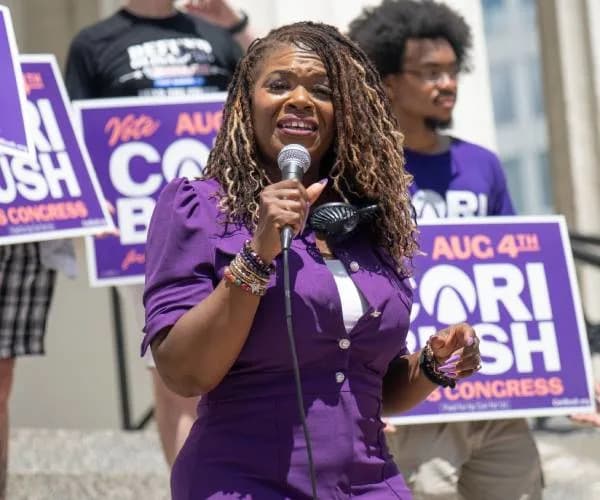
Former Rep. Cori Bush, D-Mo. (AP)
Former U.S. Rep. Cori Bush has launched a bid to reclaim Missouri's 1st Congressional District, which includes the city of St. Louis, after losing the seat in 2024. The rematch has become one of the most closely watched and contentious Democratic primaries in the country, with sharp divisions over Israel policy and heavy outside spending.
Campaign Landscape
Bush, a onetime pastor and Black Lives Matter activist who rose to national prominence as part of the progressive group of House members often called "the Squad," served two terms before she was narrowly defeated in 2024 by Wesley Bell, a more centrist Democrat and former St. Louis County prosecuting attorney. Bell beat Bush 51% to 46% in that contest.
Money, Messaging and Outside Influence
Outside spending has become central to the race: the American Israel Public Affairs Committee (AIPAC), through its spending arm United Democracy Project (UDP), has reportedly deployed roughly $3 million to support Bell. Bush, who has raised and spent about $1.3 million this cycle, has sharply criticized Israel's conduct in Gaza, publicly characterizing its actions as genocide against Palestinians — a stance that has made Israel policy a defining issue in the primary.
Grassroots Strength and Political History
Despite a fundraising disadvantage, Bush has previously demonstrated potent grassroots organizing. In 2020 she upset 10-term Rep. William Lacy Clay Jr., reclaiming a seat held by the Clay family since 1969. That same grassroots energy helped propel her to Congress and remains a key part of her comeback strategy. For this race, Bush has attracted support from progressive groups including Justice Democrats and the Democratic Socialists of America.
Local Concerns and Outside Predictions
Local challenges — from public safety and population decline to economic and education struggles — are central to voters' concerns in the district. Observers are divided over whether progressive organizing can overcome Bell's financial advantage and outside spending.
"All indications are that the [democratic] socialist blue wave is going to skip right over Missouri's 1st Congressional District," said Tim Jones, a St. Louis radio host and former Republican speaker of the Missouri House. "With the massive reality of very real problems facing the city and county of St. Louis — crime, never-ending population and business losses, a failed education system, and more — it does not appear voters have any desire to return to the nonstop circus sideshow that was Congresswoman Cori Bush."
Supporters of Bush argue the race is a test of whether progressive grassroots energy can overcome well-funded centrist challengers and outside influence. The outcome will be watched as an indicator of the balance between small-donor activism and big-spending political operations in competitive Democratic primaries.
Help us improve.