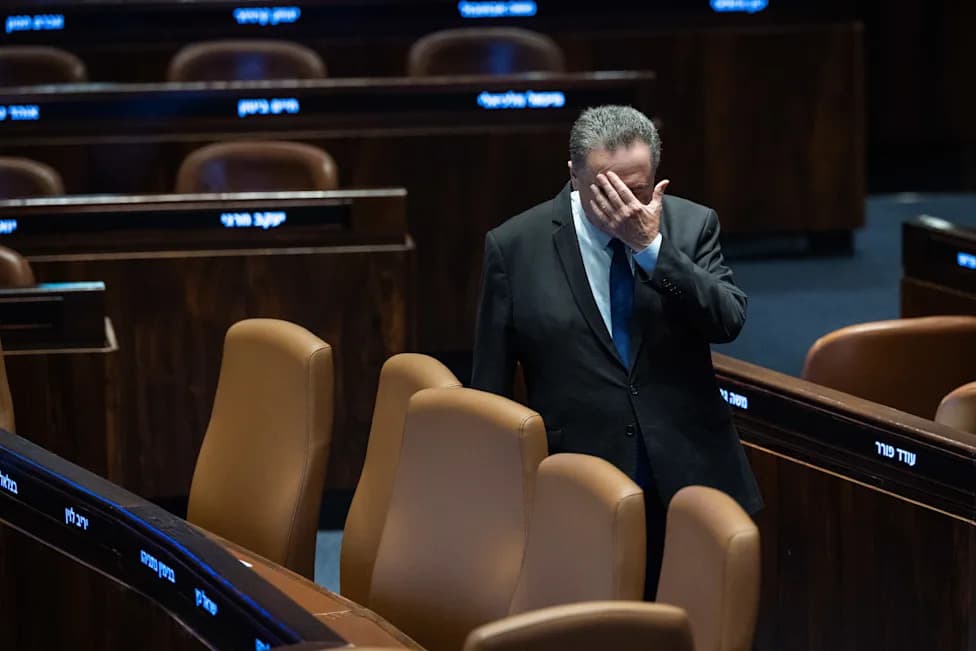
Gazans Say Trump's Gaza Deal Claims Ring Hollow: Residents said President Trump’s praise of a Gaza deal to disarm Hamas and enable phased Israeli withdrawal felt detached from reality after strikes that killed 18 people. Israel says it will not withdraw until Hamas is disarmed and tunnels are destroyed; Hamas says attacks must stop first. Mediators warned ongoing strikes breach the agreement, and residents report expanding Israeli control, fresh displacement and mounting casualties.
Gazans Say Trump’s Gaza Deal Claims Ring Hollow After Deadly New Strikes
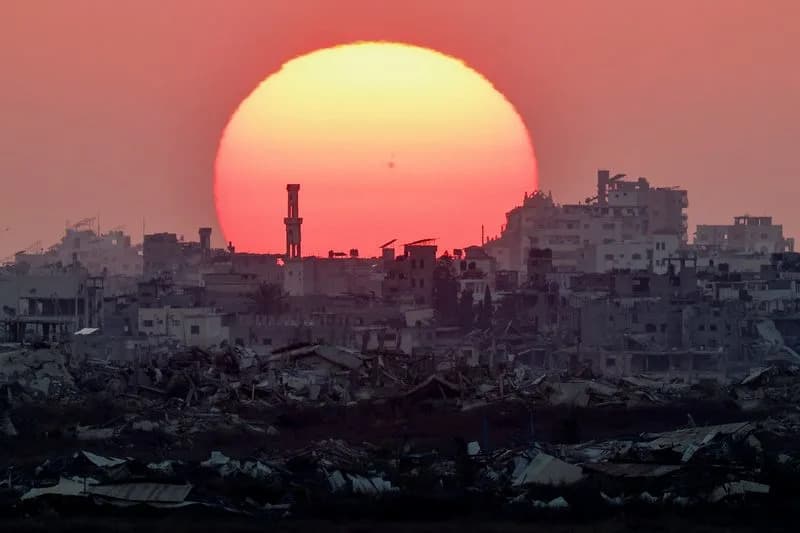
The sun sets over Gaza, as seen from the Israeli side of the border, August 2, 2026. REUTERS/Amir Cohen
CAIRO/GAZA, Aug 3 (Reuters) - Gazans on Monday said U.S. President Donald Trump’s praise for a deal meant to disarm Hamas and pave the way for a phased Israeli withdrawal felt disconnected from daily realities, after Israeli strikes killed 18 people in one of the deadliest days since last year’s ceasefire.
Last Thursday, Trump called the October agreement “a major milestone” toward implementing a Gaza plan that, he said, would see Hamas disarm and Israel withdraw in stages. But on the ground, the path to that outcome is already running into sharp practical and political obstacles.
Israel’s defence minister said on Sunday that Israeli forces would not pull back until Hamas had been disarmed and its tunnel network destroyed. Hamas, for its part, insists Israel must halt its attacks before it begins implementing the weapons-related provisions of the agreement.
The U.S.-backed board overseeing the ceasefire — described by supporters as a “Board of Peace” — said envoy Nikolay Mladenov held a “constructive and detailed” meeting on Monday with Israeli Prime Minister Benjamin Netanyahu and other officials. The board reiterated its objective: the complete decommissioning of weapons in the Gaza Strip and a transition to civilian governance.
“The goal is clear and is not in question: the complete decommissioning of weapons in the Strip and the transition away from rule by the gun to civilian governance. Reaching it will be a process. And that process will be set out in the next phase of the work.”
The board added that a full Israeli military withdrawal beyond the so-called “yellow line” — a boundary established under last October’s U.S.-brokered ceasefire — would take place only once decommissioning is complete, as Hamas reportedly committed to mediators. The decommissioning reference covers light and heavy weapons and Hamas’ tunnel networks.
On-the-Ground Violence and Displacement
Residents and Palestinian officials said the board’s statement gave disproportionate weight to weaponry while omitting explicit references to other agreed elements such as a sustained ceasefire and an end to targeting operations. Palestinian factions are consulting on the statement while reaffirming their commitment to the understandings reached last Thursday, a negotiator close to the talks told Reuters.
Much of Gaza remains devastated by the Israeli offensive launched after Hamas’s Oct. 7, 2023 attacks. Medics said an Israeli air strike on a car in Gaza City on Monday killed two people, while Sunday’s strikes included an attack on an apartment that killed a couple and their child; Israel said it targeted military operatives in those strikes.
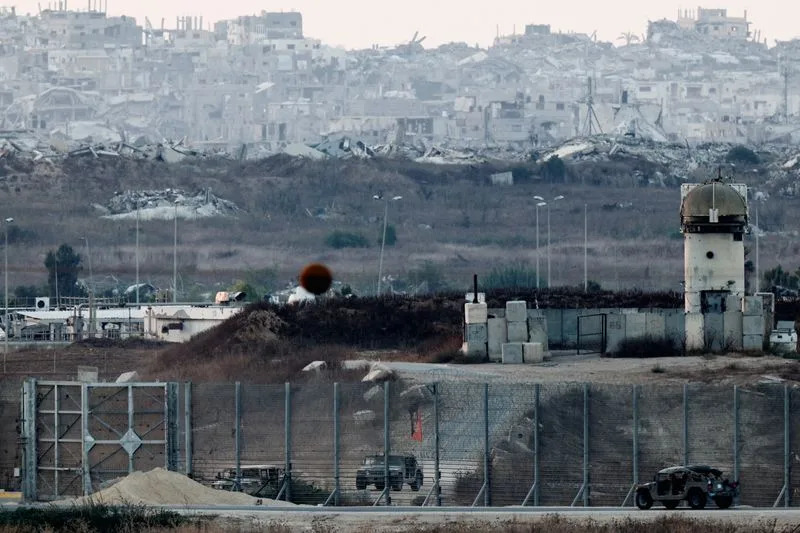
Military vehicles operate on the border with Gaza, as seen from the Israeli side of the border, August 2, 2026. REUTERS/Amir Cohen
Israeli troops currently occupy and have depopulated large parts of the enclave, leaving most of Gaza’s more than 2 million residents confined to a narrow coastal strip, many sheltering in makeshift tents or damaged buildings. Residents described renewed rounds of strikes across northern, central and southern Gaza on Monday.
Expansion of Israeli-Controlled Areas
Last year’s ceasefire initially allowed Israeli forces to retain control of roughly 53% of Gaza, with the expectation of future withdrawals. But officials say that area has expanded: Defence Minister Israel Katz said the Israeli-held zone had reached between 60% and 70% as troops searched for tunnels. Residents in at least five areas, including Gaza City, Deir Al-Balah and Khan Younis, said newly moved demarcation markers forced them to flee.
Soumah Dawla, 60, described waking to find yellow bricks that mark the Israeli-controlled area had been moved closer to her home. "We are waiting for displacement at any moment... Our entire life is gone," she told Reuters from a tent where she and her husband shelter amid rubble.
Mediators Egypt, Qatar and Turkey issued a joint statement condemning ongoing Israeli strikes and warned that continuing attacks would breach the agreement and undermine efforts to implement its second phase.
Positions And Stakes
Hamas has rejected the language of “disarmament” but says it would place weapons into U.S.-backed storage under a Palestinian administration once Israel halts operations and withdraws forces consistent with the ceasefire terms. Israeli officials, meanwhile, told Washington they remain concerned that nothing should occur before Hamas is fully disarmed.
According to Gaza health authorities, at least 1,230 Palestinians — mostly civilians — have been killed in Israeli strikes since the Trump-backed Gaza plan was agreed in October; Israeli authorities report four soldiers killed over the same period. Hamas does not disclose its own combatant casualties.
The competing conditions for progress — Israel’s insistence on disarmament before withdrawal, Hamas’ demand for an end to attacks before any weapons handover, and continued strikes on the ground — leave the next phase of the plan uncertain and Gazans skeptical that diplomatic pronouncements will translate into safer lives.
Reporting Note: Reporting by Nidal al-Mughrabi in Cairo and Dawoud Abu Alkas in Gaza; additional reporting and editing by Reuters staff.
Help us improve.