The discovery of 319 velvet belly lanternsharks off Vlorë, Albania (450–650 m) challenges assumptions of rarity and suggests the upper Adriatic slope may serve as a nursery. Genetic analysis found moderate diversity and six new mitochondrial haplotypes. Gear type strongly influenced survival—bottom trawls caused 100% mortality aboard while some longline‑caught sharks survived—underscoring how fishing methods and limited deep‑sea data heighten conservation concerns.
319 Velvet Belly Lanternsharks Reveal a Hidden Nursery and Deep‑Sea Risk in the Adriatic
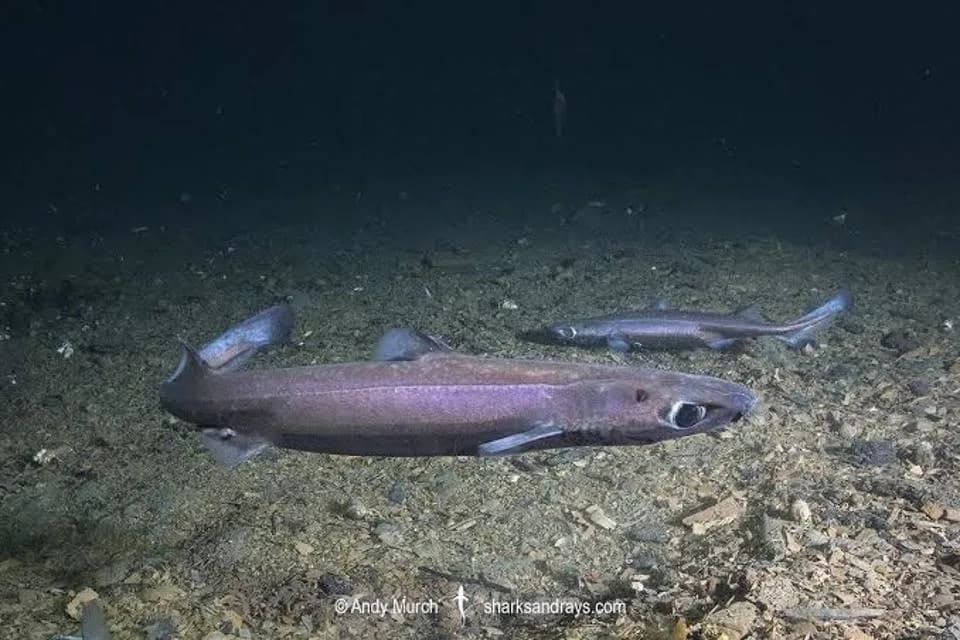
The velvet belly lanternshark does not offer easy answers. It never did.Andy Murch
The velvet belly lanternshark rarely offers tidy conclusions. It never has. Between 2023 and 2025, researchers surveying the upper Adriatic continental slope off Vlorë, Albania recorded 319 individuals of Etmopterus spinax — a species long thought to be an occasional deep‑water visitor.
Unexpected Abundance From the Deep
The first net haul just before dawn pulled up hundreds of small, bioluminescent bodies: large, dark‑adapted eyes and faint luminous markings that looked like scattered constellations. In total, sharks were documented from bottom trawls and longlines deployed between 1,476 and 2,133 feet (450–650 m), appearing consistently in hauls deeper than 1,640 ft (≈500 m). Some single catches contained more than 50 individuals.
Evidence Of A Nursery
Notably, catches included neonates, juveniles and gravid females — strong indicators that portions of the upper Adriatic slope may function as a nursery area where pups are born and begin life in deep, cold, dim waters. For a deep‑sea species with slow growth, late maturity and low fecundity, the existence of such nursery habitat is ecologically significant.
Fishing Gear Matters
Gear type had a dramatic effect on survival. Sharks captured in bottom trawls experienced 100% mortality by the time they reached the vessel, while some individuals caught on longlines were still alive when hauled aboard. This contrast suggests that how we fish can be as important as how much we fish, especially in deep ecosystems where recovery from population declines is slow.
Genetics: Moderate Diversity, New Haplotypes
Mitochondrial COI analysis revealed moderate genetic diversity and six haplotypes not previously recorded, indicating the Adriatic population is not genetically uniform. The pattern points to partial isolation combined with some connectivity — enough to make this regional population distinct, but still linked to broader movement patterns.
Why It Matters: Deep‑sea fisheries are extracting biomass while ecological baselines are still being defined. Removing animals from potential nursery areas risks recruitment failure, reduced genetic exchange and long‑term erosion of population structure before declines are recognized.
Conservation And Management Implications
This study highlights the urgent need to consider gear impacts, spatial protections, and targeted monitoring on continental slopes. If the upper Adriatic slope is a nursery for velvet belly lanternsharks — and possibly for other slow‑life‑history species — then disturbances there will have broader ecological consequences beyond immediate catches.
Originally published on Forbes.com.
Help us improve.