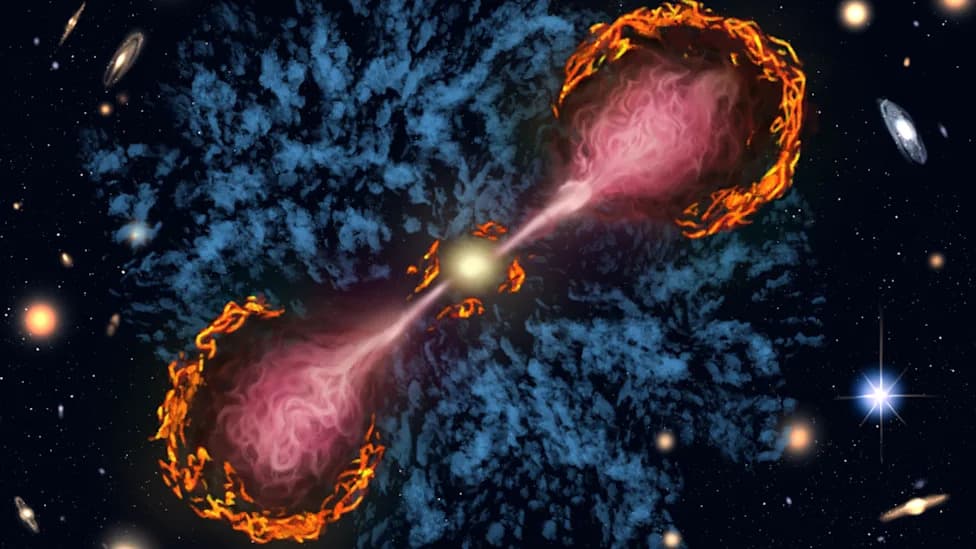
A VLT observing campaign tracked the black hole binary Swift J1727.8−1613 during a 2023 eruption and captured time-resolved data showing jets and dense winds expelled much of the disrupted star's material. The largest outflows occurred when accretion activity appeared relatively low, and the expelled mass could rival what the black hole actually consumed. These findings reveal that black holes can be inefficient eaters and improve our understanding of the link between accretion disks and relativistic jets.
Black Hole's 'Cosmic Indigestion': VLT Captures Jets and Winds That Blew Away Half Its Meal
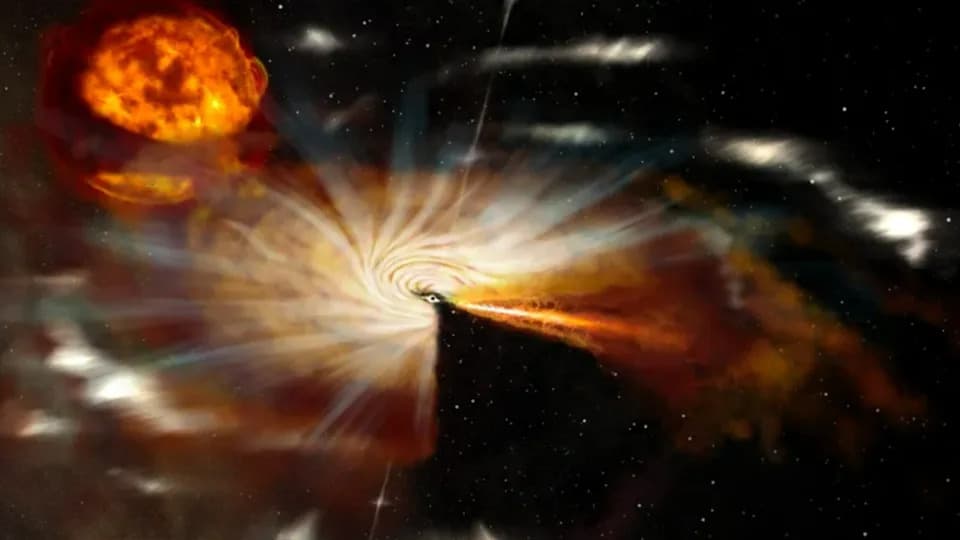
Credit: John A. Paice/ Castro Segura/ et al
Astronomers using the European Southern Observatory's Very Large Telescope (VLT) have recorded a dramatic episode in which a black hole system violently ejected stellar material, revealing in unprecedented detail that even the hungriest black holes are messy eaters.
A Feeding Frenzy—and a Windy Finale
The study focuses on the black hole binary Swift J1727.8−1613, located about 8,800 light-years from Earth. The system erupted in 2023, briefly becoming one of the brightest X-ray sources in the sky and allowing astronomers to follow the event from its initial flare through a prolonged, windy decline.
What the VLT Saw
Using time-resolved observations the team produced a detailed "movie" of the system as it stripped material from a companion star. Rather than swallowing all the stellar material, the black hole accreted some matter while launching high-speed jets and sustained dense winds that blasted a large fraction of the gas back into space.
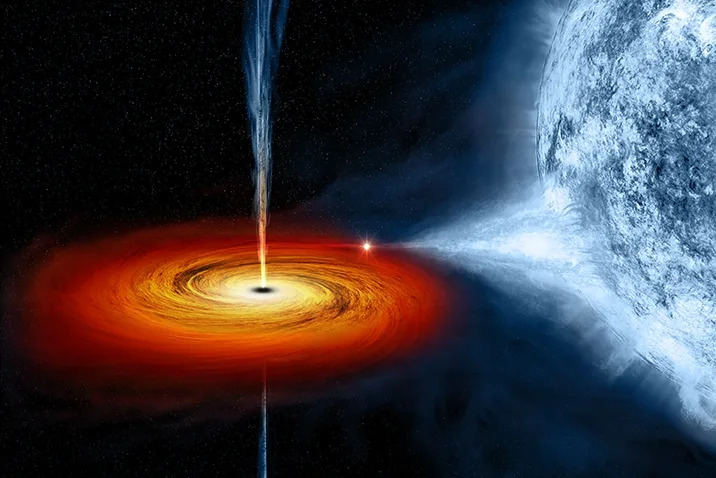
An illustration of a black hole stripping stellar material from a companion star. | Credit: Chandra X-Ray Observatory, NASA
"People often imagine black holes simply swallowing everything around them," said team leader Noel Castro Segura (University of Warwick). "What we're seeing is a much more complex process. Matter falls in, the system processes it, and a surprising amount is expelled again."
Crucially, the most massive outflows were observed at times when the apparent feeding rate (accretion brightness) was lower than expected. The authors estimate that the total mass expelled by jets and winds could eventually match the mass consumed by the black hole—meaning roughly half of the star's material may be lost to space.
Why This Matters
These observations reveal the dynamic coupling between an accretion disk and relativistic jets, and they suggest black holes can be far less efficient at growing than previously assumed. That inefficiency can affect how binary systems evolve and how black holes influence their galactic environment.
"If black holes can continue shedding material even after their largest outbursts, they may be much less efficient eaters than we previously assumed," Segura added.
The team's results were published on July 29 in the Monthly Notices of the Royal Astronomical Society (MNRAS).
Help us improve.