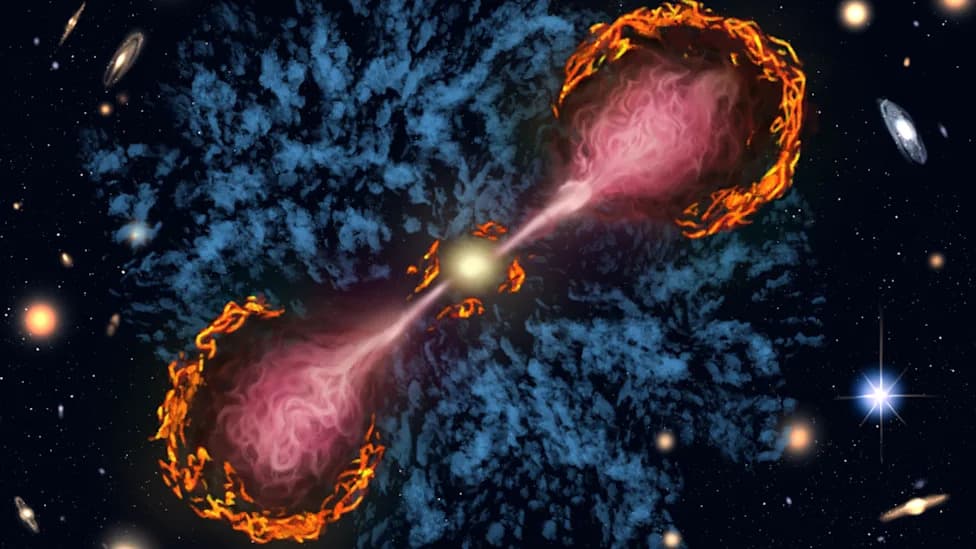
An international team used a convolutional neural network trained on realistic mock spectra to scan over 800,000 DESI quasar observations and identify seven strong candidates for quasar–galaxy strong gravitational lenses. Six candidates are newly reported and four show multiple emission lines, including the [O II] doublet, strengthening the identifications. Follow-up high-resolution imaging (for example with Hubble) is required to confirm lensing; confirmed systems would help weigh foreground galaxies and study galaxy–black hole coevolution.
AI Pinpoints Seven Rare Quasar Grenss Lensing Candidates — Narrowing 800,000+ Spectra to Seven
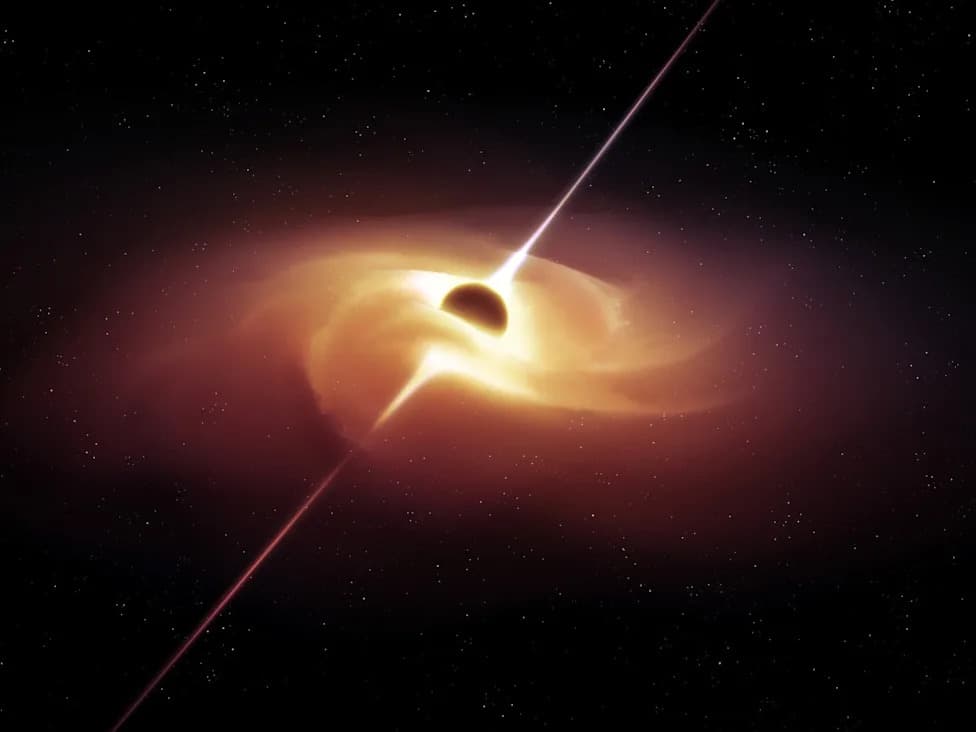
Simulated cosmic lenses trained a neural network to spot faint galaxy signals buried beneath brilliant quasars. (CREDIT: Shutterstock)
Artificial intelligence has helped astronomers narrow more than 800,000 quasar observations from the Dark Energy Spectroscopic Instrument (DESI) to seven high-quality candidates for a very rare type of strong gravitational lens. An international team trained a convolutional neural network on realistic simulated spectra—combining real quasar spectra with spectra of more distant galaxies—and then visually inspected the most promising outputs. Follow-up high-resolution imaging will be required to confirm lensing, but the method shows how AI can accelerate discovery in huge modern surveys.
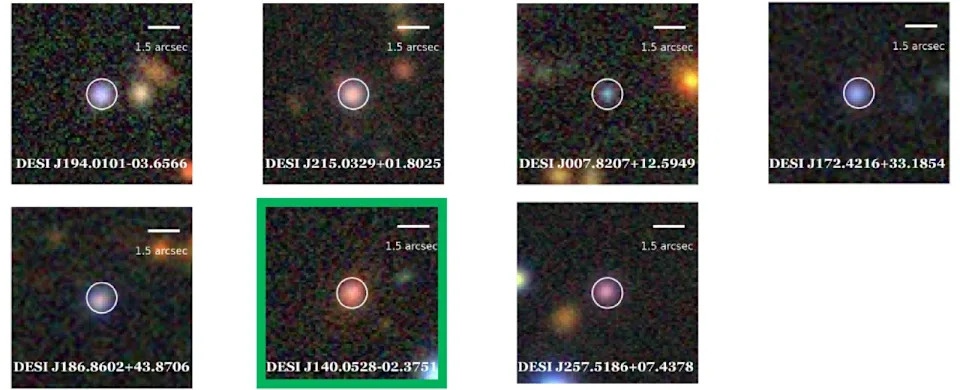
Legacy Survey images for each of the seven candidates. (CREDIT: The Astrophysical Journal)
How the Search Worked
Quasars are extremely luminous galactic nuclei powered by accreting supermassive black holes. Their brightness lets astronomers see them at great distances but often drowns out the light from their host galaxies, complicating efforts to measure host properties and study how galaxies and central black holes evolved together. Strong gravitational lensing can help: when a foreground quasar and its host galaxy align with a more distant galaxy, the nearer galaxy's gravity bends and magnifies the background galaxy's light, leaving faint but detectable spectral signatures.
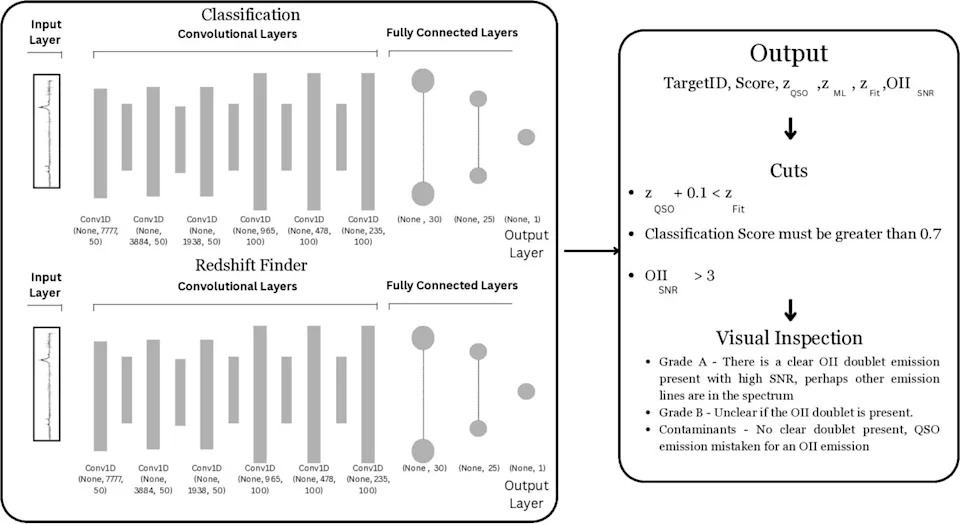
Diagram of the full pipeline illustrating the sequence of steps used to identify quasar (QSO) lens systems in the DESI DR1 dataset. (CREDIT: The Astrophysical Journal)
The team used DESI's more than 800,000 high-quality quasar spectra as the search pool. Because confirmed quasar–lens systems are scarce, researchers created realistic mock lenses by adding spectra of background galaxies to real quasar spectra. These simulated training examples preserved the diversity and observational noise of DESI data and taught the neural network to recognize faint background emission lines embedded in much brighter quasar spectra.
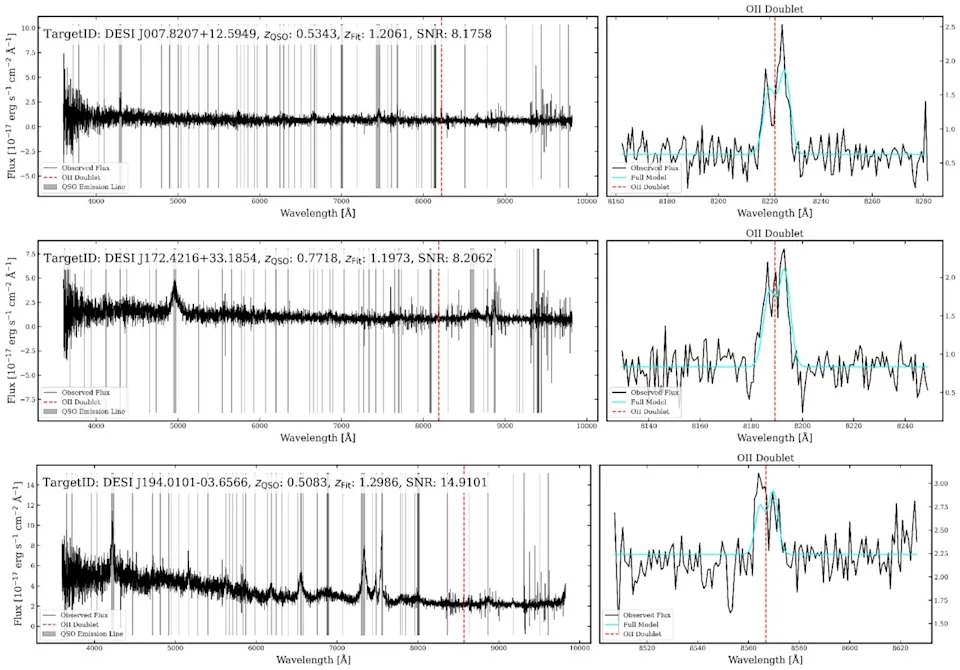
Three grade A QSO–ELG lens candidates that only display [O II]. (CREDIT: The Astrophysical Journal)
Machine Learning and Vetting
The researchers employed a convolutional neural network, a type of machine learning well suited to finding subtle patterns in complex inputs. Rather than modeling and subtracting quasar light first, the network learned to detect the combined spectral signatures of a foreground quasar with an additional set of emission lines from a background galaxy. In tests the model estimated background-galaxy redshifts more accurately than DESI's standard pipeline across data of varying quality.
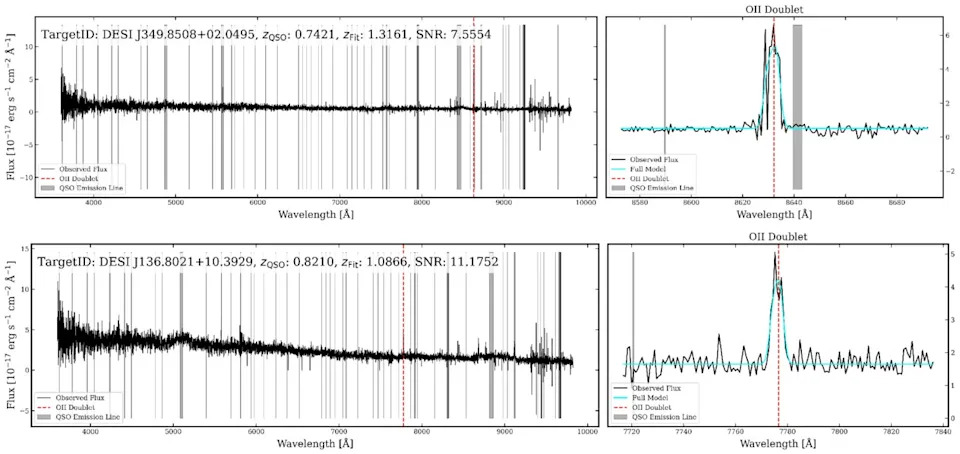
The two highest-SNR grade B QSO–ELG candidates with possible [O II] emission present. (CREDIT: The Astrophysical Journal)
After scanning the full quasar sample, the AI flagged several hundred candidate spectra. Team members then visually inspected that shortened list, looking for clear indicators such as the [O II] oxygen doublet and additional hydrogen or oxygen emission lines. Visual vetting and additional quality-control steps helped remove many false positives caused by atmospheric emission, calibration issues, or complex intrinsic quasar features.
The Seven Candidates
Visual inspection produced seven top-tier quasar–galaxy lens candidates. Six are newly reported and one had been noted previously by a different search. Four candidates show multiple additional emission lines beyond the [O II] doublet, which strengthens the interpretation that light from background galaxies is present. One candidate remains ambiguous because a neighboring galaxy might have fallen into DESI's aperture; higher-resolution imaging will be needed to determine whether that case is a true lens or an unrelated neighbor.
Why Confirmation Matters
All seven remain candidates until follow-up observations—ideally with high-resolution instruments such as the Hubble Space Telescope or comparable facilities—confirm the lensing geometry. Confirmed quasar–lens systems are valuable because they let astronomers weigh foreground galaxies and probe how galaxies and their supermassive black holes coevolved across cosmic time. Increasing the sample of confirmed systems would enable better statistical studies of galaxy mass and black hole growth across different epochs.
Broader Implications
This work demonstrates how AI can direct human attention efficiently within vast spectroscopic datasets like DESI. The method is not intended to replace astronomers but to prioritize the small fraction of observations most likely to harbor rare phenomena. With well-crafted training sets, similar approaches could be adapted to find other rare spectral signatures that standard pipelines overlook.
Source: Results reported in The Astrophysical Journal. Lead author Everett McArthur (The Ohio State University).
Help us improve.