The study analysed lexical data from 1,995 languages (193 families) and identified universal patterns in how languages reuse words and word parts. Speakers reuse forms when contexts minimize ambiguity, adopt partial reuse to signal related meanings without merging them, and create distinct words when meanings commonly co-occur. Using 25,000+ full colexifications and ~194,000 partial cases from Lexibank, the research links these patterns to cognitive trade-offs between efficiency and clarity and is published in Nature Human Behaviour.
Nearly 2,000 Languages Follow Shared Rules for Reusing Words, Large Study Finds

New research shows that languages worldwide follow the same patterns when reusing words, balancing efficiency with clear communication. (CREDIT: Shutterstock)
A seemingly simple act—naming an object or describing a feeling—follows deep, predictable patterns across human languages. An international team led by researchers at Universitat Pompeu Fabra analysed lexical data from 1,995 languages and found consistent strategies that balance efficiency and clarity when languages reuse whole words or parts of words.
Scope and Method
The study draws on standardized vocabulary from the Lexibank repository, covering 1,995 languages from 193 language families. Across this dataset the team identified more than 25,000 instances of full colexification (one form carrying multiple meanings) and nearly 194,000 instances of partial colexification (forms sharing roots or elements).
Three Strategies of Lexical Organization
The researchers describe three principal strategies languages use to connect words and meanings:
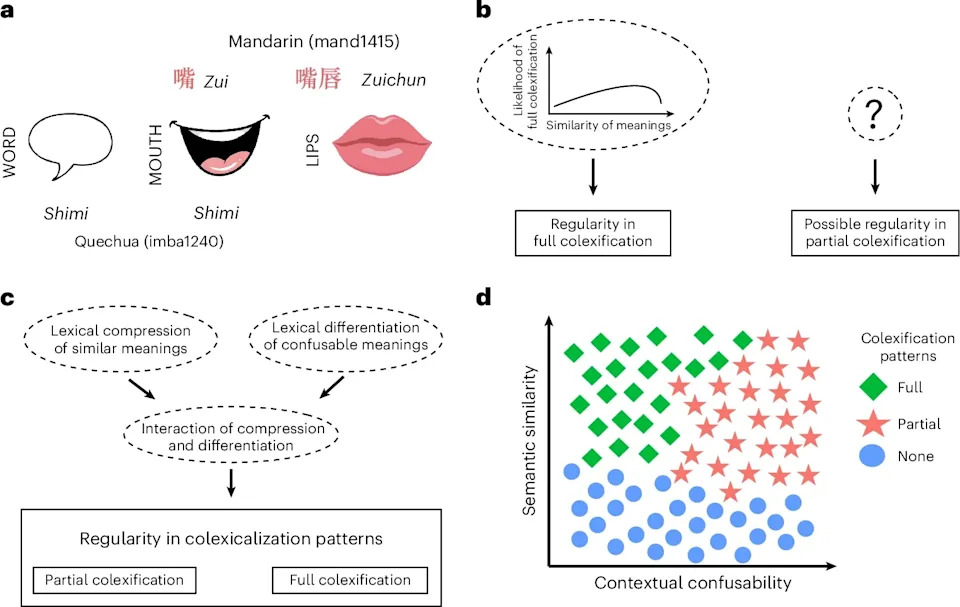
Colexification patterns. (CREDIT: Nature Human Behaviour)
- Full Colexification: A single lexical item carries multiple meanings (e.g., one word meaning both "tongue" and "language").
- Partial Colexification: Words share a root or morpheme (e.g., related forms like "cook," "cooking," and "kitchen").
- Differentiation: Distinct meanings are expressed with separate lexical items (e.g., "table" vs. "chair").
Context and Communicative Trade-Offs
The study shows that whether speakers reuse a form depends heavily on context. When two meanings rarely appear together in the same situation, reuse is common—for example, a single word for a financial "bank" and the river "bank" works because contexts rarely collide. When meanings frequently co-occur, languages tend to keep them lexically separate to avoid confusion.
"When the use of the same word may generate ambiguity, speakers typically turn to a second option before resorting to one that is completely different," said Thomas Brochhagen, the computational linguist who led the study.
That "second option" is most often partial reuse: modifying an existing form (through affixation or compounding) rather than inventing a wholly new term. Partial colexification thus serves as a flexible middle ground—preserving efficiency while maintaining clarity.
Cross-Linguistic Patterns and Cognitive Roots
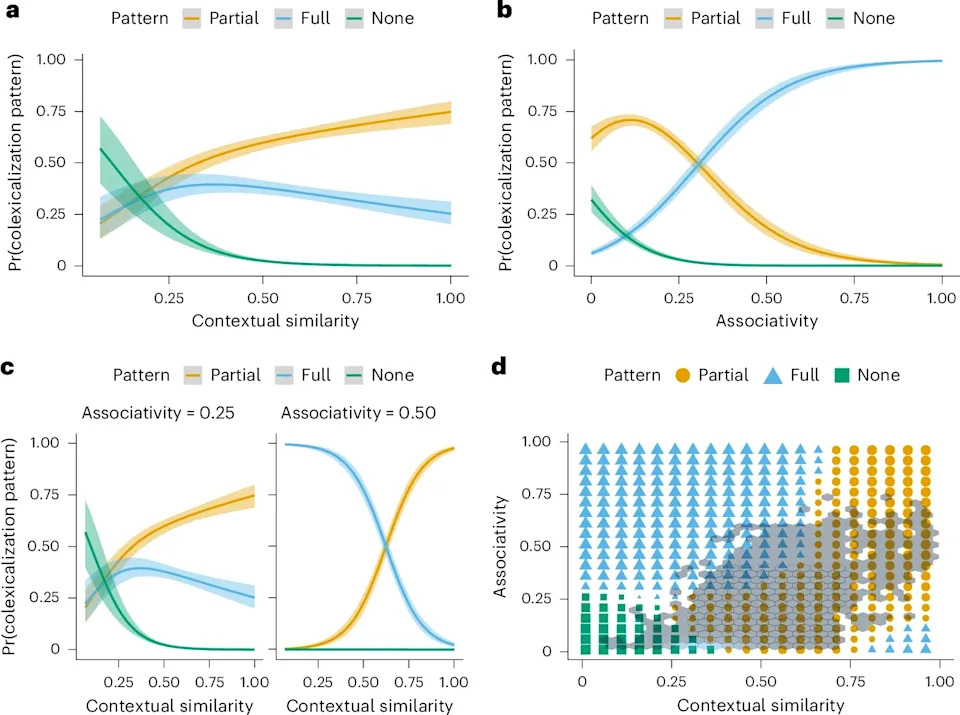
Estimates and predictions of the best model of cross-linguistic lexicalization patterns. (CREDIT: Nature Human Behaviour)
The researchers found these patterns consistently across languages from Europe, Asia, Africa and the Americas. The results suggest the distribution of reuse strategies reflects shared cognitive pressures—memory, attention and learnability—pushing languages toward simpler inventories unless communicative needs demand finer distinctions.
While full colexification is relatively stable across languages, partial colexification shows more cross-linguistic variation, likely because different languages use different morphological tools (prefixes, suffixes, compounding) to build words.
Applications and Open Questions
Beyond theoretical linguistics, the findings have practical implications: they can inform language teaching by aligning vocabulary instruction with natural reuse patterns, improve natural language processing and machine translation by modeling human strategies for balancing efficiency and clarity, and help document endangered languages by predicting reuse tendencies where data are sparse.
Conclusion
By combining large-scale computational analysis with robust cross-linguistic data, the study argues that language is shaped by recurring communicative and cognitive pressures rather than pure arbitrariness. Languages tend to reuse forms when the risk of ambiguity is low, adopt partial reuse when ambiguity is possible, and create distinct forms when meanings frequently co-occur—an organizing principle that recurs across the world's linguistic diversity.
Research findings and data are available in Nature Human Behaviour. The analysis used data from the Lexibank repository and was led by Thomas Brochhagen of Universitat Pompeu Fabra.
Help us improve.