NASA's Curiosity rover has imaged the largest known field of honeycomb-like polygonal fractures on Mars in Valle Grande. Photographs from July 19–20 show interconnected polygons about 1.5 to 3 inches across, possibly formed by repeated wetting and drying of sediments billions of years ago. Curiosity, active since 2012, has also detected sulfur crystals, meteorites and carbon-bearing molecules that may be precursors to RNA and DNA, though their origin remains uncertain.
Curiosity Finds Vast Honeycomb-Like Polygon Field on Mars — "Took Our Breath Away"
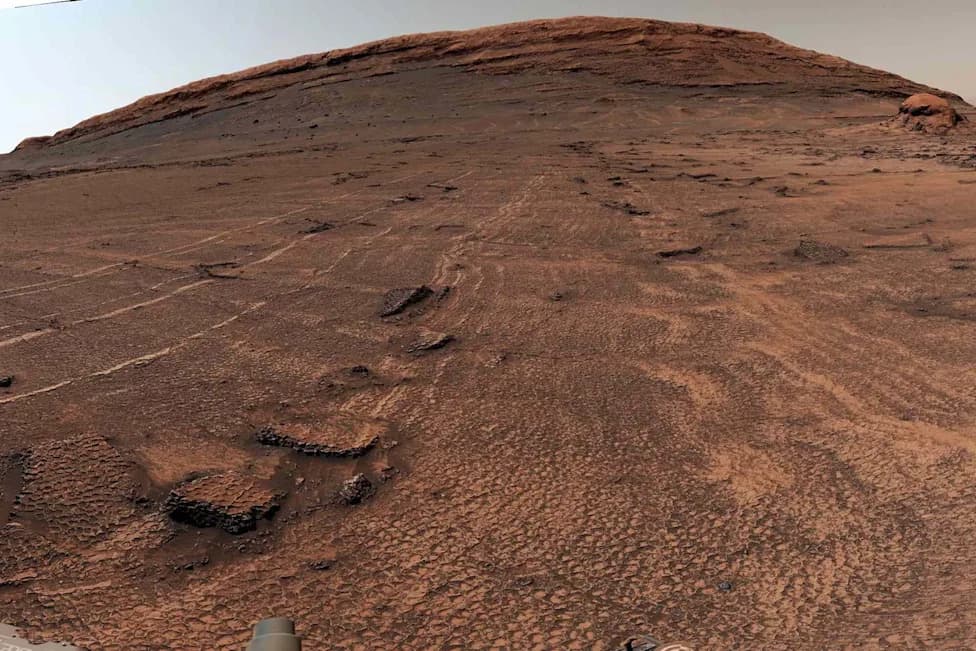
NASA's Curiosity Mars rover found a field of Martian polygonsCredit: NASA/JPL-Caltech/MSSS
NASA's Curiosity rover has discovered the largest known field of honeycomb-like polygonal fractures on Mars, offering fresh clues about the planet's ancient environment.
The formations were imaged as Curiosity traversed a valley named Valle Grande. A 360-degree panorama captured on July 19–20 shows the interlocking polygons stretching across the terrain as far as the rover's cameras can see.
Each polygonal crack measures roughly 1.5 to 3 inches (about 4 to 8 centimeters) across, according to NASA. Scientists say the exact process that produced the pattern is still uncertain, but the leading hypothesis is that repeated cycles of wetting and drying of sediment over geological time produced the fractures.
"We've seen a lot of fascinating landscapes through Curiosity's eyes, but this sea of polygons took our breath away," said Ashwin Vasavada, the mission's project scientist at NASA's Jet Propulsion Laboratory in Southern California. "We measured their shapes and chemistry carefully and are hopeful there are clues in the data as to how these features formed."
Curiosity has been exploring Mars since its 2012 landing, sending back images and chemical analyses that transformed our view of the planet's past. In addition to the polygon field, the rover has identified sulfur crystals, shiny meteorites and a variety of unusual rock textures.
Some of Curiosity's most important discoveries relate to ancient water and habitability: researchers have found chemical evidence that ancient Mars once held liquid water and contained the chemical ingredients and nutrients that could have supported microbial life. Among those findings are carbon-bearing molecules preserved in rocks — molecules that scientists say could be precursors to RNA and DNA. Current data cannot determine whether those organics were produced by biological or purely geological processes, but their presence reinforces the idea that ancient Mars had favorable chemistry for life.
Scientists will continue to analyze the polygon field's shapes and chemistry to better understand how and when they formed, and what they reveal about Mars' wetter past.
Help us improve.