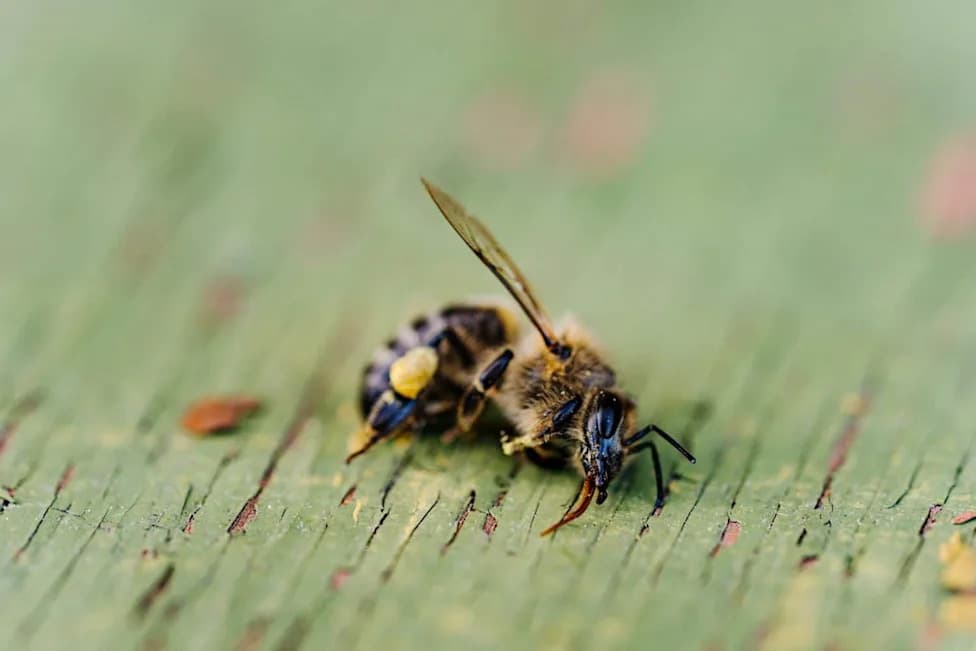
Researchers in Germany found that larvae of the oil beetle Meloe proscarabaeus synthesize a blend of 17 monoterpenoids that mimic floral scents and attract wild bees. The compounds are produced by the larvae (not taken from plants or eggs), and two cytochrome P450 enzymes, CYP347BT1 and CYP345BZ1, are implicated in their biosynthesis. Field tests show isolated monoterpenoids draw Andrena sand bees, and the team plans to map the full pathway and survey related species.
Beetle Larvae Synthesize Flower Scents to Trick Wild Bees — A New Form of Chemical Mimicry
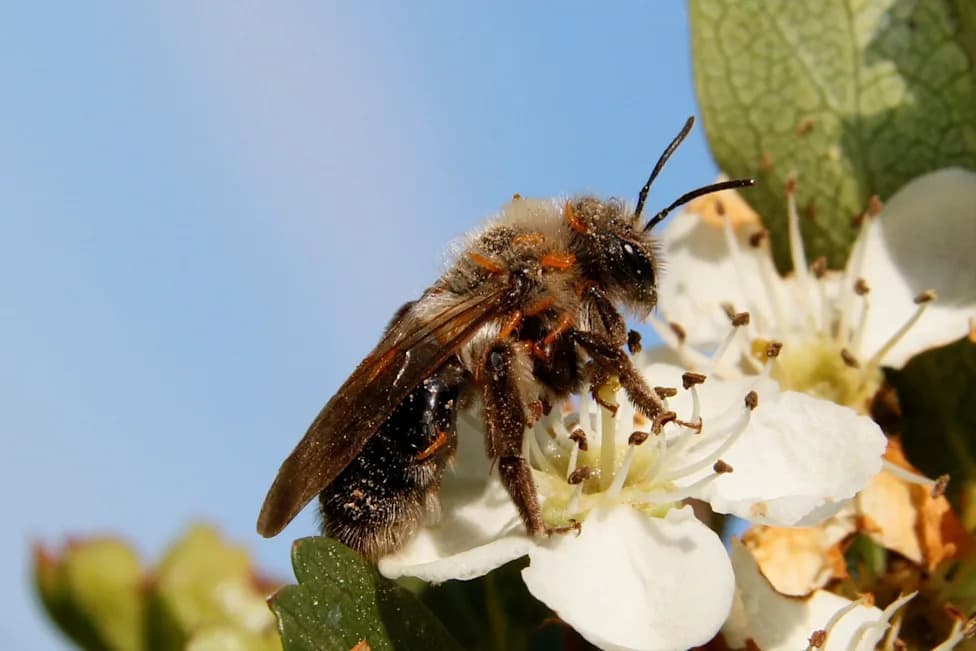
Photo Credit: Max Planck Society
Tiny larvae of the European oil beetle Meloe proscarabaeus employ a striking survival strategy: they manufacture floral-smelling chemicals that lure wild bees close enough for the larvae to hitch a ride to the bees' nests. Researchers from the Max Planck Institute for Chemical Ecology and Friedrich Schiller University in Jena report the finding in the Proceedings of the National Academy of Sciences, and summarized by Phys.org.
What the researchers found
Chemical analyses revealed that the larvae emit a blend of 17 monoterpenoids — volatile compounds commonly associated with fruit and blossom scents (for example, plum and cherry). Behavioral experiments showed that wild bees moved toward the odor even when the larvae were out of sight, demonstrating that the scent alone is sufficient to attract them.
The team ruled out several alternative sources: the flower-like monoterpenoids were absent from beetle eggs, adult beetles and the surrounding plants, indicating the chemicals are produced de novo by the larvae rather than acquired from the environment or earlier life stages.
How the scent is made
Genetic and biochemical work implicated two larval cytochrome P450 enzymes, CYP347BT1 and CYP345BZ1, as components of the biosynthetic machinery that creates these floral-mimicking volatiles. According to lead author Ryan Alam, "This discovery describes a previously unknown form of mimicry and expands our understanding of how parasites use chemical signals to manipulate other organisms."
Field validation and ecological implications
Field trials supported the laboratory results: isolated monoterpenoids placed on cotton swabs attracted wild Andrena sand bees, showing the compounds themselves are effective lures. Because the scent mimics a broadly attractive floral resource, the larvae may exploit multiple bee species as hosts, increasing their chances of reaching nests where they consume bee eggs and stored provisions.
Sarah O'Connor, head of the Department of Natural Product Biosynthesis, said the team will now work to elucidate the full biosynthetic pathway and to survey related beetle species to determine how widespread and how evolutionarily ancient this deception is.
Why it matters: The study reveals a novel form of chemical mimicry that influences pollinator behavior and highlights another ecological pressure on wild bees — a group already facing habitat loss and other threats. Understanding these interactions improves our picture of pollinator networks and their vulnerabilities.
Help us improve.