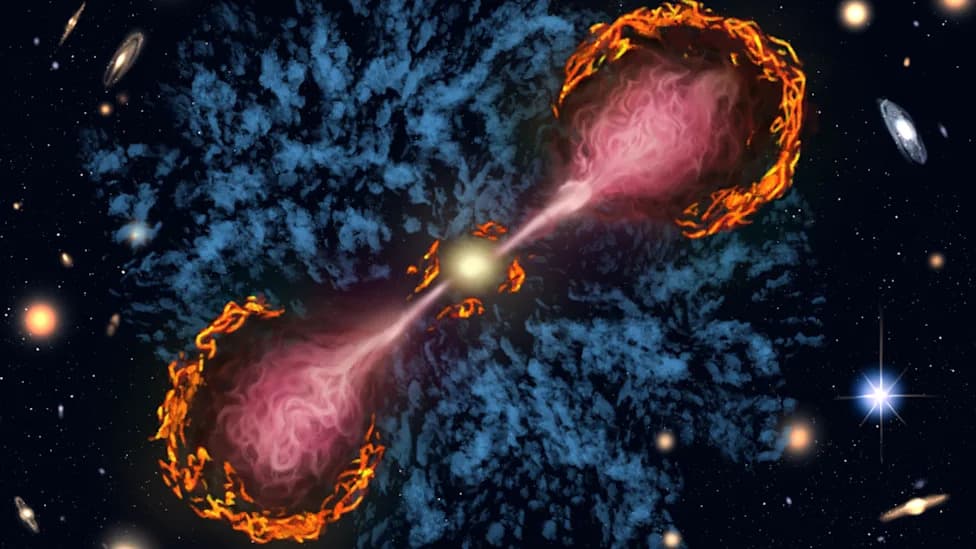
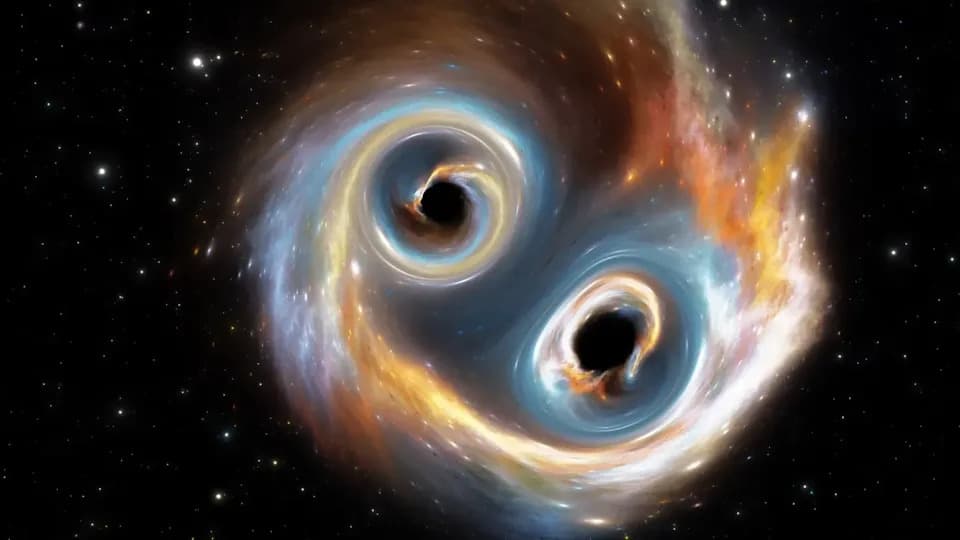
Researchers used machine learning to search DESI’s catalog of ~800,000 quasars and identified seven strong candidates for quasars that act as gravitational lenses. Trained on simulated lens systems, the AI filtered the catalog to ~200 candidates; manual review confirmed seven promising systems. These discoveries roughly double similar survey finds and could provide rare opportunities to study how supermassive black holes grow. Follow-up observations are required to confirm and characterize the lenses.
AI Spots Seven Quasar Gravitational Lenses That Could Reveal How Supermassive Black Holes Grow
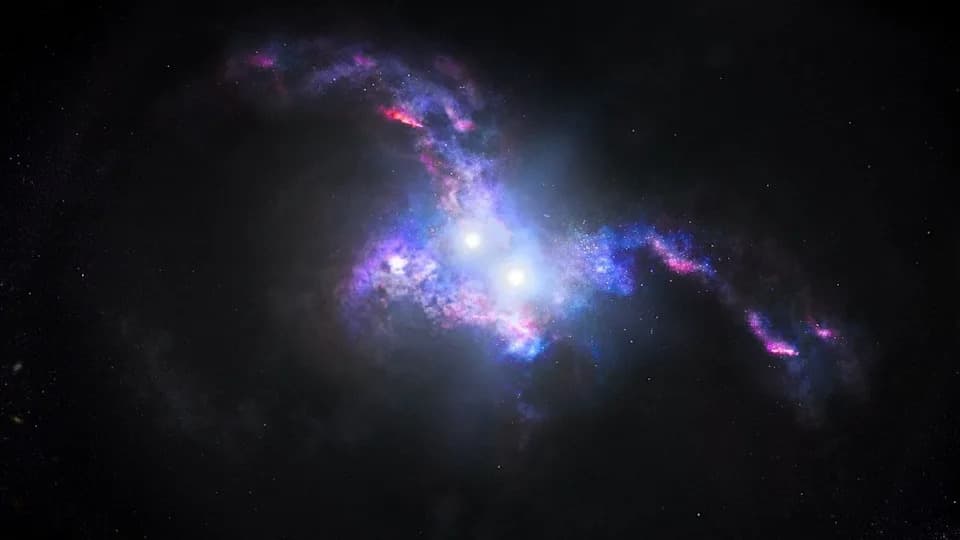
This artist's concept depicts the brilliant light of two quasars residing in the cores of two galaxies that are in the chaotic process of merging. | Credit: NASA, ESA, and J. Olmsted (STScI)
A team of astronomers has used machine learning to identify seven strong candidates for quasars that act as gravitational lenses — rare cosmic alignments that magnify background galaxies and open a new window onto black hole growth and galaxy evolution.
Starting with a catalog of roughly 800,000 quasars from the Dark Energy Spectroscopic Instrument (DESI), the researchers trained an AI model to recognize the subtle signatures of lensing. Because there are very few known examples of quasars that also serve as lenses, the team created simulated lensing systems to teach the algorithm what to look for. The trained model narrowed the dataset to roughly 200 promising candidates, which were then examined manually. That vetting produced seven high-confidence quasar-lens candidates.
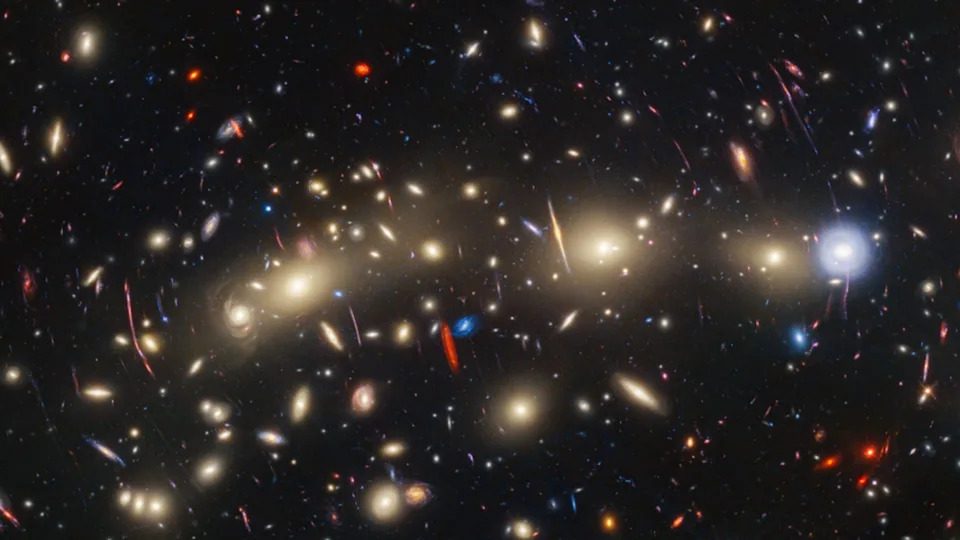
Gravitational lensing can be seen in this cosmic deep field. Notice how some glowing spots are dots while others are lines. | Credit: Image: NASA, ESA, CSA, STScI, Jose Diego (IFCA), Jordan D'Silva (UWA), Anton Koekemoer (STScI), Jake Summers (ASU), Rogier Windhorst (ASU), Haojing Yan (University of Missouri); Image Processing: Joseph DePasquale (STScI)
Why this matters: Quasars are extremely luminous galactic nuclei powered by actively accreting supermassive black holes. Their intense emission often outshines the host galaxy, making it hard to study the surrounding structure. In the unusual cases where a quasar itself lenses a more distant galaxy, astronomers can study both the bright active nucleus and the magnified background source, gaining insight into black-hole growth and the galaxy environment that feeds it.
How the discovery was made: The study relied on DESI’s vast survey data and a machine-learning pipeline trained on realistic simulated alignments. The simulation-driven approach allowed the algorithm to learn lensing signatures despite the scarcity of real examples. Human inspection then refined the results to seven strong candidates. According to the team, these finds roughly double the number of similar systems identified through comparable survey searches.
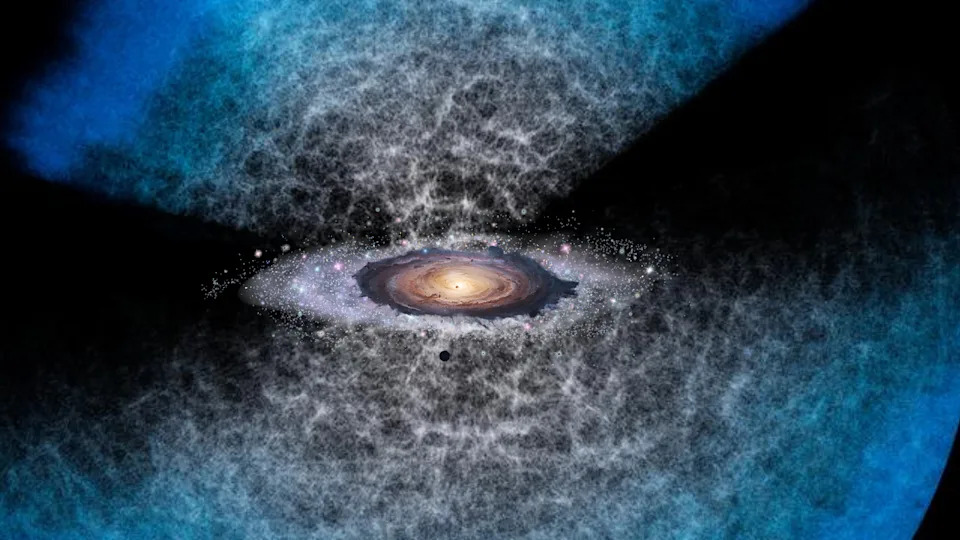
Two "fans" representing DESI observations above and below the plane of the Milky Way. | Credit: DESI Collaboration/DOE/KPNO/NOIRLab/NSF/AURA/R. Proctor/ Robert Lea (created with Canva)
“Quasars are like the baby pictures of a supermassive black hole,” said Everett McArthur, the study’s lead author and a graduate student in astronomy at The Ohio State University. “Tracing how we get from luminous quasars to the enormous black holes we see today is essential for understanding galaxy evolution.”
Next steps and implications: Follow-up observations with higher-resolution imaging and spectroscopy are required to confirm the lensing nature of these candidates and to measure their physical properties. If verified, these systems would be powerful probes of how actively growing black holes influence their host galaxies and of the mass distribution in the foreground quasar galaxies. The results also highlight the scientific value of combining large sky surveys like DESI with AI-driven searches to uncover rare but informative cosmic phenomena.
The findings were published July 22 in The Astrophysical Journal.
Help us improve.