The LHC records sudden beam-loss events called "UFOs" that are generally attributed to micron-sized dust entering the proton beam. Physicists Xunyu Liang and Ariel Zhitnitsky propose that macroscopic dark-matter objects called axion quark nuggets (AQNs) could produce faint underground acoustic pulses that shake dust loose and trigger correlated UFOs. They predict a distinctive signature — three or more correlated events within about two seconds at successive points along the 27-km ring — with signals roughly five times above background, and urge reanalysis of beam-loss monitor data.
Could the LHC’s Mysterious “UFOs” Be a Dark-Matter Signal? A New AQN Hypothesis
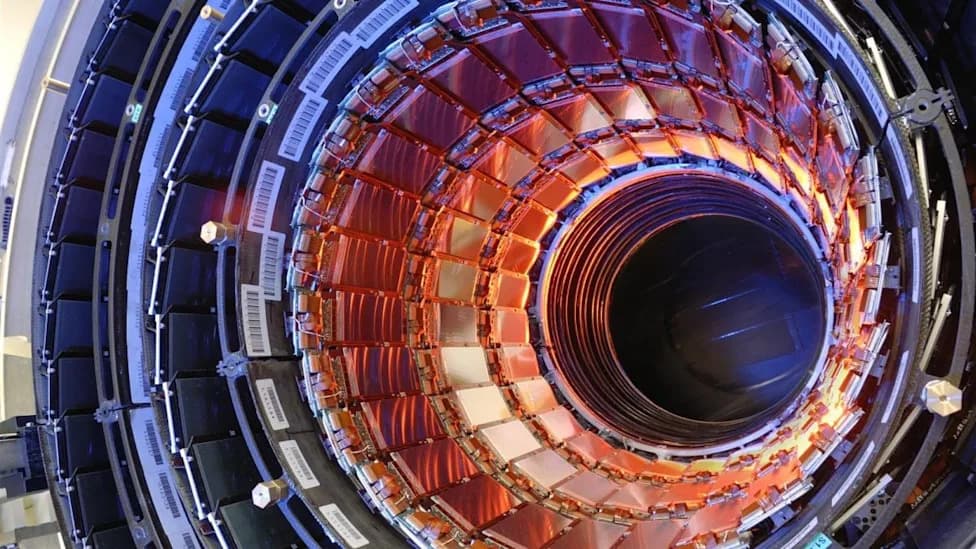
The CMS detector at CERN's Large Hadron Collider. (CERN)
For years the Large Hadron Collider (LHC) has recorded abrupt beam-loss events nicknamed "UFOs" — short for "unidentified falling objects." Teams currently attribute many of these faults to micron-sized dust grains drifting into the proton beam, but the mechanism that dislodges such particles in an extremely clean, precisely engineered accelerator remains uncertain.

YouTube Thumbnail
Physicists Xunyu Liang and Ariel Zhitnitsky of the University of British Columbia propose an intriguing, if speculative, explanation: macroscopic dark-matter objects known as axion quark nuggets (AQNs) could produce tiny underground acoustic or seismic shocks as they pass through Earth, and those faint vibrations might be enough to shake dust free and trigger correlated beam-loss events at the LHC.
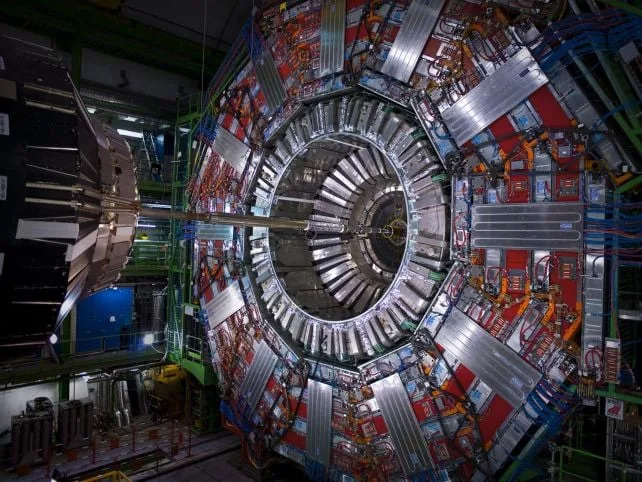
No LHC upgrades would be required to search for dark matter. (CERN)
"You can think of the LHC as a gigantic and extremely delicate Swiss watch... A piece of dark matter passing through the Earth tens of kilometers away could create a tiny vibration... That vibration could travel to the LHC and shake loose a microscopic piece of dust inside it," Liang and Zhitnitsky told ScienceAlert.
What Are Axion Quark Nuggets (AQNs)?
AQNs are a speculative macroscopic dark-matter candidate: dense, composite objects that could carry masses up to roughly a kilogram. Unlike elementary dark-matter particles, AQNs would interact with normal matter primarily through their large, extended structure and could create localized energy deposition and tiny mechanical disturbances when crossing solid material.

Subscribe to ScienceAlert's free fact-checked newsletter
How This Would Produce LHC Signals
The authors estimate that an AQN passing within roughly 100 kilometers (≈62 miles) of the LHC could generate an underground acoustic pulse. Although extremely faint, the pulse might be sufficient to vibrate accelerator components and dislodge micron-scale dust from the beam screen. If those grains drifted into the proton beam, they would cause beam-loss events — the UFOs already observed.

YouTube Thumbnail
Liang and Zhitnitsky calculate that an AQN-induced sequence would be distinguishable from ordinary background: roughly five times stronger than background fluctuations and leaving a characteristic pattern — three or more correlated UFOs appearing within about two seconds at successive locations along the LHC's 27-kilometre ring.
Practical Advantages and Next Steps
An appealing aspect of the proposal is that it requires no new hardware: the LHC's existing beam-loss monitors (installed to protect the machine) could, in principle, be reanalyzed to search for the predicted correlated bursts. The authors have not yet examined archived event logs themselves; their paper is intended to motivate experimental teams to reanalyze past data and to pursue targeted searches going forward. The idea could also be extended to other large accelerators, forming a sparse global acoustic detector network for macroscopic dark-matter candidates.
Caveats and Context
The AQN explanation is speculative. The leading interpretation for individual UFOs remains micron-sized dust, and many conventional mechanical or environmental sources could produce vibrations. A confirmed detection would require a statistically significant cluster of correlated events with the specific timing and spatial pattern predicted and independent cross-checks. If such a pattern were found, it would broaden dark-matter searches beyond microscopic elementary particles and motivate further theoretical and experimental study.
The research is scheduled to appear in Physical Review D. The work highlights an imaginative way to repurpose existing instrumentation and archived data to probe unconventional dark-matter models.
Help us improve.