The Austronaga minuta fossil from Yunnan, China, preserves a largely articulated skeleton plus soft-tissue traces of the stomach, liver and intestines, making it the oldest well-preserved reptile digestive tract known. The 2-ft (60 cm) specimen had a single-chamber sac-like stomach, a reddish liver with hemoglobin residues, and a simple straight intestine containing fish scales, indicating a fish-eating diet. Researchers say the find suggests the double-chambered stomach seen in birds and crocodilians evolved later in archosaur history.
245-Million-Year-Old Chinese Fossil Preserves Internal Organs of Fish-Hunting Marine Reptile
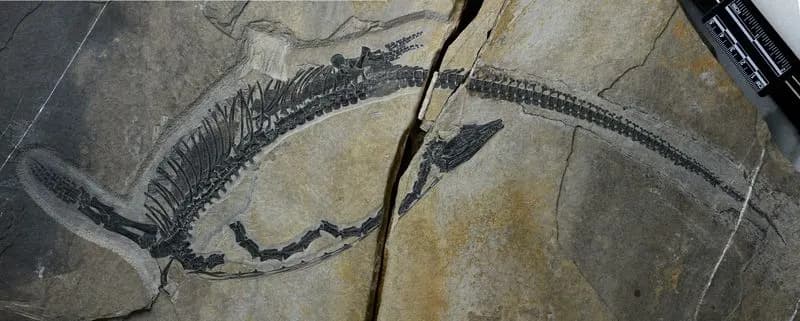
The fossil of the 245-million-year-old marine reptile Austronaga minuta, in an undated photograph in Beijing, China released on July 29, 2026. Wei Wang/Handout via REUTERS THIS IMAGE HAS BEEN SUPPLIED BY A THIRD PARTY. NO RESALES. NO ARCHIVES.
Scientists have unveiled a remarkably complete fossil from Yunnan Province, China, that preserves not only the skeleton of a long-necked marine reptile but also its internal organs. The specimen, identified as Austronaga minuta from the Triassic Period, dates to roughly 245 million years ago and offers an unprecedented window into reptile anatomy before dinosaurs rose to dominance.
Discovery and Context
Austronaga was recovered from fossil beds in southern Yunnan, a region renowned for exceptionally well-preserved Triassic fossils. The individual measured about 2 feet (60 cm) long and displays a body plan adapted for a life at sea: a relatively small head with a narrow, fang-lined snout, a long neck and torso, an even longer tail, large foreflippers and smaller hind flippers.
Exceptional Preservation
Most of the skeleton is articulated with bones in life position, but the standout feature is the preservation of soft tissues that mark a complete gastrointestinal tract. Researchers report identifiable residues that correspond to the stomach, liver and the length of the intestines, making this the oldest well-preserved digestive tract known for any reptile.
To our knowledge, this represents the oldest well-preserved digestive tract of any reptile.
What the Organs Reveal
The stomach is sac-like and single-chambered, unlike the double-chambered stomachs seen in modern birds, crocodiles and some dinosaurs. Directly behind it lies a reddish liver that retains traces consistent with hemoglobin residues and elevated iron — an unusually clear chemical signature for a 245-million-year-old fossil. A long, mostly straight tubular intestine follows, consistent with a carnivorous diet.
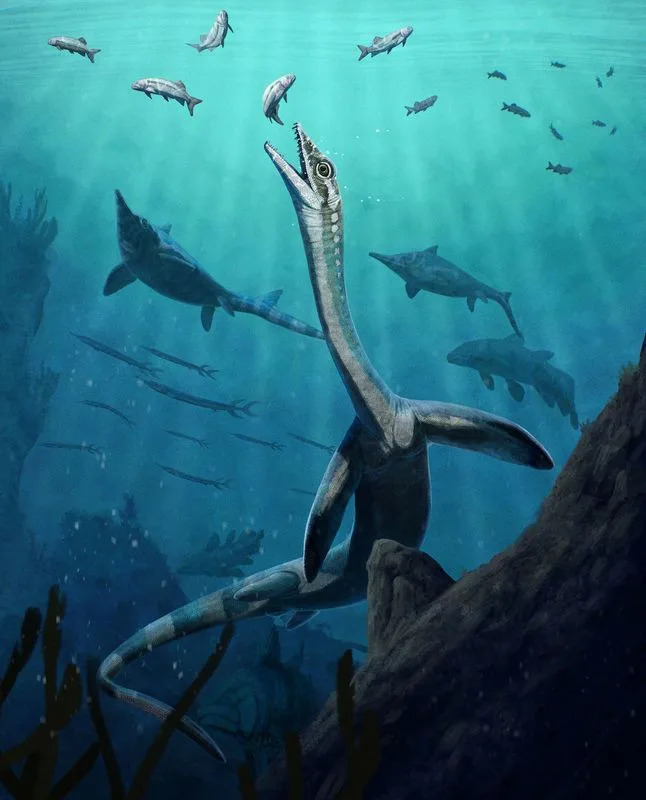
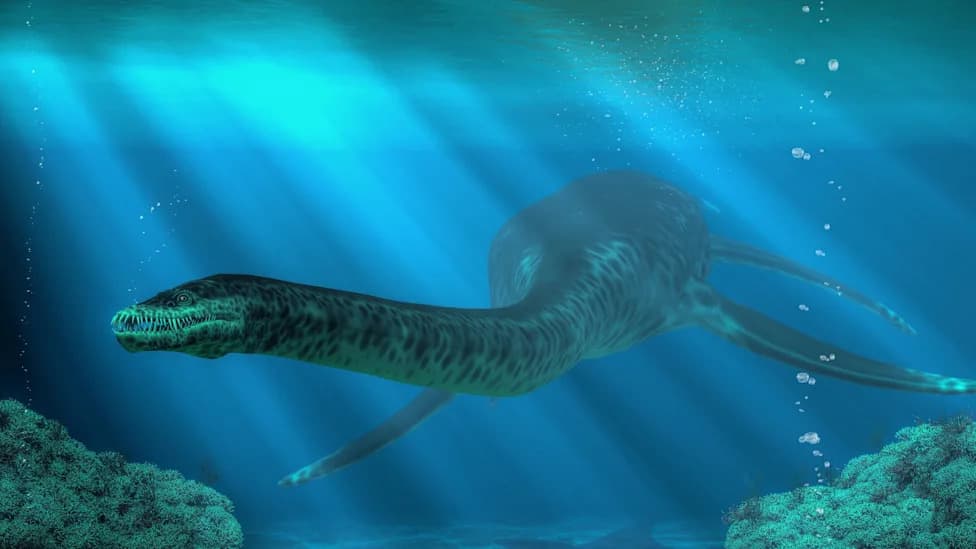
An artist’s reconstruction of the long-necked Triassic Period marine reptile Austronaga minuta, in this illustration released on July 29, 2026. Gabriel Ugueto/Handout via REUTERS THIS IMAGE HAS BEEN SUPPLIED BY A THIRD PARTY. NO RESALES. NO ARCHIVES.
Diet and Behavior
Fish scales found inside the gut indicate this Austronaga had recently eaten fish. Anatomical features suggest an agile swimmer that relied on tail-driven propulsion, used foreflippers to steer, and employed its long neck to snatch slippery prey from the water.
Evolutionary Significance
Austronaga belongs to a group closely related to archosaurs, the lineage that produced crocodiles, dinosaurs, pterosaurs and birds. Very few members of that broader lineage adopted a marine lifestyle, and among those that did, Austronaga shows an especially high degree of aquatic adaptation. The single-chambered stomach and simple gut architecture imply that the evolution of a double-chambered stomach in archosaurs occurred later, closer to the split leading to modern crocodilians and birds.
Environment and Size
The specimen lived in a warm, shallow equatorial sea teeming with fish and other marine reptiles, including large predators like nothosaurs. Researchers are uncertain whether the individual was fully grown; if not, adults might have been somewhat larger, but Austronaga was likely a relatively small marine reptile compared with some contemporaries.
Conclusion
This fossil provides rare direct evidence of internal organ anatomy in early marine reptiles and sheds light on how digestive systems and aquatic adaptations evolved in relatives of archosaurs. The find helps bridge a major gap in our understanding of vertebrate evolution after the Permian mass extinction.
Help us improve.