The article explores how the 2012 STOCK Act — which required members of Congress to disclose stock trades within 30 days — reduced obvious self-dealing but failed to restore public trust. Increased transparency often produces damaging headlines from late filings and broker-led trades in blind trusts. Partisan politics and narrow reforms have compounded the perception of corruption, and experts argue that stronger enforcement, deeper investigations, and broader rules (including for the executive branch) are needed to rebuild confidence.
How Efforts to Curb Lawmakers’ Stock Trading Deepened Public Distrust
How Congress entrenched its own unpopularity by trying to rein in stock trading
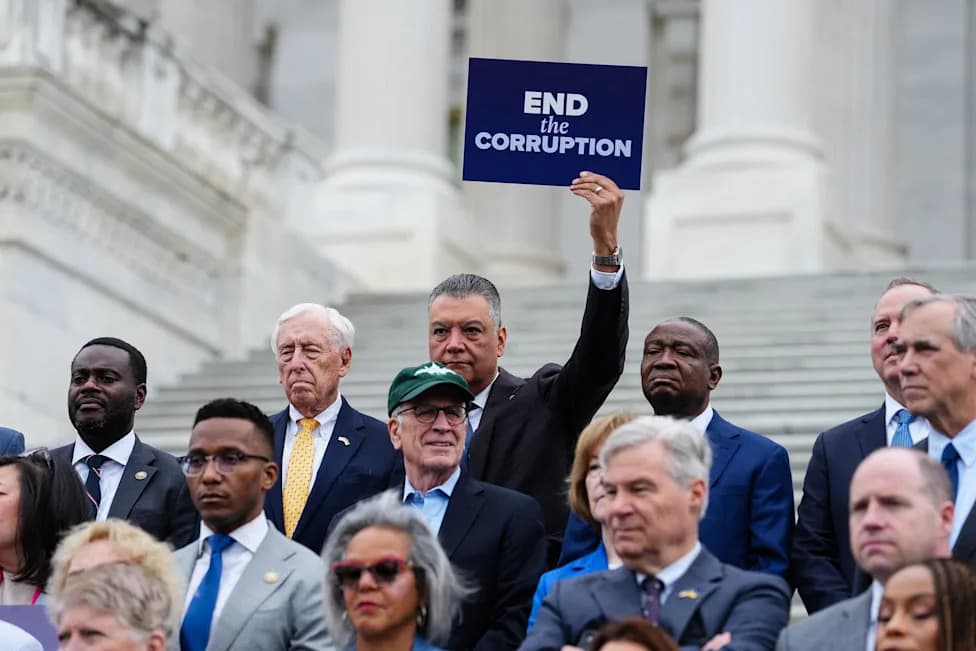
When Democrats are not publicly at odds — a rare occurrence these days — they broadly agree on three elements of their midterm message: focus on affordability, take on corruption, and confront the political challenge that voters view both parties as crooked, which undermines anti-corruption appeals.
At a recent progressive conference, former Bernie Sanders and Joe Biden adviser Alex Jacquez summed up the problem: "My friends who aren't politically engaged — I say, 'Trump has made $4 billion since he's been president, he's getting a jet from Qatar,'" he said. "And they say, 'Nancy Pelosi is long on Nvidia.'"
Banning members of Congress from trading stocks is a popular reform with voters, driven in part by high-profile examples and conflicting public statements about lawmakers' finances. But the reform Congress enacted in 2012 had an unintended political effect: it reinforced the public perception that lawmakers are profiting from privileged access rather than restoring trust.
The 2012 law commonly known as the STOCK Act required members to disclose any trades made by them or their brokers within 30 days. Academic researchers concluded within a few years that the law had been "effective in deterring politicians from exploiting their official positions for personal financial gains." But increased transparency did not translate into increased public confidence.
Transparency That Produces Headlines
Disclosure rules can create damaging headlines even when there is no evidence of insider trading. Late filings — an administrative lapse far short of criminality — are often reported as violations of the STOCK Act, and disclosures from blind trusts can look suspicious when a broker makes profitable trades.
"It did not achieve its design of increasing public confidence in Congress," said Kedric Payne, senior director for ethics at the Campaign Legal Center. "But it did achieve its design of providing more transparency."
One prominent example involved Rep. Tom Kean Jr., R-N.J., whose office disclosed trades that were reported while he was seeking treatment for depression. The timing invited speculation and heated media coverage despite no proven wrongdoing.
Former Rep. Tom Malinowski, a Democrat who lost to Kean in 2022 and who himself faced criticism for late disclosures, said the headlines often do more harm than good. "You immediately leap to the conclusion that if this guy's too sick to be in Congress, why does he have the energy to be stock trading?" he said. "The reality is that, like the vast majority of Americans who have retirement savings in the stock market, members of Congress are not directing their trades."
Politics, Partisanship and Narrow Reforms
Partisan maneuvering further complicates reforms. Some House Republicans are preparing to use their version of an insider-trading ban as a political weapon against Democrats who opposed the measure, in part because those Democrats wanted a broader approach that would also cover the executive branch.
"Why would you apply this to a freshman member of Congress and not the president of the United States or the Secretary of Commerce?" Malinowski asked. The uneven scope of some proposals fuels complaints that ethics rules are being used selectively for political gain.
History shows a familiar cycle: scandal leads to new rules, which can generate new controversies. After the #MeToo movement, the House tightened rules in 2018 to bar members from relationships with their own staff and created a new process for handling harassment claims. Now there is bipartisan momentum to expand those restrictions further — a sign that lawmakers and the public want stricter ethics but also a reminder that rules alone rarely erase public cynicism.
What Will Restore Trust?
Reporters and ethics experts say only thorough investigations, stronger enforcement, and possibly broader rules covering the executive branch will meaningfully address the public's concerns. Dave Levinthal, whose reporting frequently examines members' personal finances and stock trades, noted that members of Congress wrote their own ethics laws and could change them if they wanted greater public confidence. He added that claims by lawmakers that they do not directly direct trades are difficult to verify without subpoena power or deep investigative reporting.
Polling underscores the depth of public concern: a recent Brennan Center survey found that more than 90% of Americans see corruption as a "big problem" across government. The question facing reformers is whether new transparency and enforcement measures can break the cycle of scandal and restore faith in democratic institutions.
Help us improve.