Quick Take: President Trump repeatedly says Iran is "desperate" to make a deal, even though he recently explained why Tehran still holds the strategic advantage. Control of the Strait of Hormuz, dwindling global reserves and a series of attacks and counterattacks have left Iran little incentive to negotiate. Critics and analysts say sanctions and strikes have not compelled Tehran to the table, and public support for the war remains low.
Trump Says Iran Is 'Desperate' For A Deal — Weeks After He Explained Why It Isn't
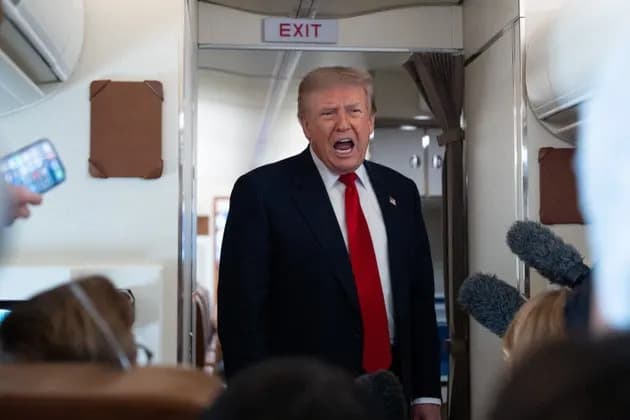
President Donald Trump speaks with reporters on Air Force One on July 27, 2026. AP Photo/Alex Brandon
WASHINGTON — President Donald Trump has repeatedly told the public that Iranian leaders are "desperate" to cut a deal to end the conflict he launched against the country. Yet only weeks earlier he described precisely why Tehran still holds strategic leverage and shows little incentive to negotiate.
What the President Is Saying
On Monday, en route to a campaign rally in Michigan, Trump told reporters,
“We're talking right now. Their people, they wanted to talk.”He has often asserted that Iranian officials or emissaries are contacting him directly: “They want to make a deal so badly. They called a little while ago,” he said on the return flight from the NATO summit aboard a 747 he secured from Qatar. When pressed on Fox News about who in Iran he was speaking with, Trump declined to provide specifics, saying only, “We've had some very good talks.”
Why Trump Previously Said Iran Holds The Upper Hand
Only six weeks earlier, at the G7 summit, Trump himself explained why Iran retained leverage: Tehran controls high ground on three sides of an inverted "V" formed by the Strait of Hormuz, a vital chokepoint for global oil shipments. Since the conflict began on Feb. 28 — when Trump and Israeli leader Benjamin Netanyahu launched strikes — tanker traffic through the strait has been reduced dramatically, and countries and companies are drawing down reserves.
Trump warned that global oil reserves could be exhausted in roughly four weeks and argued that his decision to sign a temporary ceasefire then likely prevented an economic crisis. That ceasefire, signed at Versailles, lasted only weeks before Iran attacked ships traversing a channel Tehran opposed. The truce unraveled, U.S. forces struck Iranian targets for two weeks, and Iran retaliated with strikes on U.S. troops in the region.
Casualties And Recent Attacks
The conflict has had a significant human cost: five months in, 18 U.S. service members have been killed and more than 600 injured. On July 17, a missile strike on Muwaffaq Salti Air Base in Jordan killed three U.S. soldiers and wounded dozens. Iran again launched missiles against bases hosting U.S. forces on Tuesday, and Trump vowed a response.
Voices From Washington And Analysts
John Bolton, a national security adviser in Trump's first term and a longtime advocate of military pressure on Iran, argued Tehran no longer presents a single coherent negotiating partner and said the IRGC (Islamic Revolutionary Guard Corps) has “zero interest in a deal.” Bolton also faces legal consequences unrelated to the conflict: he recently agreed to plead guilty to one count of illegally retaining classified documents and will pay a $2.25 million fine and perform 100 hours of community service.
Robert Kagan, a former senior State Department official, emphasized that control of the Strait of Hormuz is not merely a power play for Iran but a vital national interest and deterrent. Former Defense Department official Jim Townsend added that years of sanctions have taught Iran to work around pressure, making it unclear that a sanctions-or-bombardment strategy would force Tehran to the table.
History Of The Claim
Trump has repeatedly claimed — dating back to his May 2018 withdrawal from the 2015 Iran nuclear accord (the Joint Comprehensive Plan of Action) — that Tehran is eager to make a deal with him. He said during his 2020 campaign that Iran would call him first if he won a second term and has continued to assert Tehran’s eagerness even when evidence is lacking. Notably, much of Iran's highly enriched uranium accumulation occurred after the U.S. left the JCPOA.
Domestic Support And The Road Ahead
Public support for the conflict is limited: a Reuters/Ipsos poll finds roughly one in three Americans backs the war, raising questions about sustained domestic backing for an extended campaign. With strategic control of the Strait of Hormuz, recurring attacks and counterattacks, and limited clarity about backchannels or credible negotiations, the path to a durable settlement remains unclear.
Bottom line: The president's public assertions that Iran is "desperate" to make a deal conflict with his own recent explanation of Tehran's strategic leverage. Analysts and former officials say Iran currently has reasons not to negotiate, while the human and economic costs of the conflict continue to mount.
Help us improve.