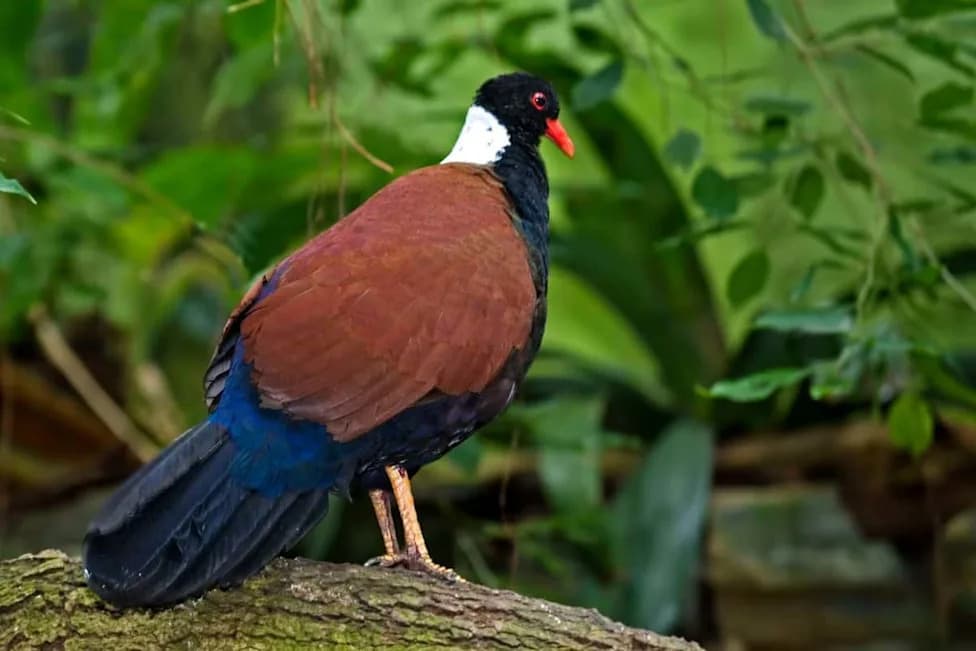
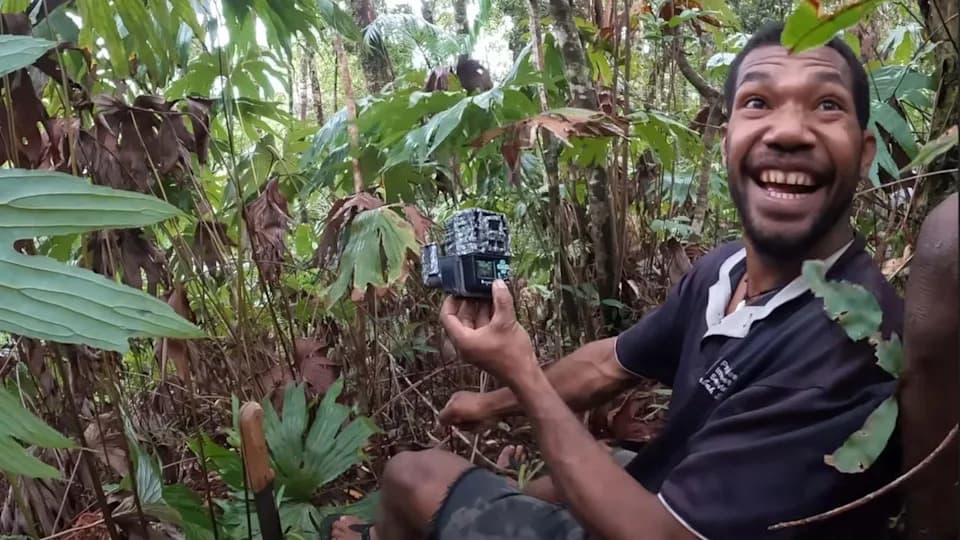
Camera traps on Fergusson Island captured the black-naped pheasant-pigeon (Auwo) in 2022 — the first confirmed documentation since 1882. A 2026 video of the moment, shot by co-lead Jordan Boersma, shows local biologist Doka Nason celebrating as the trail camera revealed the bird. The rediscovery, made just two days before the month-long expedition concluded, underscores the power of community-led fieldwork and non-invasive monitoring for protecting endemic species.
Auwo Rediscovered: 'Mythical' Black-Naped Pheasant-Pigeon Caught on Camera After 140 Years
Credit: Jordan Boersma
In 2022, researchers working on Fergusson Island in Papua New Guinea — with crucial assistance from the local community — recorded the black-naped pheasant-pigeon (Otidiphaps insularis) using camera traps. Known locally as Auwo, this ground-dwelling bird had not been documented by researchers since its first scientific description in 1882, roughly 140 years earlier.
Four years later, in 2026, footage of that rediscovery went viral. The clip, recorded by study co-lead Jordan Boersma of the Cornell Lab of Ornithology, captures the exact moment a trail camera revealed the bird and shows local biologist Doka Nason jumping for joy. In the video both Boersma and Nason repeatedly call out the name "Auwo" in disbelief.
"I felt like I'd been confronted by an image of a mythical creature,"
— Jordan Boersma, Cornell Lab of Ornithology (recalling the moment)
The field team was co-led by John C. Mittermeier, director of the American Bird Conservancy's Search for Lost Birds Program. The researchers had spent about a month on Fergusson Island, and the camera-trap record came just two days before the expedition was due to end. Mittermeier described the event as "the kind of moment you dream about your entire life as a conservationist and birdwatcher."
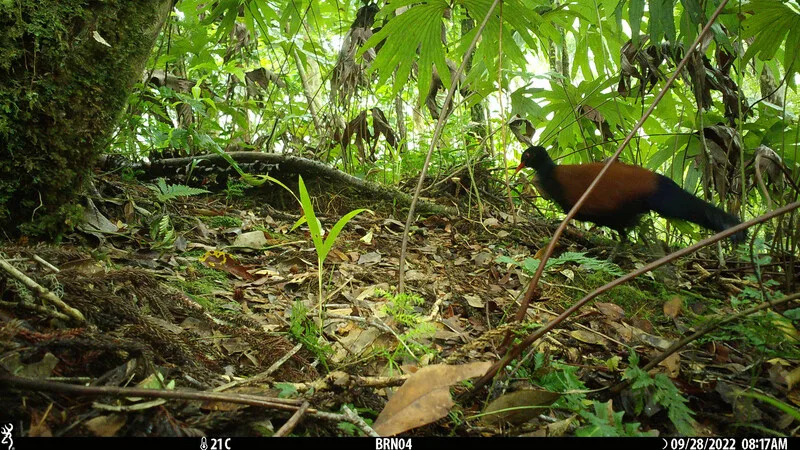
Footage of the | Credit: Doka Nason/American Bird Conservancy
About the Species
The black-naped pheasant-pigeon is a rare, terrestrial bird endemic to Fergusson Island. Although a member of the pigeon and dove family, its appearance and behavior more closely resemble those of a pheasant. The species displays iridescent green, bronze and black plumage, with a distinctive solid black nape. It has a flattened, bobbing tail and long legs adapted for walking rather than perching.
Why This Matters
Beyond being an extraordinary conservation success, the emotional footage—showing a local biologist visibly overjoyed at proof the species still exists—highlights the deep cultural and ecological importance of endemic wildlife to Indigenous communities. The discovery also underlines the value of community collaboration and non-invasive survey methods like camera trapping for monitoring elusive species.
Members of the Search for Lost Birds Program, including John C. Mittermeier, were later involved in a separate 2026 rediscovery: the blue-fronted lorikeet, a small parrot endemic to the Indonesian island of Buru that had not been seen for about 100 years.
Help us improve.