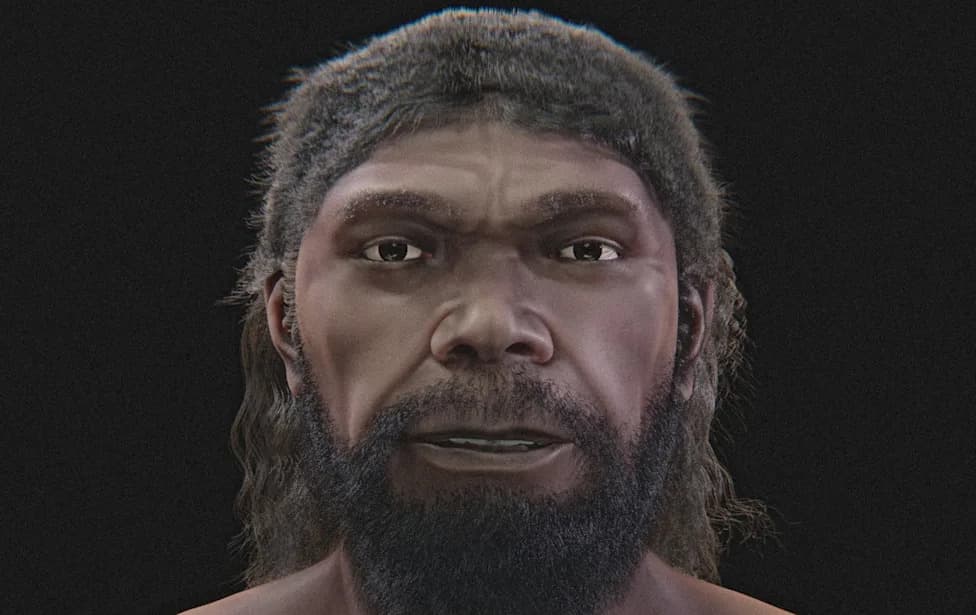
Researchers developed a cranial-shape method and applied it to 123 infant CT scans, hundreds of historical human skulls, nearly 1,000 great ape skulls and fossil remains from Homo erectus and Homo floresiensis. They found that human skulls — both modern and fossil — show a much wider range of deformational plagiocephaly than great apes, suggesting prolonged infant dependence. The results imply that intensive neonatal care and social support may have been present in hominins more than one million years ago.
Study Finds Human Newborns Were Helpless for Over 1 Million Years
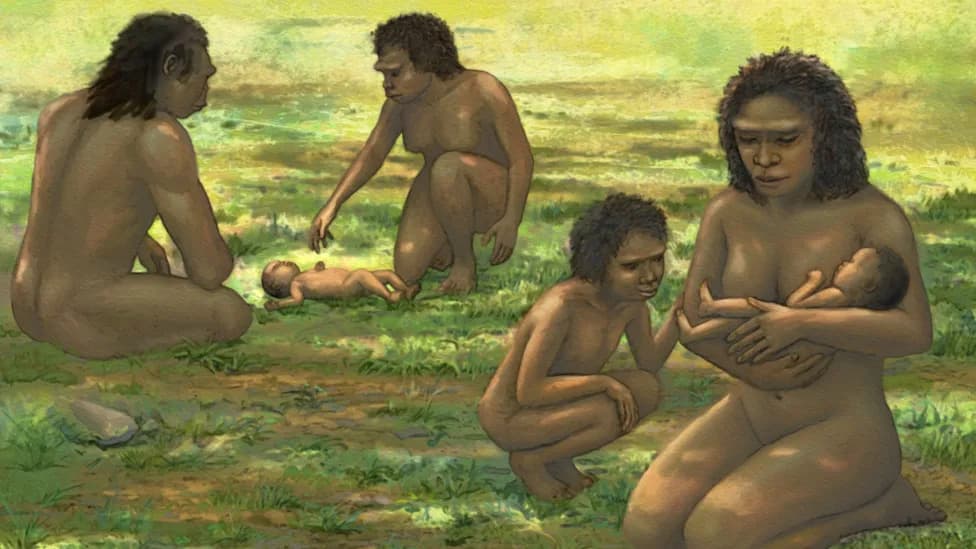
Like modern humans, from this research the team believes 'Homo erectus' mothers held helpless newborns in their arms and shared the care with the father and other group members. Laying newborns with immature heads and neck muscles on the ground can cause deformational plagiocephaly.
Modern human infants are born far less developed than the young of other great apes: they have weak neck muscles, softer skull bones and brains that continue to grow rapidly after birth. A new study published in Proceedings of the Royal Society B presents evidence that this prolonged, dependent newborn stage — and the related risk of deformational plagiocephaly ("flat head" syndrome) — has been present in our lineage for more than one million years.
New Method Sheds Light on Infant Development in Fossils
The research team developed an approach that detects cranial shape changes that arise around or shortly after birth and persist, to some degree, into adulthood. Because infant fossils are rare and often fragmentary, this method can be applied to skulls of any age and may help fill gaps in the evolutionary record.
"Our method looks for changes in the shape of the cranium that occurred around or soon after birth and remained to some extent into adulthood," said Yousuke Kaifu, co-author and anthropologist at the University Museum at the University of Tokyo.
What the Researchers Analyzed
To test their idea, the authors analyzed a large and varied dataset: CT scans of 123 healthy modern infants (ages one day to 17 months), measurements from 385 historical human skulls from Japan (roughly 200–1,000 years old), 996 non-human great ape skulls, five fossilized Homo erectus skulls and one fossilized Homo floresiensis skull.
Key Findings
Non-human great apes (chimpanzees, bonobos, gorillas and orangutans), whose infants are comparatively more independent at birth, showed a relatively narrow range of cranial deformation. By contrast, all human samples — modern and fossil — exhibited a much broader range of cranial shapes and levels of deformational plagiocephaly.
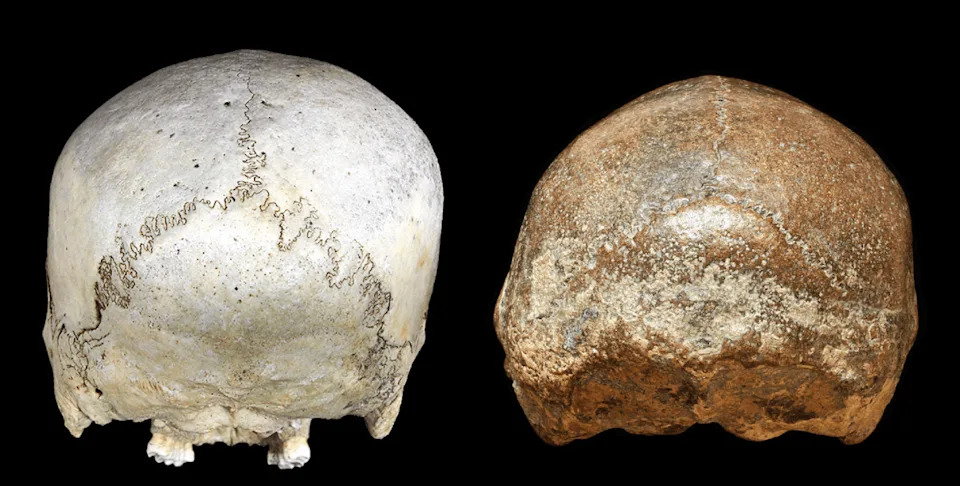
Back views of the skulls of a historical human (left) and aHomo erectusfrom Ngawi, Java (right: undated), exhibiting severe transverse deformational plagiocephaly.Image: Kaifu Y et al. 2026 CC BY.
Notably, the Homo erectus samples (which date back more than one million years) showed deformation patterns consistent with postnatal skull flattening, implying infants with soft, underdeveloped crania and limited head mobility. The single Homo floresiensis skull also displayed surprising levels of deformation despite its relatively smaller brain size.
Implications
The findings suggest that prolonged neonatal dependence and the intensive caregiving it requires — likely including social support beyond a lone mother — were established early in the Homo lineage, possibly by the time the ancestors of H. erectus and H. floresiensis diverged more than one million years ago. While these results do not settle debates such as the "obstetrical dilemma" (the trade-off between large brain size and bipedal pelvic shape), they indicate that childcare and social cooperation may have been integral to hominin evolution.
Caveats: Fossil samples remain limited, especially for infants, and some interpretations (for example, from a single H. floresiensis specimen) should be treated cautiously. Further fossil discoveries and broader datasets will help refine these conclusions.
Image credit: Kaifu Y et al. 2026 CC BY — Back views of a historical human skull (left) and a Homo erectus skull from Ngawi, Java (right) showing severe transverse deformational plagiocephaly.
Help us improve.