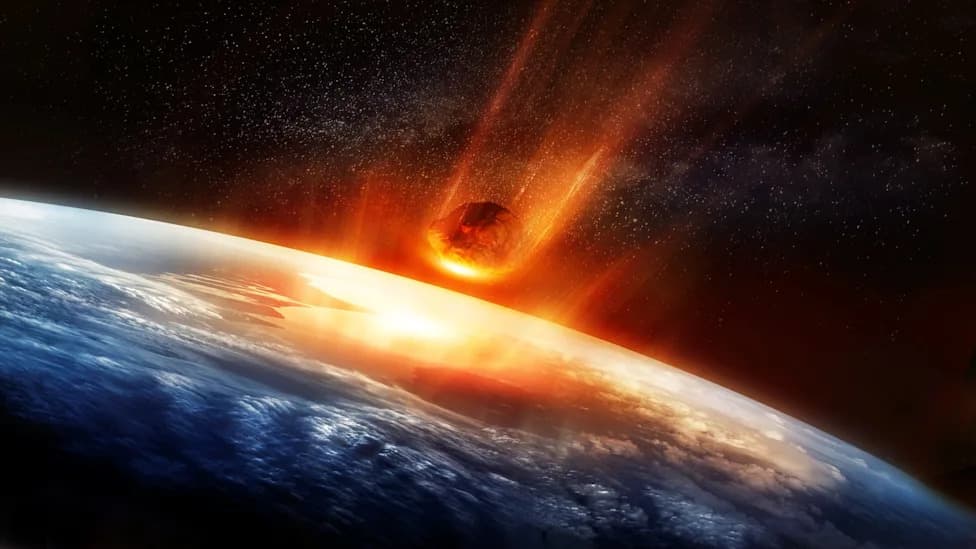
New research in the Journal of Geophysical Research: Biogeosciences suggests the Chicxulub asteroid impact 66 million years ago may have killed many terrestrial animals within hours. Models show vaporized rock and fine atmospheric dust could have boosted surface heating by at least 3.5× compared with falling debris alone, igniting widespread fires and causing rapid mortality. The study allows for a follow-up period of years of reduced sunlight and ecological collapse as lingering dust chilled and darkened the planet.
New Study: Chicxulub Impact May Have Killed Most Dinosaurs Within Hours
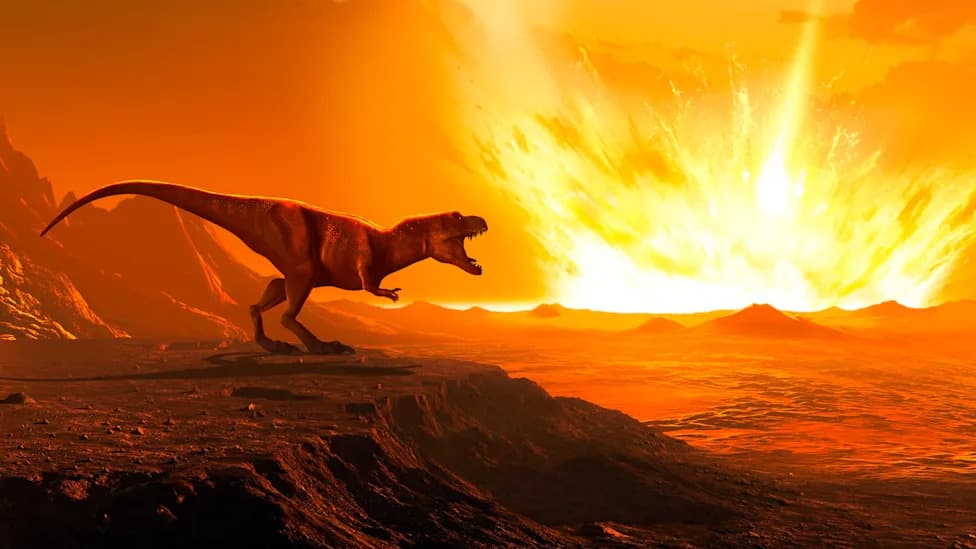
The Chicxulub asteroid released energy equivalent to 100 teratons of TNT.
New research suggests the mass extinction 66 million years ago was far more instantaneous than many previously thought. A team led by planetary scientist Brandon Johnson combined impact simulations with measured dust layers and found that vaporized rock and fine atmospheric dust from the Chicxulub impact could have heated Earth's surface to levels at least 3.5 times higher than the effects of falling debris alone—igniting widespread fires and killing many animals within hours.
“We’re in the realm where we might be essentially killing off everything within that first hour or two,”Johnson said, summarizing the study published in the Journal of Geophysical Research: Biogeosciences.
The asteroid that produced the Chicxulub crater was roughly six miles wide and struck at about 12 miles per second, releasing energy on the order of 100 teratons of TNT—more than one billion times the blasts at Hiroshima and Nagasaki. The impact excavated a cavity roughly 62 miles across and 19 miles deep, launched two-mile-high tsunamis, generated winds estimated at ~620 mph, and lofted an estimated 25 trillion metric tons of rock into the atmosphere. Much of that ejecta re-entered as superheated spherules that rained fire globally.
Vapor, Dust and a Deadly Atmospheric Blanket
In addition to solid ejecta, large volumes of target rock were vaporized and injected as fine particles and vapor high into the atmosphere. Recent work documenting an extinction-era fine dust layer in North America helped motivate Johnson's team to model how that vaporized material behaved. Their combined simulations indicate an insulating cloud of vaporized rock and fine dust could have trapped heat near the surface and boosted thermal effects well beyond the immediate showers of hot spherules.
“It reinvigorated my interest in what happened to the leftover vapor—that's where this work started,”Johnson said.
Those raised temperatures would have been sufficient to cause near-instantaneous mortality for many terrestrial animals and to ignite spontaneous fires across broad regions. The researchers argue these rapid, fire-driven deaths could account for a large portion of early extinctions.
From Instant Inferno to Prolonged Collapse
The authors caution their model does not exclude longer-term collapse. Johnson likens the post-impact atmosphere to a thermos: after the initial global infernos subsided, the dust- and vapor-filled atmosphere would have continued to block sunlight for years or decades, driving cooling, plant die-offs, and eventual starvation for species that survived the first hours or days.
Study authors note a current limitation: most clear wildfire proxies tied to the Chicxulub event are from North America, with sparser evidence from more distant regions. As University College London paleontologist Alessandro Chiarenza (not involved in the study) observed, it remains possible that future discoveries will reveal a truly global wildfire record.
Bottom line: The Chicxulub impact plausibly combined an immediate, heat-driven extinction pulse with a subsequent, longer period of darkness and ecological collapse—together producing the catastrophic loss of non-avian dinosaurs and many other species.
Help us improve.