Two Massachusetts brothers fishing off Cape Cod expected brown sharks but instead landed a juvenile tiger shark, identified by its vertical stripes under a headlamp. The catch follows other recent tiger shark sightings—one seen near Popponesset Bay feeding on a leatherback turtle—and earlier shore landings in 2024 and 2025. NOAA-backed research links these northward shifts to ocean warming driven by fossil-fuel emissions. The anglers documented the sighting, removed the hook quickly, and released the shark to minimize harm.
Expecting Brown Sharks, Anglers Haul Juvenile Tiger Shark Ashore on Cape Cod
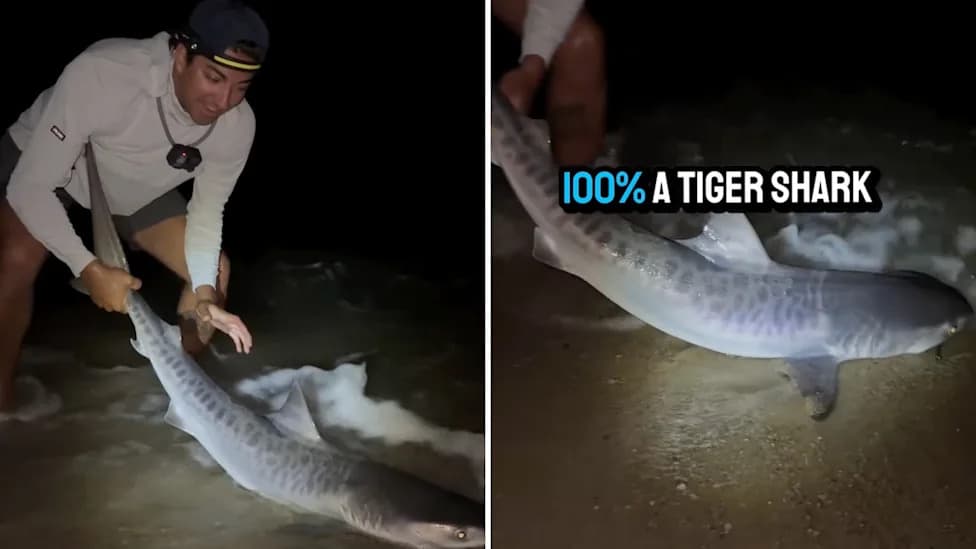
Photo Credit: Instagram
What began as a nighttime search for brown sharks on Cape Cod turned into a rare and surprising catch when two Massachusetts anglers landed a juvenile tiger shark from the surf.
Nate Rouette, social media manager for On The Water, went to the beach with his brother, Nelson, baiting eel rigs for brown sharks. After several missed strikes and a long lull, a final strong bite produced an unfamiliar catch. In the beam of a headlamp, the shark's vertical stripes were unmistakable: a juvenile tiger shark, a species still uncommon in New England waters.
Rouette shared photos on On The Water's Instagram showing the shark's distinctive stripes glistening under a flashlight.
Nearby Sightings and Growing Pattern
The landing gained added attention because it followed another recent report: a tiger shark seen roughly three miles off Mashpee's Popponesset Bay feeding on a leatherback turtle, described as the first such sighting near the Cape this season. On The Water also documented juvenile tiger sharks taken from Cape Cod shorelines in August 2024 and August 2025, suggesting these visits may be becoming more frequent.
Why Scientists Are Watching
Researchers say the pattern aligns with tiger sharks' preference for warmer water—typically around 72°F or warmer. Findings supported by the National Oceanic and Atmospheric Administration (NOAA) indicate that as ocean temperatures rise, tiger sharks and other species are moving northward and appearing earlier in the season on the Northeast Continental Shelf.
Ocean warming is closely linked to human-driven greenhouse-gas emissions from burning fossil fuels such as oil, gas, and coal. NOAA Fisheries and other research programs have spent years documenting how these temperature shifts are changing where marine animals live, feed, and migrate. That monitoring helps coastal communities understand which species they might encounter offshore—or even from the beach—during warmer months.
Responsible Handling and Scientific Value
According to On The Water, the Rouette brothers followed expert recommendations after an unusual catch: they kept the shark wet, removed the hook quickly, photographed it for documentation, and released it back into the sea. Those steps reduce stress on the animal while preserving a record of an important sighting.
"It's a Tiger, Nels!"
Such documented sightings contribute to the broader scientific record and help researchers track changing species distributions along the Atlantic coast.
Help us improve.