Researchers captured the first in situ footage of the Arctic bobtail squid Rossia moelleri, filming a mature female tending egg clutches at about 164 ft (50 m) in roughly −1.6°C water. The team documented three egg clusters estimated at 22, 33 and 50 capsules, confirming active reproduction in Northeast Greenland National Park. Filmed with a 4K ROV during a September 2025 Secret Atlas micro‑cruise, the finding establishes an important baseline for monitoring ecological change in a rapidly warming Arctic.
First Wild Footage of Arctic Bobtail Squid Shows Female Tending Eggs in Sub‑Zero Water
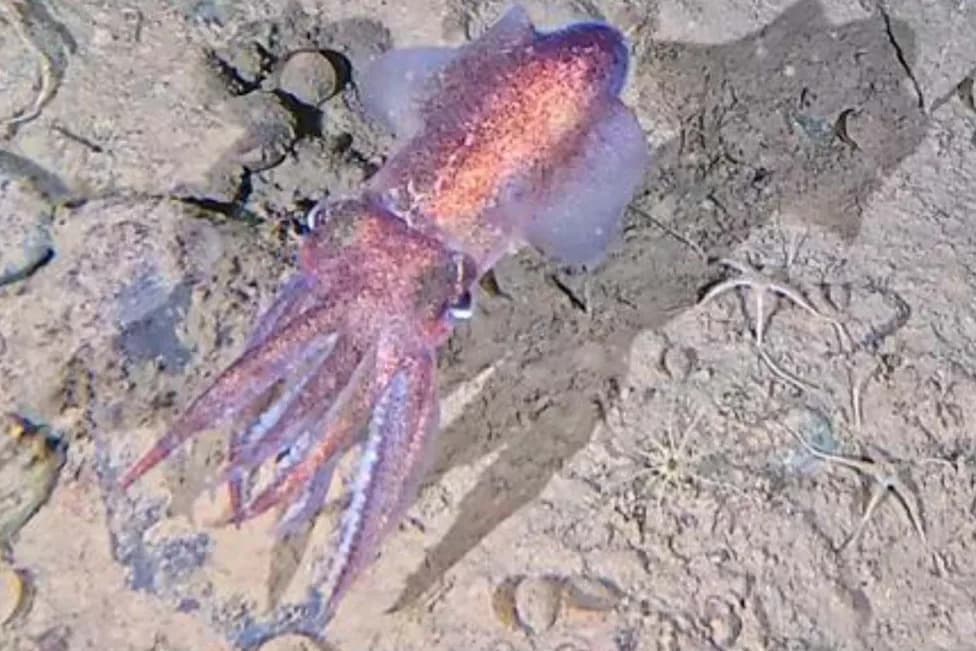
A colorful squid on a seafloor viewed from aboveCredit: Maroni, P.J., Cornet, J., Skorikova, Y. et al./Springer Nature
Scientists have recorded, for the first time in the wild, an Arctic bobtail squid (Rossia moelleri) actively tending egg clusters in the frigid waters of Northeast Greenland National Park. The sighting provides direct evidence that this endemic cephalopod is reproducing in high Arctic conditions and helps close a long-standing gap in regional knowledge.
The Observation
The team filmed a mature female bobtail squid at about 164 feet (50 m) depth along a sheltered fjord wall, where seawater temperature measured roughly 28.9°F (−1.6°C). Using a remotely operated vehicle (ROV) equipped with a 4K camera, floodlights and laser scaling, researchers recorded the animal during a 60‑minute dive along a transect of roughly 121–287 feet (37–87 m).
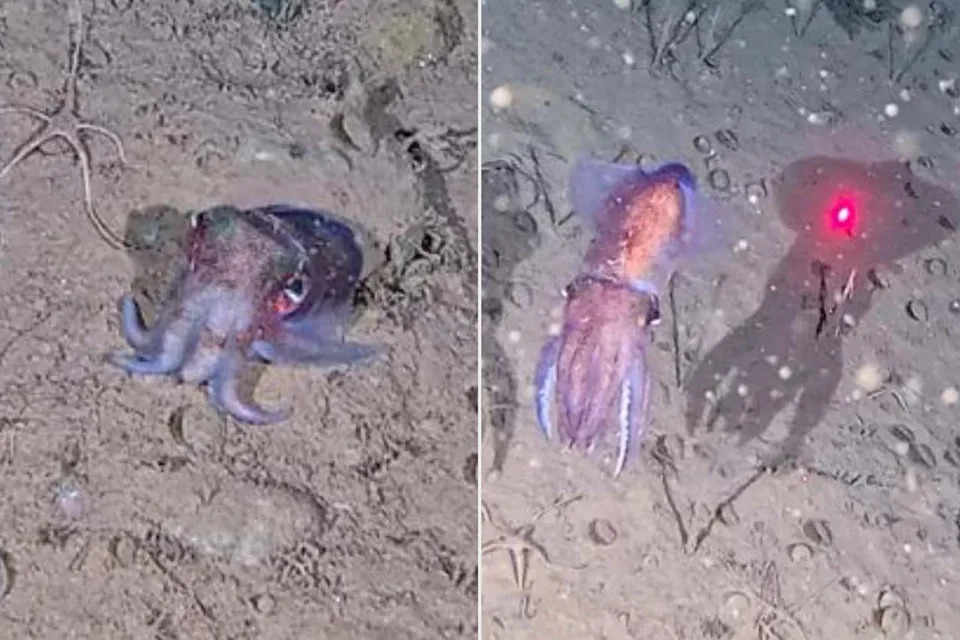
Frame grabs from 4 K ROV video showing the bobtail squid, Rossia moelleri, swimming near or resting on the seafloorCredit: Maroni, P.J., Cornet, J., Skorikova, Y. et al./Springer Nature
Egg Clutches and Reproduction
Nearby the squid, researchers documented three egg clusters attached directly to rocky substrate. The clusters were estimated to contain about 22, 33 and 50 capsules respectively, providing clear, in situ evidence of reproduction for this species within the park.
Why This Matters
Cephalopods such as bobtail squid play key roles in Arctic food webs as both predators and prey, but confirmed records from the region are scarce: one biodiversity database search returned 14,497 marine records inside the park boundary but only seven entries for cephalopods. Because cephalopods have short lifespans and are sensitive to changes in temperature and salinity, documenting their presence and reproductive activity establishes an important baseline for detecting ecological responses to rapid Arctic warming and ice loss.
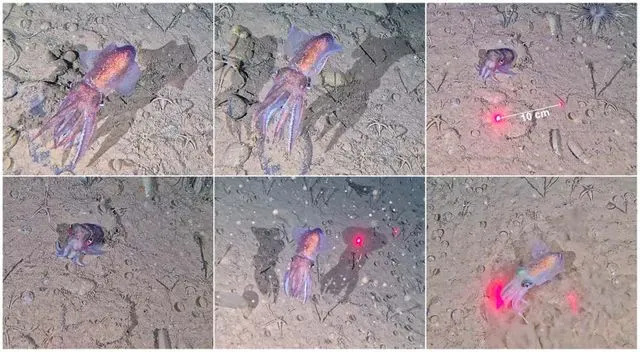
Frame grabs from 4 K ROV video showing the bobtail squid, Rossia moelleri, swimming near or resting on the seafloorCredit: Maroni, P.J., Cornet, J., Skorikova, Y. et al./Springer Nature
"Documenting early evidence of reproductive presence therefore provides an essential reference point for tracking ecological change under accelerating warming and ice-loss scenarios."
Methods and Access
The discovery was made during a Secret Atlas expedition micro‑cruise in September 2025, demonstrating the value of small, low‑impact surveys and advanced ROV systems for studying remote polar habitats that larger vessels cannot access. The footage and observations have been published in the journal Polar Biology, expanding verified in situ records for Rossia moelleri in Northeast Greenland National Park.
Implication: This record not only confirms the species' presence but also provides a measurable benchmark for future studies tracking biological responses to Arctic climate change.
Help us improve.