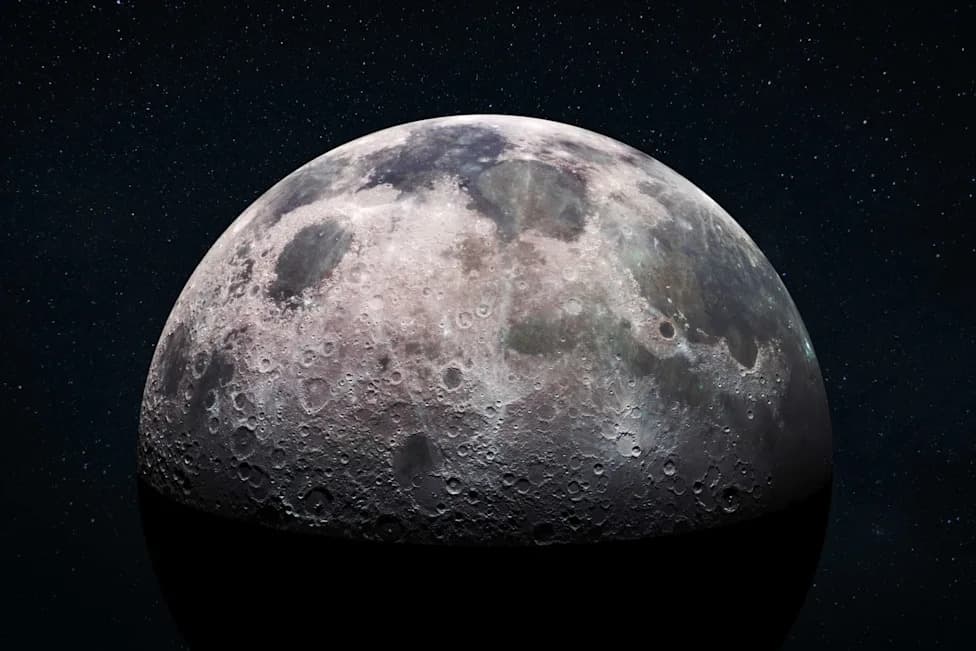
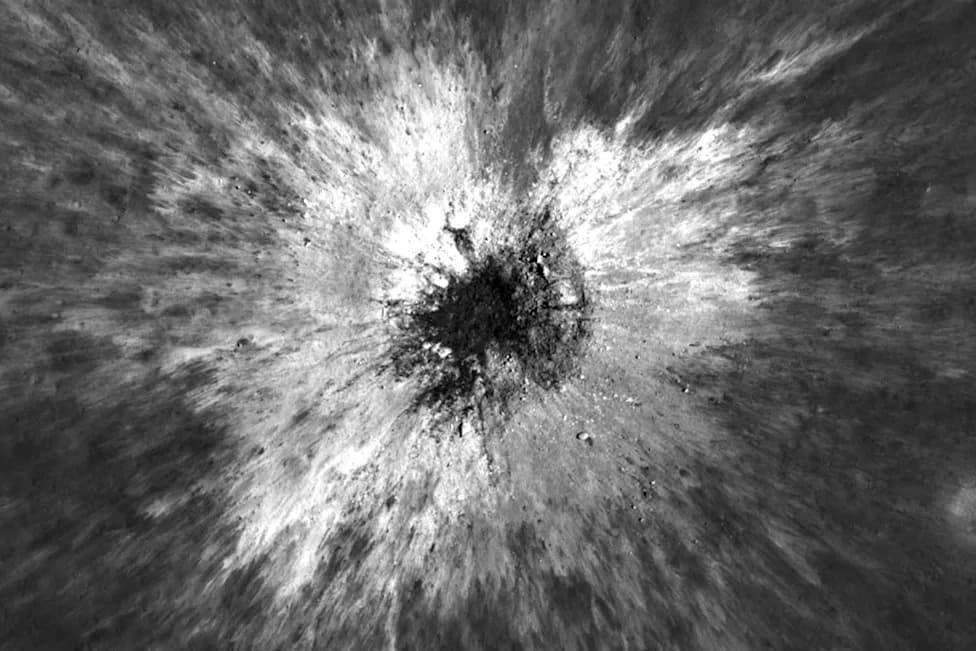
A spent Falcon 9 upper stage — roughly five stories tall and weighing several tonnes — is predicted to impact the Moon near Einstein crater on Aug. 5, 2026, around 06:35–06:44 UTC (2:35–2:44 a.m. ET). Tracked by Bill Gray with Project Pluto, it will strike at roughly 5,400 mph (≈2.4 km/s), producing an ejecta plume and a new crater. Professional observatories may detect the brief flash or ejecta, but the event will be faint against sunlit terrain and unseen by backyard telescopes or the naked eye. Scientists say there is no threat to Earth, but the impact underscores rising concerns about cislunar debris.
Spent Falcon 9 Upper Stage To Impact the Moon at ~5,400 MPH on Aug. 5, 2026 — What to Expect
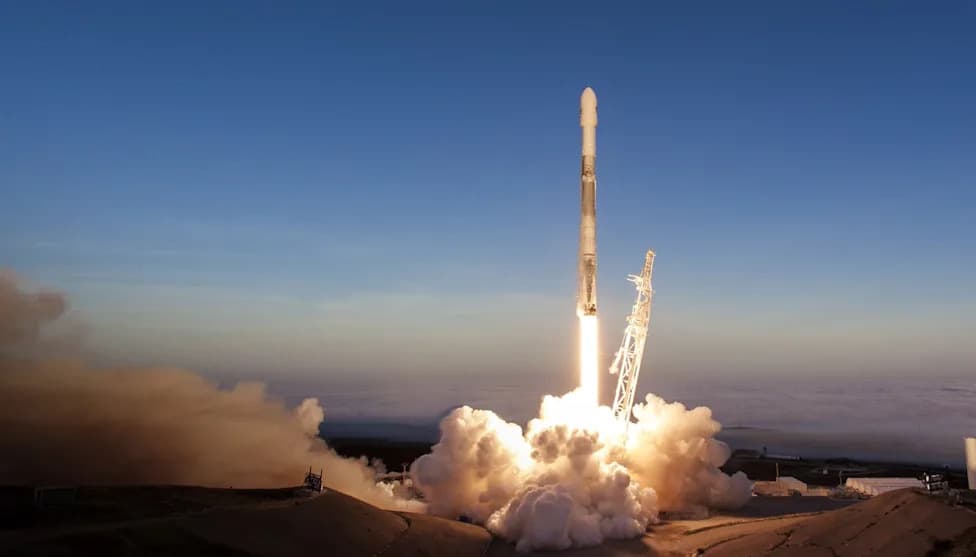
Image: SpaceX
A five‑story section of a spent SpaceX Falcon 9 upper stage that has been tumbling in cislunar space for more than a year is scheduled to strike the lunar surface on Aug. 5, 2026. Independent astronomer Bill Gray, using his Project Pluto orbital‑tracking software, places the impact window at roughly 06:35–06:44 UTC (2:35–2:44 a.m. ET). The object is estimated to weigh several tonnes and will hit near the Einstein crater on the Moon's near side.
Impact Details
Estimated impact speed is about 5,400 mph (≈2.4 km/s), roughly seven times the speed of sound. The strike point is near latitude 19°N, longitude 267°E, close to the Moon's eastern limb on sunlit terrain. With no atmosphere to slow it, the upper stage will produce a high‑energy impact, ejecta plume, and a fresh crater.
How It Got There
The stage completed its primary mission in January 2025 when it helped launch Firefly Aerospace's Blue Ghost Mission 2 toward the Moon, then remained in a chaotic, roughly 26‑day elliptical Earth orbit. Lacking propellant to adjust its trajectory and without the velocity to escape, gravitational interactions with Earth, the Moon and the Sun — aided by subtle solar radiation pressure — gradually steered it onto a lunar collision course over the next 18 months.
'We now have another upper stage due to hit the Moon, this one on Aug. 5 and (just barely) on the near side of the Moon,' Bill Gray noted in published orbital solutions.
Scientific Opportunity
Planetary scientists treat the unintentional strike as an unplanned experiment. The resulting ejecta and crater will provide data on the Moon's subsurface layers and crater‑formation mechanics, similar to scientific returns from NASA's LCROSS impact and the 2022 impact later attributed to China's Chang'e 5‑T1 stage. Researchers are coordinating observation campaigns with professional telescopes and spacecraft instruments to capture the event and its aftermath.
Visibility And Risk
The impact site lies on sunlit terrain near the eastern limb, which creates a bright background that will make any impact flash faint and brief. Professional observatories and high‑end imaging systems have a realistic chance of detecting an ejecta plume or brief flash; typical backyard telescopes almost certainly will not, and the event will be invisible to the naked eye. Scientists confirm there is no danger to Earth or to ongoing lunar operations.
Broader Context
As commercial lunar activity increases, more upper stages and hardware on high‑energy lunar trajectories may be left drifting in cislunar space. Uncontrolled impacts highlight the growing need to track and, where possible, mitigate debris. This Aug. 5 impact serves as both a scientific opportunity and a reminder of that policy and engineering challenge.
Observation Tip: If you represent a professional observatory or are part of a coordinated campaign, point high‑sensitivity instruments and fast‑cadence imagers at the predicted coordinates in the impact window; prioritize wide spectral coverage to catch any brief flash and follow the expected ejecta evolution.
Help us improve.