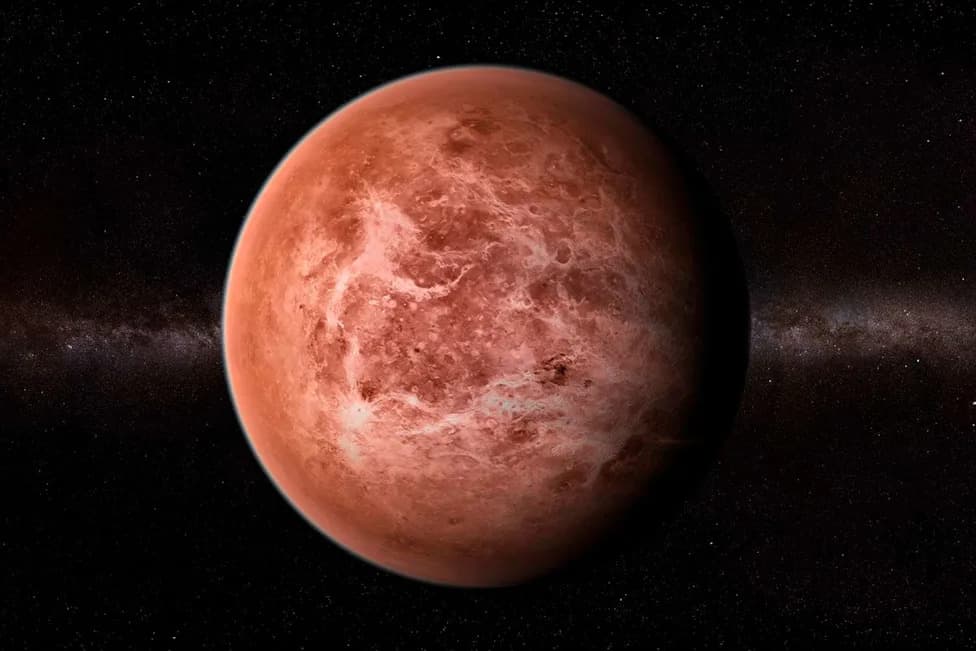
The 2010 ExPo polarimeter captured large, concentric rings in Venus's atmosphere visible only in linearly polarized light during a single 36‑minute observation. Extensive checks found no convincing instrumental cause, and radiative‑transfer simulations show that 5–10% density variations from atmospheric gravity waves could reproduce the pattern. The result is unconfirmed and based on one dataset, so the authors published their findings to prompt new polarimetric observations that could test whether these rings reveal planet‑scale atmospheric dynamics linked to Venus's superrotation.
Mysterious Concentric Polarization Rings Spotted in Venus’s Atmosphere — A Single 36‑Minute Glimpse That Could Reveal Planet‑Scale Waves
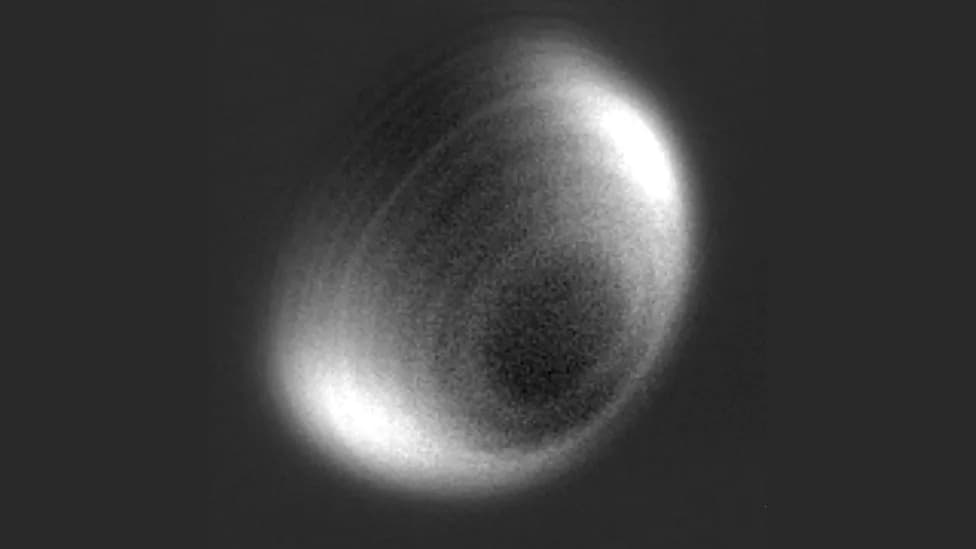
Vast, planet-scale concentric rings of polarization in the atmosphere of Venus. (Mahapatra et al., Planet. Sci. J., 2026)
During a brief, opportunistic 36‑minute observation in 2010, astronomers recorded an atmospheric phenomenon around Venus that had never been seen before: vast, concentric rings visible only in linearly polarized light. The signal — captured with an experimental polarimeter and surviving extensive checks for instrumental error — has prompted researchers to publish their findings and urge independent confirmation.
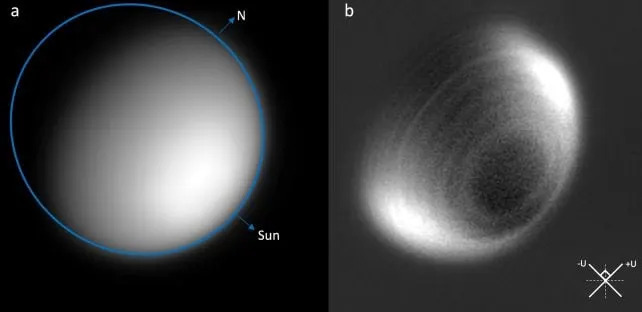
The total light reflecting off Venus (left) compared with only the polarized light (right). (Mahapatra et al.,Planet. Sci. J., 2026)
How the Signal Was Seen
The data were taken with the Extreme Polarimeter (ExPo), an instrument developed by Michiel Rodenhuis while he was a PhD student at the Utrecht Astronomical Institute and installed on the William Herschel Telescope on La Palma. ExPo measures linearly polarized light while suppressing unpolarized light, revealing subtle scattering signatures that ordinary cameras miss. On an unusually clear evening, Rodenhuis diverted ExPo to Venus and recorded 36 minutes of polarized‑light data before the instrument was later dismantled.
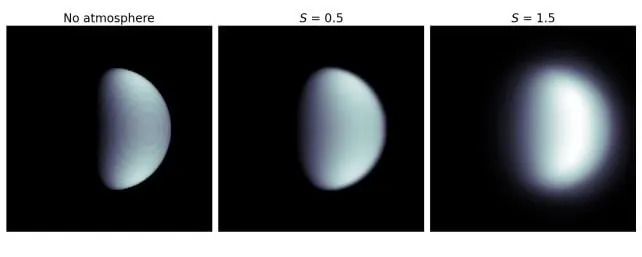
Rings appeared in the radiative transfer simulations (left), but they become blurred (right panels) as the light passes through Earth's atmosphere. (Mahapatra et al.,Planet. Sci. J., 2026)
What the Team Found
Months after the observation, researchers noticed broad concentric rings encircling much of Venus's dayside in polarization maps — features absent in the planet's total reflected light. Because polarization arises when sunlight scatters from gas and particulates, the rings appeared to be an atmospheric signature rather than a simple brightness effect.
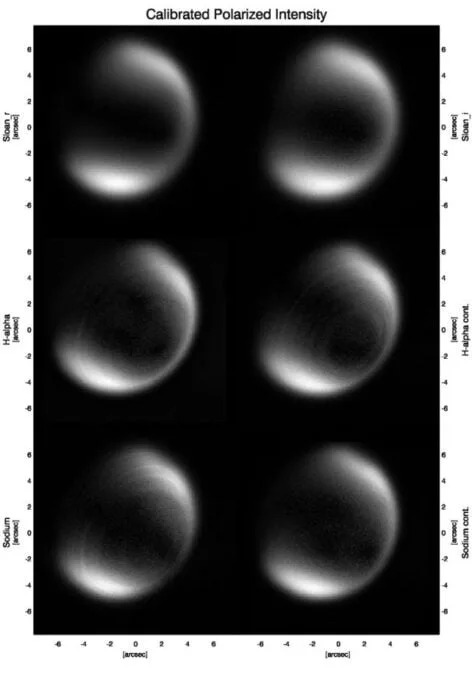
The polarized light observed through six different filters. (Mahapatra et al.,Planet. Sci. J., 2026)
"It is quite frustrating to have potentially unique observations that cannot be confirmed," said atmospheric physicist Gourav Mahapatra of Delft University, lead author of the study. "We decided to publish the data, clearly explain its limitations, and let the wider community test the interpretation."
Instrumental Checks and Modeling
The team spent years searching for instrumental artifacts — digitization effects, electronic smearing, or processing errors — but the pattern persisted through reprocessing and hardware tests. By the time Mahapatra joined the project, Daphne Stam had proposed that atmospheric density structures might explain the rings, and Japan's Akatsuki spacecraft had independently observed a pole‑to‑pole atmospheric wave on Venus, demonstrating that planetary‑scale waves can exist there.
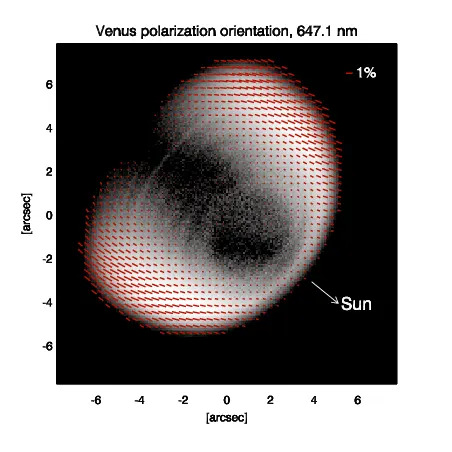
The direction and degree of polarization, indicated by the orientation and length of the red lines. (Mahapatra et al.,Planet. Sci. J., 2026)
Using radiative‑transfer and atmospheric simulations, Mahapatra and colleagues tested whether modest density fluctuations in Venus's upper atmosphere — such as those produced by atmospheric gravity waves — could produce the observed polarization pattern. They found that realistic density variations of about 5–10% can create concentric polarization rings resembling the ExPo data, after accounting for blurring by Earth's atmosphere.

Subscribe to ScienceAlert's free fact-checked newsletter
Interpretation and Scientific Importance
The rings are not the waves themselves but the polarization signature imprinted by small density changes as sunlight scatters through Venus's thick, sulfuric‑acid cloud layers. If confirmed, these rings would provide evidence that coherent, planet‑scale density structures can form in Venus's upper atmosphere and might play a role in transporting energy and momentum — processes thought to help sustain Venus's long‑standing atmospheric mystery: superrotation, where the upper atmosphere circles the planet far faster than the solid body rotates.
Limits and Next Steps
The authors emphasize the result rests on a single, unreplicated dataset, so it cannot yet be treated as definitive proof. ExPo no longer exists in its original form, but the detection shows such measurements are feasible. The researchers urge observers to target Venus with modern polarimeters — including newer instruments on Earth‑based telescopes and experimental devices — especially during local post‑noon conditions that modeling suggests may favor the formation of the density structures.
Mahapatra and coauthors published their work in The Planetary Science Journal (2026) to encourage independent observations. Confirming or refuting the rings will clarify whether this signal offers a new remote method to study Venusian atmospheric dynamics or remains an intriguing anomaly.
Reference: Mahapatra et al., The Planetary Science Journal, 2026.
Help us improve.