Pakistan-administered Kashmir (AJK) has experienced sustained unrest since June as protests led by the banned JAAC expanded from economic demands to include abolition of 12 assembly seats reserved for refugees from Indian-administered Kashmir. The AJK Supreme Court ruled those seats can only be removed by constitutional amendment, and JAAC has urged an election boycott as the region votes on staggered dates in late July and early August. The dispute raises broader questions about who represents AJK, the role of Islamabad, and the limits of local autonomy.
The 12 Seats That Could Decide Pakistan-Administered Kashmir’s Election
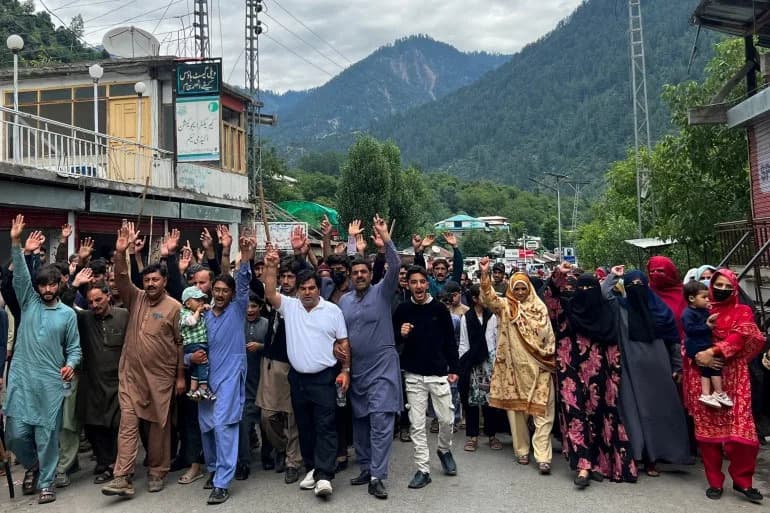
People chant slogans as they walk during a protest and shutter-down strike called by the banned Joint Awami Action Committee (JAAC), an alliance of civil society groups, in Neelum Valley, Pakistan-administered Kashmir, June 21, 2026 [Naseer ud Din/Reuters]
Islamabad — Pakistan-administered Kashmir, officially Azad Jammu and Kashmir (AJK), has been under heightened emergency-like conditions since early June as mass protests and confrontations with security forces escalate ahead of a staggered legislative election.
Background
Since June, nearly 40 people have died in clashes between protesters and security forces. Sit-ins, road blockades and shutter-down strikes have become routine, banks were closed for two weeks and mobile and internet services remain suspended across much of AJK. Poonch division, which borders India and has been the epicentre of the unrest, was effectively sealed for weeks, disrupting supplies of flour and other essentials to communities that depend on them.
The Movement And Its Central Demand
The banned Jammu Kashmir Joint Awami Action Committee (JAAC) spearheads the protests. Having begun with economic grievances — subsidised flour, cheaper electricity and a fairer share of hydropower revenues — JAAC expanded its demands to a 38-point charter that now includes the abolition of 12 assembly seats reserved for refugees from Indian-administered Kashmir. JAAC leaders have been arrested, gone underground or continue to organise from sit-in camps in Rawalakot. The group has urged supporters to boycott the election.
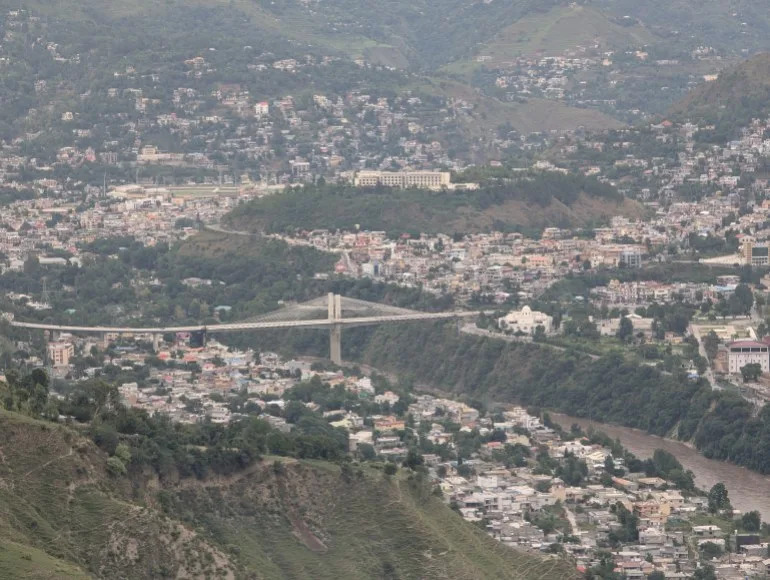
A view of Muzaffarabad, the capital of Pakistan-administered Kashmir, on July 15, 2026. The unrest in the city follows the recent banning of the Jammu Kashmir Joint Awami Action Committee (JAAC), with authorities maintaining heightened security and restrictions on internet and phone services across the region [Amiruddin Mughal/EPA]
The Refugee Seats: History And Mechanics
Of the AJK Legislative Assembly’s 45 elected seats, 33 represent constituencies within AJK; the remaining 12 are reserved for refugees from Indian-administered Kashmir who now live across Pakistan (cities such as Lahore, Rawalpindi and Sialkot). The arrangement dates back to rules introduced in 1960, reinforced by laws in 1964 and 1970, incorporated in AJK’s 1974 Interim Constitution and reaffirmed by the constitution’s 13th Amendment in 2018. Chaudhry Muhammad Ibrahim Zia, a former chief justice of the AJK Supreme Court, says the seats have "both historical grounding and constitutional support."
Legal And Political Dispute
JAAC argues the refugee seats are outside AJK’s territorial jurisdiction and should be abolished. The AJK Supreme Court and constitutional experts counter that the seats can only be removed through a formal constitutional amendment — "a solemn constitutional act," the court said, not a concession made under duress. With the outgoing assembly’s term ended, judges and jurists note that no amendment process can begin until a new legislature is elected.
Competing Proposals And Reactions
In May, JAAC offered two alternatives: preserve symbolic refugee representation until a final settlement of the Kashmir dispute, or convert the 12 assembly seats into four seats on the Islamabad-chaired AJK Council. Both proposals were rejected at an All-Parties Conference on June 3. AJK leaders and some former officials say the refugee representatives are neither an unaccountable bloc nor a primary driver of budgetary decisions; critics, including some analysts, argue the seats enable Pakistan-based parties and institutions to influence AJK politics.
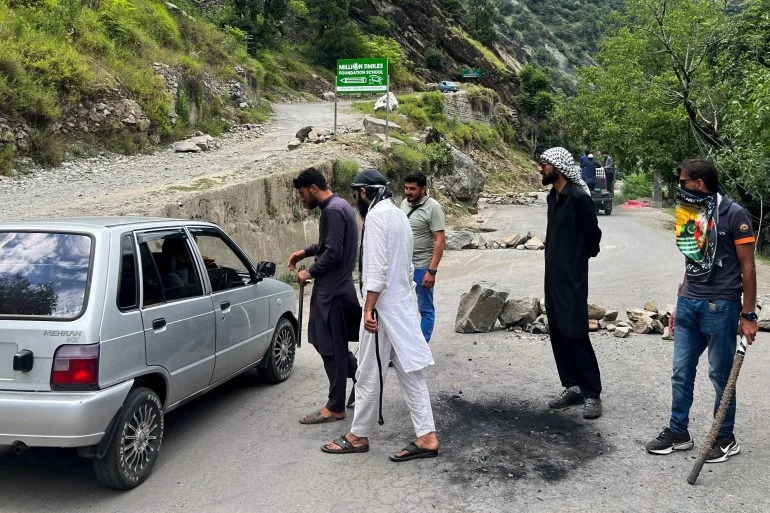
People approach a vehicle at a makeshift checkpoint during a protest and shutter-down strike called by the banned Joint Awami Action Committee (JAAC), an alliance of civil society groups, in Neelum Valley, Pakistani Kashmir, on June 21, 2026 [Naseer ud Din/Reuters]
Election Timeline And Stakes
The 45-seat assembly election was split across three dates: Mirpur division voted on July 27, Muzaffarabad division and the 12 refugee seats vote on August 2, and Poonch — the flashpoint for unrest — is scheduled for August 10. AJK’s electorate has grown from about 3.2 million in 2021 to more than 3.8 million in 2026; the 12 refugee constituencies account for roughly 439,000 registered voters. AJK’s budget last year was about 310 billion rupees (roughly $1.1 billion), a fact cited by some officials to downplay claims that the refugee seats wield disproportionate fiscal power.
Perspectives
"These seats simply cannot be abolished without a proper constitutional process,"
said Chaudhry Zia, emphasising legal constraints. Abdul Majid Khan, a former finance minister from a refugee family, defended the historical basis of refugee representation and argued the seats do not translate into outsized control over AJK resources. Analysts such as Ershad Mahmud say the crisis highlights wider constraints on AJK’s elected leadership and the influence of Pakistan’s federal bureaucracy, military and intelligence agencies. Historian Anam Zakaria warns of a constitutional contradiction: candidates in AJK must pledge allegiance to accession to Pakistan, which she says complicates claims of self-determination.
International Context
The controversy over the refugee seats is embedded in the longer Kashmir dispute. A 1949 UN commission recommended a plebiscite to decide Kashmir’s final status — a plebiscite that has never taken place. Some analysts believe the refugee seats allow Pakistan to preserve a claim that AJK represents the entire former princely state, while also retaining political levers through Pakistan-based parties.
What To Watch For
- Voter turnout in the refugee constituencies and Poonch division, where tensions are highest.
- Whether JAAC’s boycott affects overall turnout and the election’s perceived legitimacy.
- Post-election momentum for constitutional reform — and whether any new assembly will consider an amendment to change the refugee seats.
As AJK votes in a tense and closely watched contest, the fate of 12 seats — and the wider questions they represent about representation, autonomy and federal influence — will remain central to both local politics and Pakistan’s broader Kashmir policy.
Help us improve.