New Rutgers-led simulations indicate liquid water ascending Europa’s ice shell would cool rapidly, form frazil ice crystals, and likely clog narrow fractures before reaching shallow reservoirs. Turbulent flows (≈5–20 m/s) accelerate heat loss; a 0.1 m dyke can freeze shut in 2–6 hours, and frazil growth seeded by thin wall-ice layers (0.13–19 µm) can convert ~1%–3% of the water to ice. The results imply near-surface water is more likely produced locally than supplied directly from the global ocean—an important caveat for Europa Clipper and JUICE observations.
New Simulations Suggest Europa’s Ice May Block Deep Ocean Water From Reaching The Surface
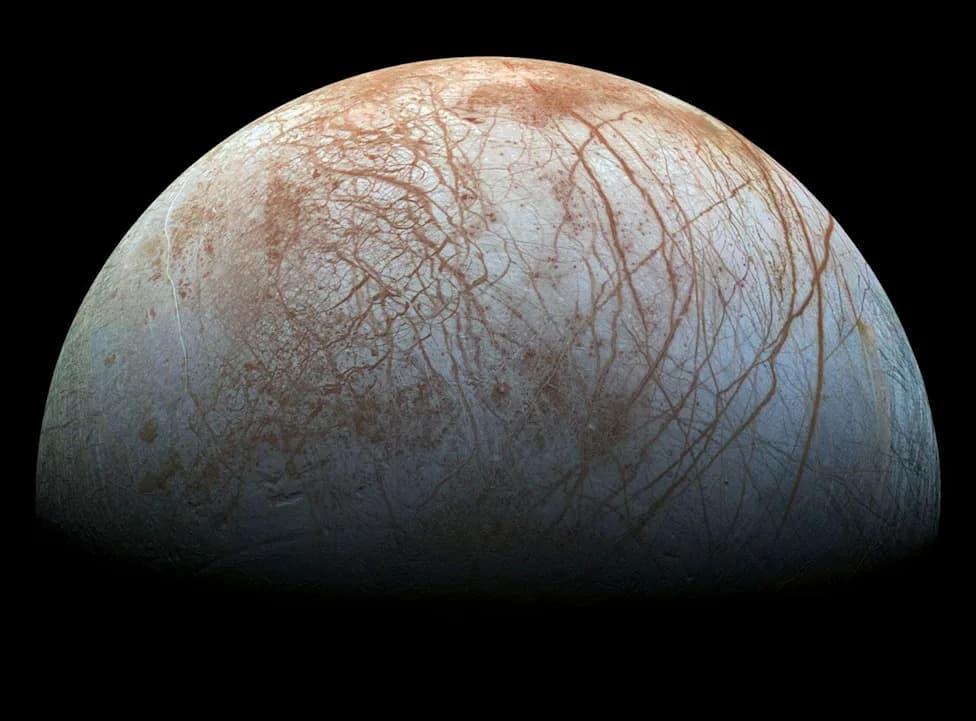
Europa ocean water transport may stall as turbulence forms ice crystals that clog fractures beneath the moon's surface. (CREDIT: NASA/JPL-Caltech/SETI Institute)
New simulations led by Rutgers University and published in Nature Astronomy suggest that liquid water attempting to rise from Europa’s global ocean through narrow fractures in the ice shell would likely cool, crystallize, and clog its passage before reaching shallow reservoirs.
Study Overview
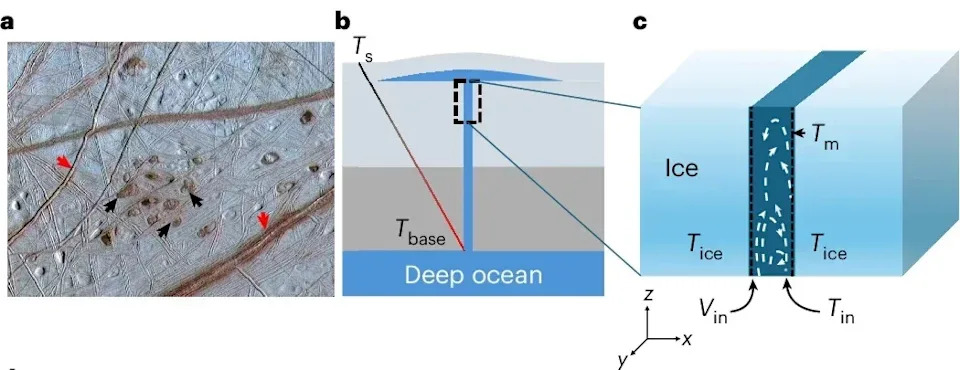
Europa's surface features and conceptual model schematics. (CREDIT: Lujendra Ojha et al, Nature Astronomy)
The team, led by Associate Professor Lujendra Ojha (Rutgers Department of Earth and Planetary Sciences), used COMSOL Multiphysics models that couple fluid flow and heat transfer to examine how both pure and salty water behave as they ascend through fractures (dykes) in Europa’s upper ice shell. The simulations focused on the cold, near-surface region—about the top 1–2 kilometers—where background ice temperatures may range roughly from 140 to 200 K (≈ −208 to −100 °F).
Key Findings
Unlike earlier models that assumed smooth, laminar flow, the new analysis indicates ascent would likely be turbulent, with speeds on the order of 5–20 m/s. Turbulent motion presses warmer fluid against freezing walls and drives rapid heat loss into surrounding ice, cooling the ascending water and promoting ice formation.
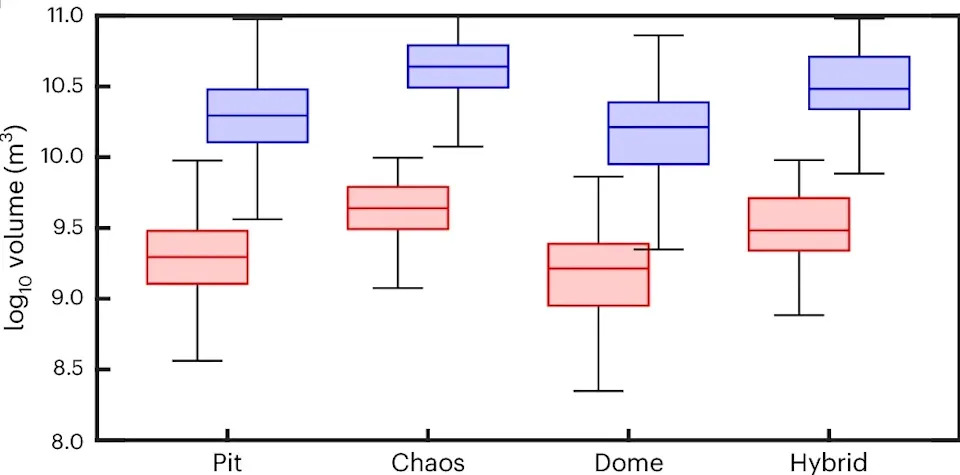
Box plot showing the estimated volume of liquid water (log10 m3) required to account for the formation of various surface features on Europa. The red boxes represent estimates assuming elastic support of the overlying ice shell, whereas the blue boxes correspond to estimates under near-isostatic compensation conditions. (CREDIT: Lujendra Ojha et al, Nature Astronomy)
Even without turbulence, very narrow fractures close quickly. The models show a 0.1 m–wide dyke could freeze shut in about 2–6 hours. Under favorable conditions, delivering 1 billion cubic meters of water would require a single crack roughly 77 km long; in colder scenarios the required length exceeds 200 km. A realistic 1 km–long fracture would therefore need hundreds of parallel dykes to transport comparable volumes.
As water cools while rising it can become supercooled—remaining liquid below its normal freezing point—and turbulent flow favors the formation of frazil ice: tiny, needle-like crystals that nucleate in moving water. The simulations indicate a 1 km section of ascent typically cools water by ~1–2 K (longer ascents permit more cooling). If seed crystals are present—potentially supplied by tiny fragments from fracture walls—a thin wall-ice layer (roughly 0.13–19 µm) can trigger rapid frazil growth.
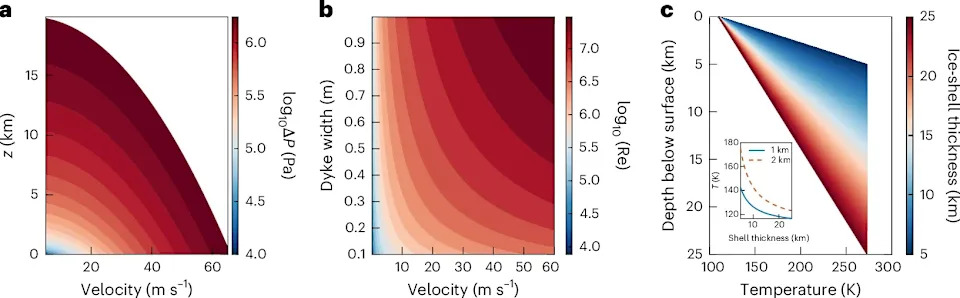
Dynamical and thermal constraints on ascent of liquid water on Europa's dykes. (CREDIT: Lujendra Ojha et al, Nature Astronomy)
Frazil crystals can collide and agglomerate into a slushy mixture. Modeled cooling could convert ~1%–3% of rising water into frazil ice; if only 1%–5% of crystals adhere to the fracture walls, a one-meter-wide conduit can clog within hours.
Implications
These results do not rule out liquid water near Europa’s surface, but they change the most likely origin story for such reservoirs. Rather than representing direct upwelling from the deep ocean, shallow pockets may be produced locally—by in-place melting due to focused tidal heating, frictional heating along sealed fractures, or other heat sources inside the ice shell. That distinction matters: near-surface water could have very different chemistry from the global ocean and therefore may be a less direct probe of Europa’s habitability.
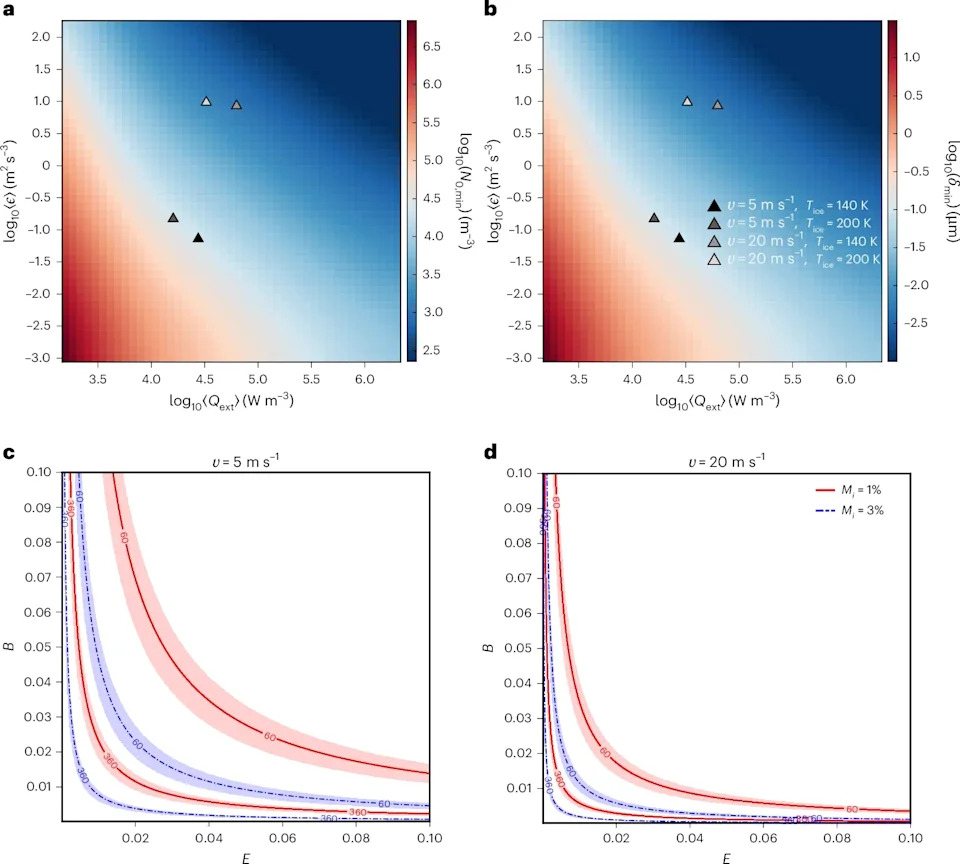
Seed ice requirement for runaway frazil ice growth and implications for hydraulic clogging in turbulent Europan dykes. (CREDIT: Lujendra Ojha et al, Nature Astronomy)
Relevance to Missions
Nasa’s Europa Clipper (launched Oct 2024; arriving ~Apr 2030) and ESA’s JUICE (launched Apr 2023; arriving ~Jul 2031) can test these ideas. Radar and other instruments may detect shallow reservoirs, frozen fractures, or groups of parallel dykes, helping determine whether water pathways ever connected deep layers to the surface. The new findings caution that detecting shallow liquid does not automatically mean a spacecraft has sampled material from the global ocean.
What’s Next
Future measurements of ice structure, ocean conductivity, salt content, fracture geometry, and tidal heating patterns could refine these freezing models and identify any realistic conditions that allow water to ascend farther. For now, investigators conclude Europa’s ice shell is likely a more effective barrier between the ocean and surface than previously assumed—complicating the search for life but sharpening the questions future missions must answer.
“There’s an icy shell, there’s water underneath, and there’s all this speculation about how that water can come from deep underground and make its way all the way up without freezing en route. That’s really what we think we disproved.” — Lujendra Ojha, Rutgers University
Research findings are available in Nature Astronomy.
Help us improve.