NASA's Psyche spacecraft performed a close flyby of Mars on May 15, passing about 4,600 km above the surface and recording a vivid timelapse of the planet as a thin crescent. The encounter calibrated instruments, imaged Mars' bow shock, the 700 km south polar cap and Huygens crater, and delivered a gravity assist that added ~1,000 mph and tilted the orbital plane by ~1°. Launched in 2023 on a SpaceX Falcon Heavy, Psyche is bound for asteroid 16 Psyche, arriving in August 2029 with a suite of imagers, spectrometers, a magnetometer, and an optical communications demo.
NASA's Psyche Skims 2,800 Miles Above Mars, Captures Hypnotic Timelapse — En Route to a Metal Asteroid
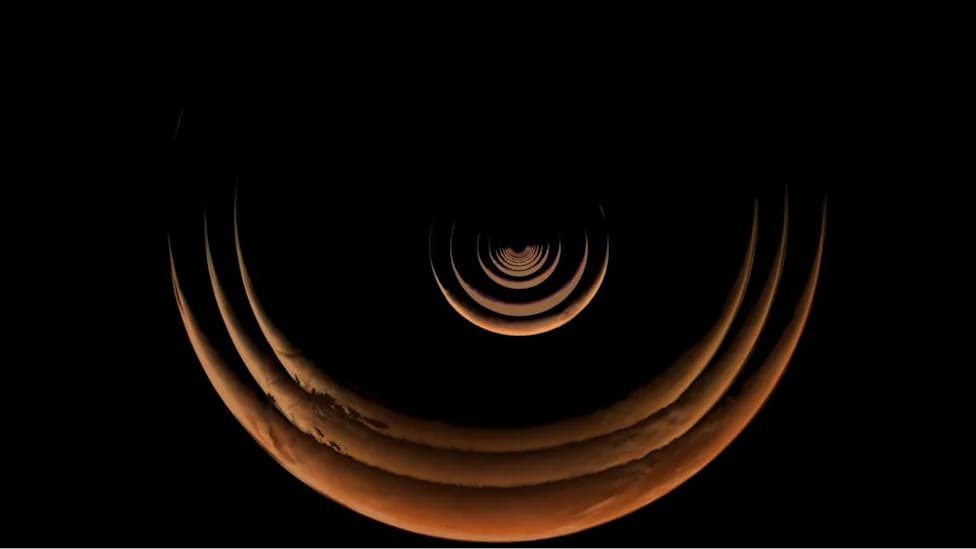
A psychedelic composite image of Mars, showing what the Psyche mission saw as it approached the red planet from 2 May to 15 May 2026. (NASA/JPL-Caltech/ASU)
The Psyche spacecraft, on a mission to investigate a metal-rich world, executed a close flyby of Mars on May 15 and returned a striking timelapse of the Red Planet as a thin, nighttime crescent. The encounter served both as a visual feast and a mission-critical rehearsal on the way to rendezvousing with the asteroid 16 Psyche in 2029.

YouTube Thumbnail
Flyby Highlights
During the May 15 flyby, Psyche passed roughly 4,600 km (about 2,800 miles) above Mars while traveling at more than 19,848 km/h (~12,000 mph). The spacecraft captured a hypnotic timelapse and natural-color imagery showing Mars' nightside crescent, the double-ringed Huygens crater, and the water-ice-rich south polar cap (about 700 km across).
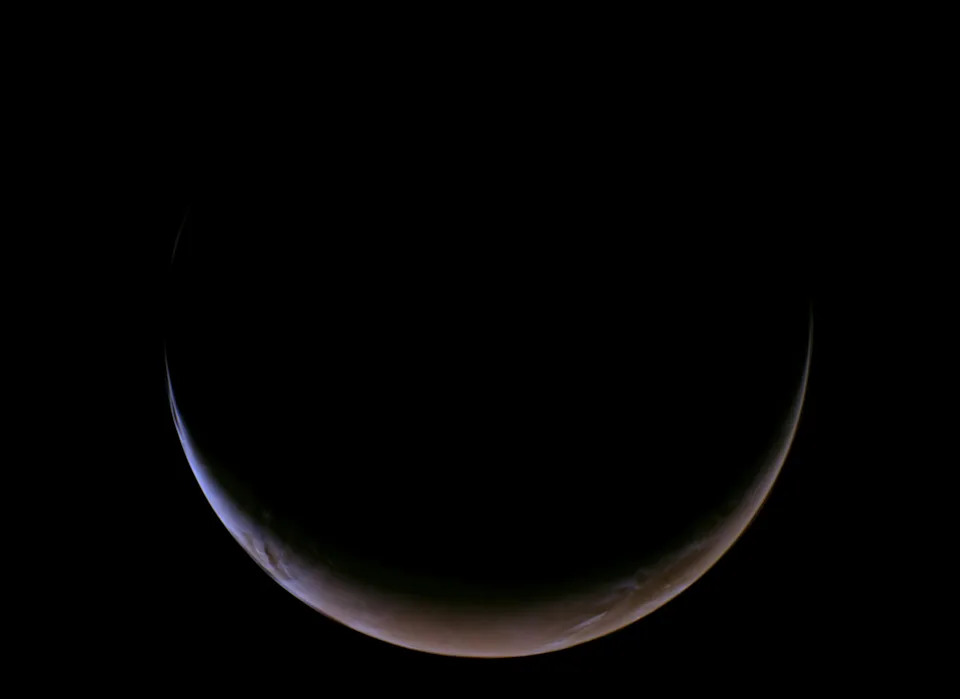
Crescent Mars, captured on 15 May 2026, processed into a natural-color image utilizing red, green, and blue data from the Psyche spacecraft's multispectral imager.(NASA/JPL-Caltech/ASU)
Instrument Calibration and Science: The close pass acted as a dress rehearsal for Psyche’s science payload, allowing teams to further calibrate the multispectral imager, magnetometer, and gamma-ray and neutron spectrometer. The data improved observations of Mars’ bow shock — the region where the solar wind is diverted around the planet — and validated instrument performance ahead of the asteroid encounter.
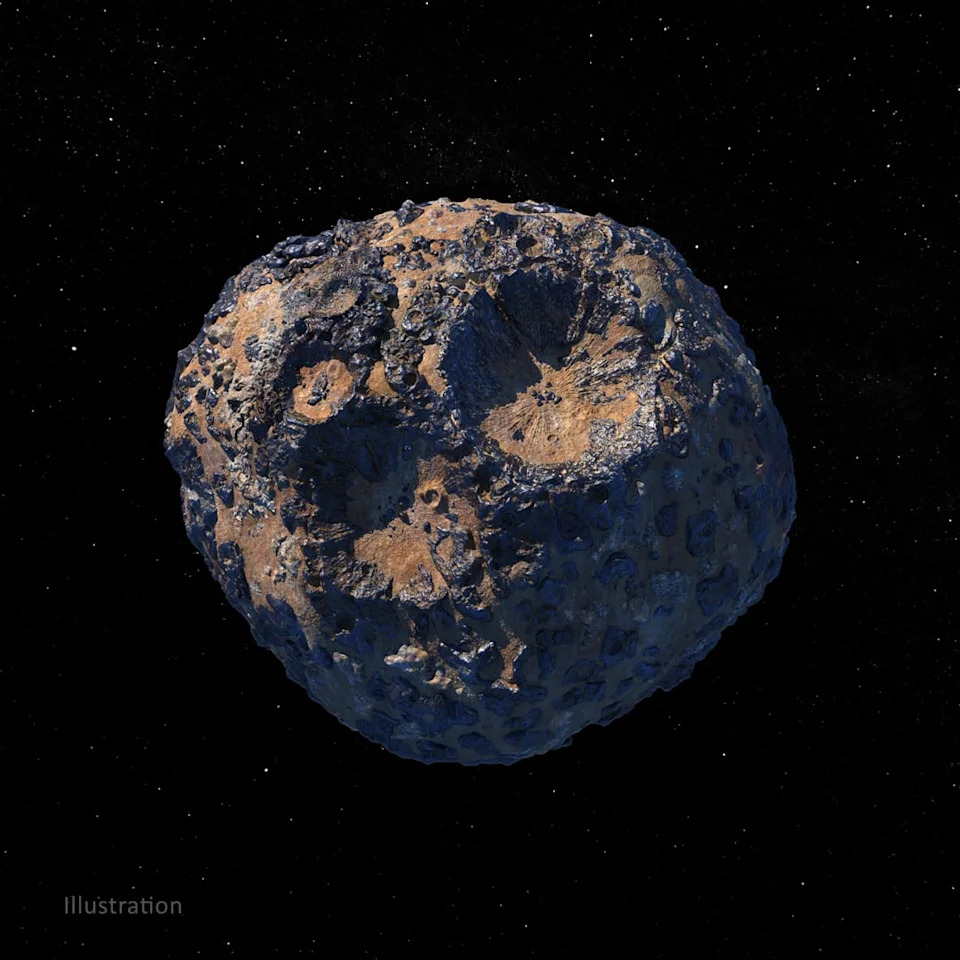
An illustration of the 16th asteroid to be discovered, named Psyche, or 16 Psyche, though its true visual appearance is still unknown.(NASA/JPL-Caltech/ASU)
Gravity Assist: Psyche used Mars as a gravity assist, gaining roughly 1,000 mph and shifting its orbital plane by about 1° relative to the Sun. That velocity boost was achieved without burning xenon propellant: the spacecraft effectively borrowed a minute amount of Mars’ orbital energy to increase its heliocentric speed and set a trajectory aimed at an August 2029 rendezvous with 16 Psyche.
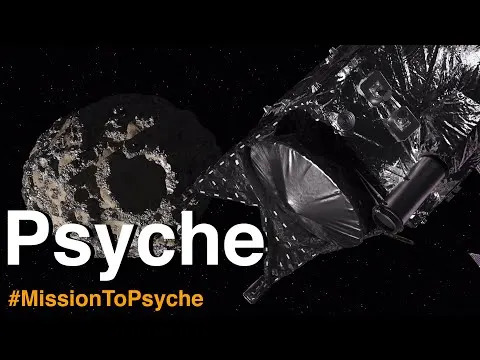
YouTube Thumbnail
About the Target — 16 Psyche
Named after the Greek goddess of the soul and discovered in 1852, 16 Psyche is an unusually large asteroid located in the main belt between Mars and Jupiter. At roughly 280 km (170 miles) across its longest dimension — comparable in size to the U.S. state of Massachusetts — Psyche may represent an exposed metallic core of an early planetesimal or, alternatively, a porous rubble pile. Determining which scenario is correct is a central goal of the mission.

Tater the cat, streamed from nearly 19 million miles away, at up to 1.8 Mbps.(NASA/JPL-Caltech)
Spacecraft And Instruments
- Spacecraft: Launched in 2023 on a SpaceX Falcon Heavy, Psyche is solar-powered and about the size of a singles tennis court.
- Payload: Multispectral imager, gamma-ray and neutron spectrometer, magnetometer, and an X-band radio system to help map gravity and interior structure.
- Communications Demo: The mission is testing a deep space optical communications (DSOC) experiment that uses near-infrared lasers to beam data home — including a widely publicized interplanetary video of a cat named Tater, streamed from nearly 19 million miles away at up to 1.8 Mbps.
Why This Matters
Studying 16 Psyche will give scientists a rare window into planetary formation and differentiation. If Psyche is an exposed iron core, it would offer a unique opportunity to examine the composition and magnetic history of a body more akin to a planetary core than a typical rocky or icy asteroid. If it is a rubble pile, that too would reshape expectations about asteroid formation and collisional history.

Subscribe to ScienceAlert's free fact-checked newsletter
“This gravity assist was years in the making, and the navigation team nailed it — Psyche flew by Mars on exactly the trajectory we needed,”
The spacecraft is reported to be in good health, with sustained thrusting using its solar-electric propulsion planned to resume this fall as it continues toward the main-belt asteroid. Onward to Psyche!
Help us improve.