The Attorney-General has asked Israel's High Court to void a law that suspends criminal enforcement against haredi yeshiva students who ignore military draft orders, calling it a discriminatory "group immunity" that removes penalties without replacing them with enlistment measures. The Knesset's legal advisers also said the final text differs fundamentally from the bill approved at first reading, alleging a defective legislative process. The court froze the law days after its passage; five petitions will be heard by a nine-justice panel that will weigh constitutional and procedural objections.
Attorney-General Asks High Court To Void Law Freezing Enforcement Against Haredi Draft Evaders

Attorney-General Gali Baharav-Miara attends a House committee meeting at the Knesset, the Israeli Parliament in Jerusalem on, June 8, 2026. (photo credit: YONATAN SINDEL/FLASH90)
The Attorney-General, Gali Baharav-Miara, has asked Israel's High Court of Justice to annul a law that suspends criminal enforcement against ultra-Orthodox (haredi) yeshiva students who fail to comply with military service orders, arguing the amendment preserves the duty to enlist while removing legal consequences for refusal.
Court Freezes Law; Nine-Justice Panel To Hear Petitions
The Knesset approved the measure on July 14. Justice Ofer Grosskopf froze its application on July 15 and ordered the state and the Knesset to explain why the law should not be struck down. Five petitions will be heard by an expanded nine-justice panel.
Main Legal Objections
In a written response, the Attorney-General's Office described the amendment as a discriminatory "group immunity mechanism" that shields a specific sector from arrest, investigation and prosecution while leaving other draft evaders subject to criminal enforcement. "The law has no legal future," the filing concluded.
The AG argues the amendment does not create lawful exemptions or deferments: draft orders remain valid, and the obligation to serve persists. Instead, qualifying students who declare they meet the law's Torah-study requirements would be insulated from arrest, investigation, prosecution and related enforcement measures — effectively removing penalties without replacing them with enlistment targets, incentives or alternative mechanisms to increase service participation.
Two Core Constitutional Concerns: The state says the amendment (1) widens the wartime burden on conscripts and reservists by shrinking the recruit pool, and (2) breaches equality before the law by treating identical conduct differently depending on group membership.
Knesset Legal Advisers Cite Procedural Defects
Separately, the Knesset's legal advisers declined to defend the legislative process that produced the law. They told the court the final text is fundamentally different from the bill approved at first reading and therefore was enacted through a defective procedure. The filing emphasized that the procedural flaws go "to the root" of the legislation.
The proposal began as a broad 2022 government bill intended to regulate haredi enlistment while balancing military service, Torah study and employment. Over more than 80 committee hearings, lawmakers considered enlistment targets, service alternatives, supervision and sanctions. The coalition later replaced that comprehensive framework with a narrow, time-limited measure that simply suspended criminal enforcement, a shift the Knesset lawyers say created a "new subject" that was never properly approved at first reading.

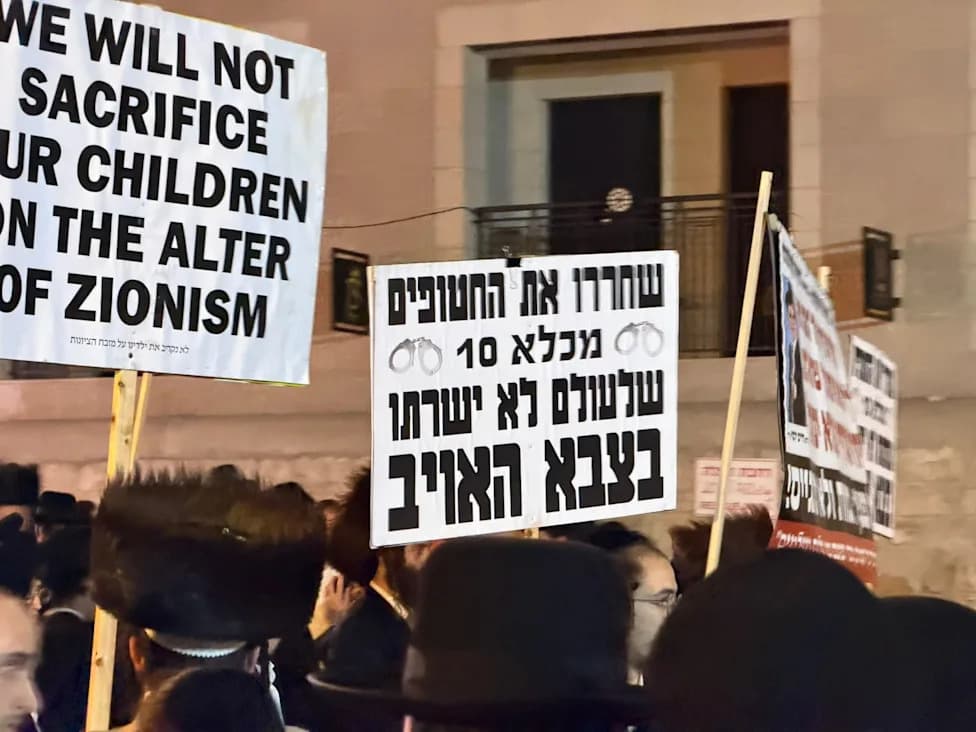
Haredi men are seen protesting the effort to draft ultra-Orthodox Israelis into the IDF. (credit: FLASH90)
Security And Military Viewpoints
The IDF and its leaders have warned that enforcement tools — including arrests, imprisonment and travel restrictions — are part of the military's ability to fill its ranks. IDF Chief of Staff Lt.-Gen. Eyal Zamir cautioned that granting protection from enforcement would create an incentive not to report, undermine recruitment efforts and risk a "deep rupture" with serving soldiers by damaging confidence in the system's fairness.
Military officials have argued enforcement must be paired with adapted service tracks and outreach. The IDF has expanded haredi service options, including the Hashmonaim Brigade, technology tracks and Border Police programs, but officials maintain these must be accompanied by some effective enforcement against persistent noncompliance.
Government Defense And Political Context
Supporters of the law said it was a temporary "tourniquet" meant to halt rising tensions with the haredi public and allow time for negotiated arrangements tailored to the community's needs. Proponents warned aggressive enforcement could radicalize parts of the haredi population and reverse modest gains in voluntary enlistment.
The Attorney-General acknowledged the need for adapted service tracks and outreach but argued that removing immediate consequences for noncompliance without a substitute policy undermines equality and the rule of law. She asked the court to keep the amendment frozen and ultimately declare it void.
Background And Prior Rulings
Previous haredi enlistment frameworks were struck down by the High Court for relying on voluntary cooperation and lacking meaningful sanctions. A 2017 framework was invalidated; after it expired in June 2023, the court in June 2024 unanimously ruled there was no legal basis for treating yeshiva students differently and ordered equal enforcement under the Security Service Law.
With both constitutional and procedural objections before the court, the upcoming hearings will test whether the law's goals and political context can justify its disparate treatment and whether the Knesset followed proper parliamentary procedure when it passed the enforcement freeze.
Help us improve.