New research led by Chris Kirkland suggests the Solar System’s repeated crossings of the Milky Way’s spiral arms may have triggered spikes in cometary bombardment that helped form Earth’s earliest continental fragments. The team compared hafnium and oxygen isotope records from zircon crystals in 11 Archean cratons with predicted spiral-arm passages and with terrestrial and lunar impact ages, finding recurring, broadly coincident pulses. The correlation is suggestive but not conclusive: Galactic reconstructions, stochastic comet delivery, and internal Earth processes leave significant uncertainties. Further tests could look for the same timing signals on the Moon and Mars.
Could The Milky Way Have Helped Forge Earth's First Continents?
(fotograzia/Moment/Getty Images)
At the dawn of the Solar System, Earth began as a soft, partially molten globe — a primordial "moosh" that slowly cooled and consolidated into the first fragments of continental crust. Most geologists explain continental emergence through processes inside Earth: mantle convection, crustal recycling, plumes and plate tectonics. A new study led by Chris Kirkland (Curtin University) proposes an additional, bolder influence: the Solar System's repeated crossings of the Milky Way's spiral arms may have increased cometary bombardment and helped seed early continental growth.
YouTube Thumbnail
A Galactic Trigger?
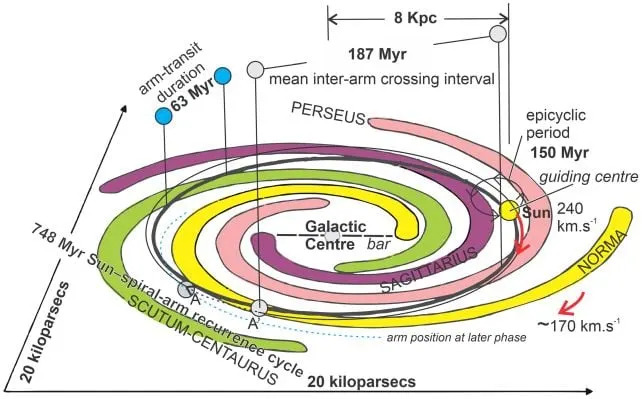
A diagram of the Sun's journey around the center of the Milky Way. (Kirkland et al.,Earth Planet. Sci. Lett., 2026)
The Solar System orbits the Galactic center roughly every 250 million years and passes through denser, star-forming spiral arms on timescales of ~150–200 million years. Those arms concentrate gas, dust and newborn stars — and their stronger gravitational environment could perturb distant reservoirs of icy bodies, notably the Oort Cloud, sending comets inward and briefly increasing impact rates on the inner planets.

YouTube Thumbnail
"Geology has perhaps drawn the boundary around the Earth system too tightly," Kirkland told ScienceAlert. "The real question is not whether Earth is connected to the wider galaxy, but whether those connections left a geological signal strong enough for us to detect."
Why Zircon Matters
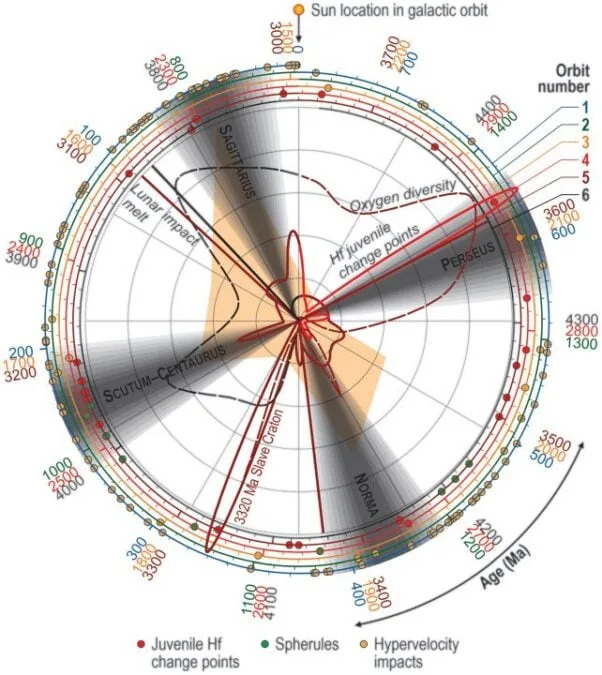
The team's hypothesis connects spiral-arm crossings with continental growth and ancient impacts. (Kirkland et al.,Earth Planet. Sci. Lett., 2026)
Much of Earth’s earliest crust has been erased by erosion and tectonics, but tiny zircon crystals survive in ancient rocks and preserve isotopic fingerprints. Hafnium isotopes in zircon can indicate episodes of new, juvenile crust formation; oxygen isotopes reveal involvement of surface-altered, weathered materials. Kirkland’s team compiled hafnium and oxygen isotope records from zircons across 11 widely separated Archean cratons and identified recurring, similar isotope shifts in multiple regions.

Subscribe to ScienceAlert's free fact-checked newsletter
Multiple Lines of Evidence
The researchers compared those zircon isotope patterns with predicted timings for spiral-arm crossings and with independently dated terrestrial and lunar impact ages. They found recurring episodes of crustal growth and bombardment that broadly align with spiral-arm passage predictions — a correlation the authors argue is consistent with a scenario in which arm crossings enhance comet delivery from the Oort Cloud and trigger impact-driven crustal stabilization.
"We cannot examine an individual zircon age peak and simply label it 'impact'," Kirkland noted. "Mantle overturns, plumes, subduction and collisions can all change zircon records. The difference here is a repeated, geographically widespread pattern that coincides with independent evidence of increased bombardment on Earth and the Moon."
Caveats And Next Steps
The team emphasizes that correlation does not prove causation. Reconstructing the Solar System’s path through the Milky Way billions of years ago carries large uncertainties; comet delivery from the Oort Cloud is stochastic; and many internal Earth processes can alter zircon signatures. Confirming the hypothesis would benefit from searching for the same timing signals in lunar and Martian mineral records and from improved Galactic orbital reconstructions.
The study, published in Earth and Planetary Science Letters (2026), raises a provocative possibility: that Earth's evolution was shaped not only by internal geodynamics but also by the Solar System’s changing environment in the Galaxy. Whether those galactic influences were strong enough to leave a clear geological record remains an open question.
Help us improve.