The Nebra Sky Disk is a thin bronze plate inlaid with gold moons, stars and curved motifs, discovered by looters near Nebra in 1999 and recovered in 2002. Scientific dating links the associated hoard to about 1600 B.C.E. and attributes the objects to the Únětice culture, while analyses suggest the disk itself may be slightly older and was produced in stages. Scholars read the star cluster as the Pleiades and debate the lower curve’s meaning—ranging from a sickle used for agricultural timing to an Egyptian-style solar barge—while metallurgical tests and experimental reconstruction indicate advanced Bronze Age metalworking. The disk continues to prompt debate about ancient astronomy, cultural contacts, and prehistoric craftsmanship.
The Nebra Sky Disk: Looters Dug Up a Bronze Plate That May Be Humanity’s Oldest Star Map
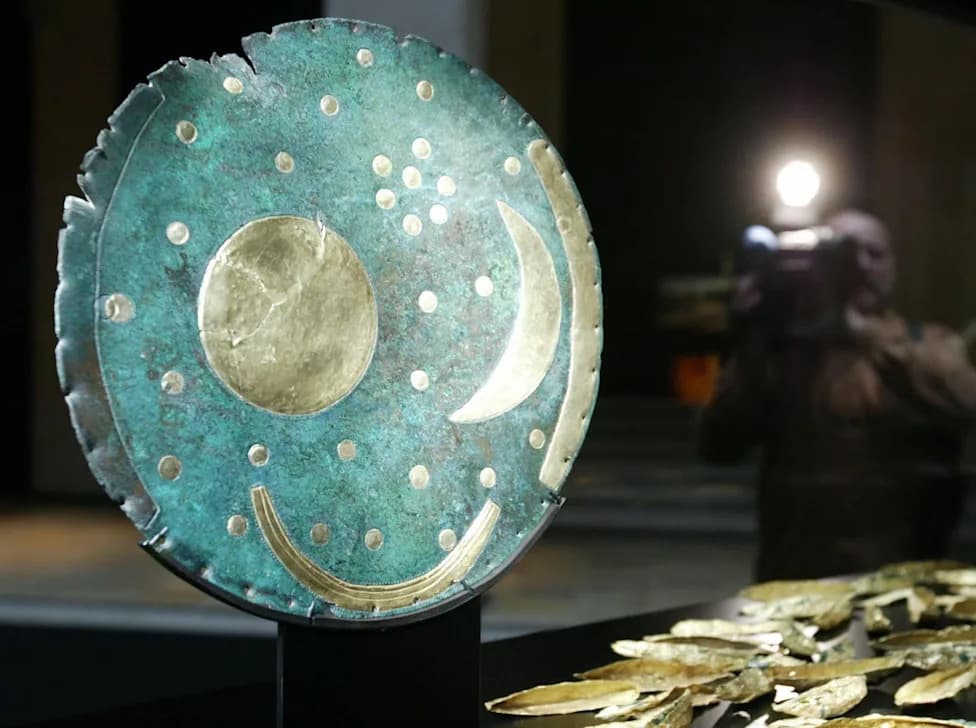
Is This the Oldest Map of the Cosmos?SEBASTIAN WILLNOW - Getty Images
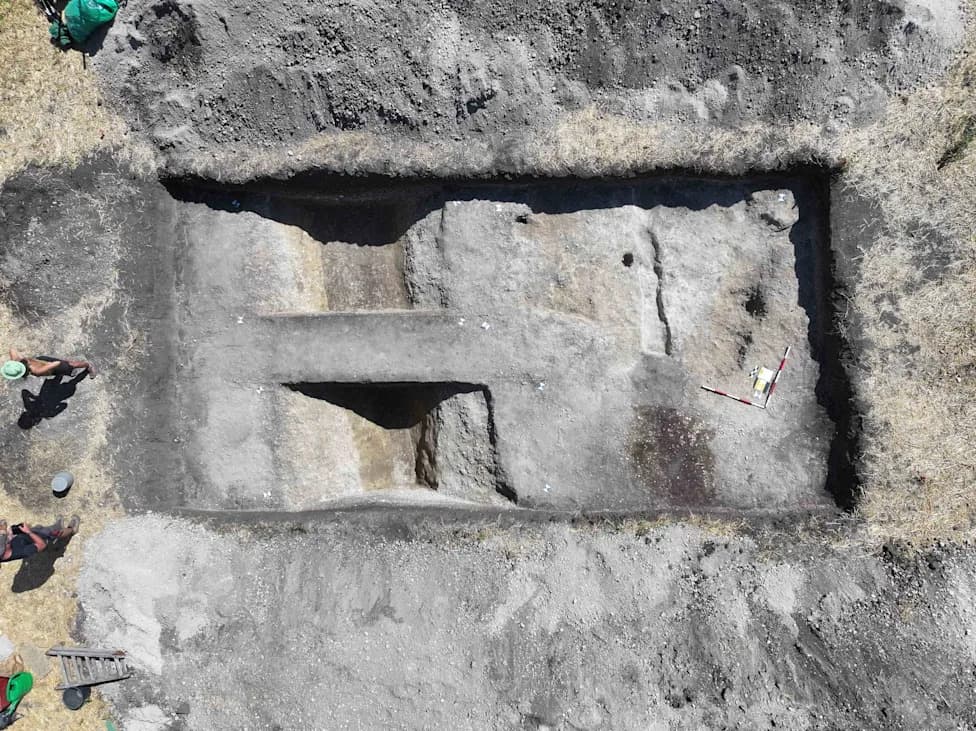
In 1999 two looters carrying a metal detector and a pickaxe slipped onto Mittelberg Hill near Nebra, Germany, and uncovered a bronze disk inlaid with gold moons and stars. At the time the findters had no sense of its importance; later study suggested the object could be the earliest known precision depiction of the heavens.
Origins, Recovery and Dating
The disk and associated objects were recovered after a police sting in 2002. Archaeologists retrieved swords, spiral bracelets, a chisel and flanged axes alongside the disk. Scientific analysis dates the hoard to roughly 1600 B.C.E., linking it to the Únětice culture of the Early Bronze Age in Central Europe. Researchers also argue the disk itself may have been manufactured a century or two earlier and then altered in distinct phases.
What the Disk Shows
Now widely known as the Nebra Sky Disk, the object is a thin bronze plate decorated with gold inlays that form a crescent moon, clustered stars and curved motifs along the rim. Archaeologist Harald Meller and colleagues described the disk in a 2024 Scientific Reports paper as "the oldest precise depiction of the heavens in human history." The disk is also listed on the UNESCO Memory of the World register.
Phases Of Manufacture And Interpretation
Detailed study suggests the disk was made in stages: the earliest phase placed a gold crescent and star cluster; later phases added gold arcs on the sides—interpreted by many as markers for the solstices—and a curved motif along the lower rim engraved with fine details. Scholars disagree about the lower curve's meaning: interpretations include a sickle used as an agricultural calendar marker, the Egyptian solar barge of Ra, or mythic vessels from northern tradition such as the ship associated with Freyr and Freyja.
Astronomical And Agricultural Significance
The pattern of stars is unlikely to be random. Many researchers read the clustered stars as the Pleiades (the "Seven Sisters"). The Pleiades have long served as seasonal markers: ancient farmers, including the Greek poet Hesiod, used their heliacal rising and setting to time sowing and harvesting. If the disk’s markings were used as a guide, it would represent an early, practical integration of astronomical observation and agricultural planning.
Metallurgy And Manufacture
Isotopic and geochemical analysis traces the disk’s copper to the Alps and its gold to Cornwall, England. Microstructural work and experimental reconstruction by Meller’s team, in collaboration with coppersmith Herbert Bauer, indicate the thin plate was most likely hammered from an existing sheet of bronze rather than cast from molten metal—an approach consistent with advanced Bronze Age metalworking techniques associated with the Únětice culture.
"The Nebra Sky Disk documents that Únětice craftsmen were excellent and innovative coppersmiths with extensive experience in sophisticated bronze manufacturing," Meller and colleagues note.
Scholarly Debate And Criticism
The disk’s authenticity and archaeological context have been challenged. Some researchers argued the burial context might date to the later Iron Age—about 1,000 years after the Bronze Age hoard—and proposed that the disk could have been reburied to appear older. Others suggested the green patina was artificially produced. These claims have been contested by the State Museum for Prehistory, by physical testing, and by provenance studies of the metals.
Why It Matters
Whether interpreted as the earliest star map, a ritual offering, or a syncretic object blending northern and Mediterranean symbolism, the Nebra Sky Disk remains a remarkable artifact. It sparks discussion about long-distance contacts in the Bronze Age, the spread of iconography (including possible Egyptian influences), early astronomical knowledge, and high-level metallurgical skill in prehistoric Europe.
Help us improve.