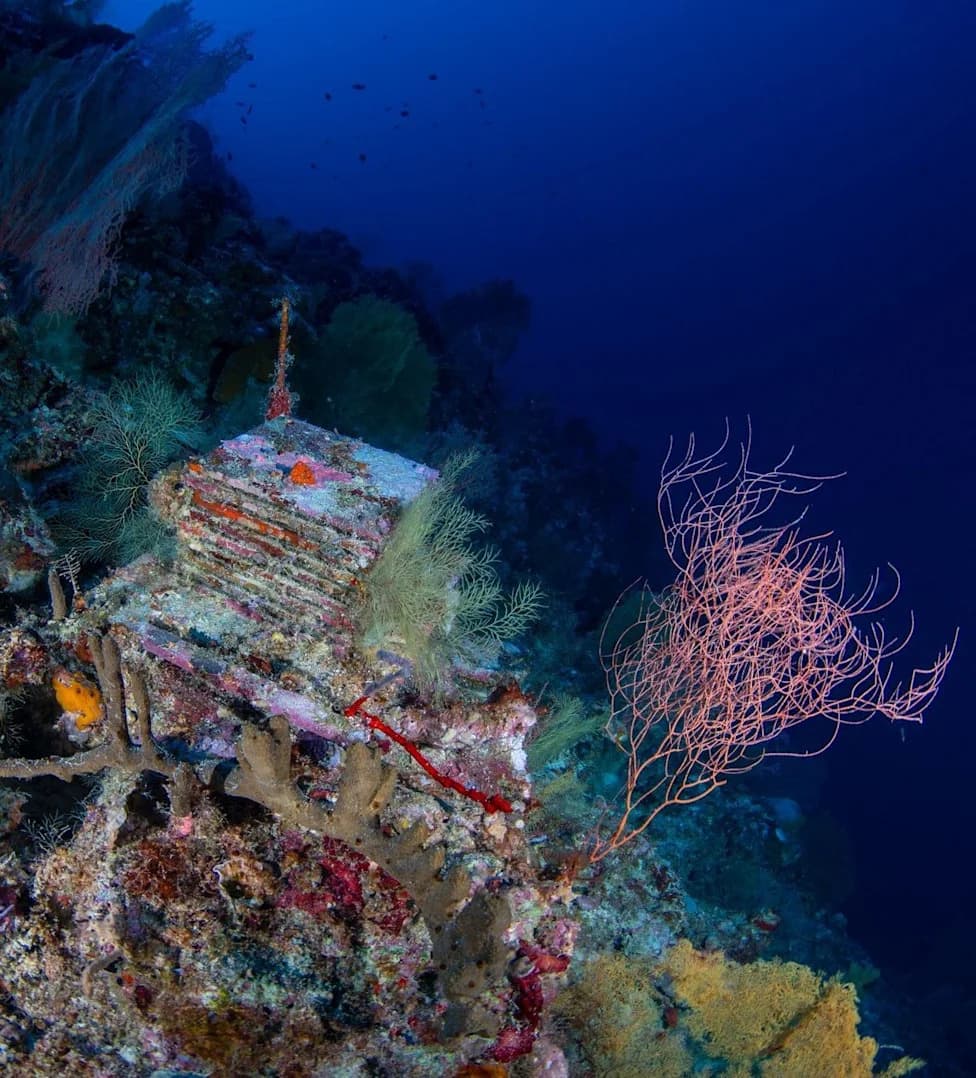
Deep has placed Vanguard, a subsea habitat, about 60 feet (≈18 m) deep on Tennessee Reef in the Florida Keys. The module provides a dry living space for four aquanauts for up to five days and is tethered to a surface buoy that supplies air, power and communications. Certified by Det Norske Veritas (DNV), Vanguard is a demonstrator for a larger Sentinel station and a fleet of research submersibles, with Deep aiming for more permanent underwater habitation by 2027. The habitat will support research on coral restoration, long-term monitoring, climate impacts, and human performance.
Vanguard Deployed Near Florida Keys: A Major Step Toward Living Underwater
Permanent ocean living may come sooner than expected. | Credit: Illustration by Stephen P. Kelly / Getty Images / Shutterstock
Deep, a U.K. ocean engineering firm, has installed a new subsea research habitat called Vanguard on the Tennessee Reef within the Florida Keys National Marine Sanctuary. Set roughly 60 feet (≈18 m) below the surface, the module provides a dry living environment for up to four aquanauts for up to five days without resurfacing.
Installation and Support Systems
Engineers prepared a dedicated foundation on the seabed and lowered Vanguard into place using a crane from a surface vessel. The habitat remains connected to a bright yellow surface buoy that houses critical support systems — communications arrays, breathable-air supplies, and power — and links the station to surface operations.
Certification and Safety
Deep says Vanguard has received approval from Det Norske Veritas (DNV), an internationally recognized accreditation body commonly used by oceanographic organizations and marine companies. That certification indicates the facility meets relevant safety and operational standards for subsea habitats.
How Living Undersea Works
Vanguard operates on the same principles used in saturation diving: after an extended period under pressure, inert gases such as nitrogen saturate body tissues and blood, permitting longer stays at depth without repetitive decompression. As Dawn Kernagis, Deep’s director of scientific research, explained, "It's like you have been scuba diving for a really long time and your tissues and your blood get saturated with nitrogen." Residents can also make extended excursions from the habitat using an umbilical tether to the habitat's air supply, enabling dives that last hours rather than the roughly 60 minutes typical of recreational scuba.
Sentinel and Future Plans
Vanguard is a demonstrator for a larger planned station called Sentinel, which Deep describes as an underwater facility with direct ocean access, private suites (including showers and toilets), configurable workspaces, and communal areas for meetings and dining. Deep also intends to deploy a complementary fleet of submersibles and dive systems to support scientific operations across a wide range of depths. The company has stated an ambition to enable more permanent underwater living as early as 2027.
Research Mission and Local Context
The Tennessee Reef has been designated a research-only zone by the National Oceanic and Atmospheric Administration (NOAA). Deep says Vanguard will expand opportunities for research focused on coral reef restoration, long-term ecological monitoring, climate impact studies, human performance undersea, and training for extreme environments. The Florida Keys already host the Aquarius Reef Base, a long-standing underwater research facility operated by Florida International University, underscoring that submerged habitats have precedent in scientific work.
Why This Matters
Vanguard represents a modern, modular approach to extended ocean access that could accelerate ocean science, conservation, and specialized training. While ambitions for year-round, permanent underwater living remain challenging — requiring advances in infrastructure, logistics, economics, and long-term human health data — Vanguard demonstrates renewed interest and technological progress in subsea habitation.
Help us improve.