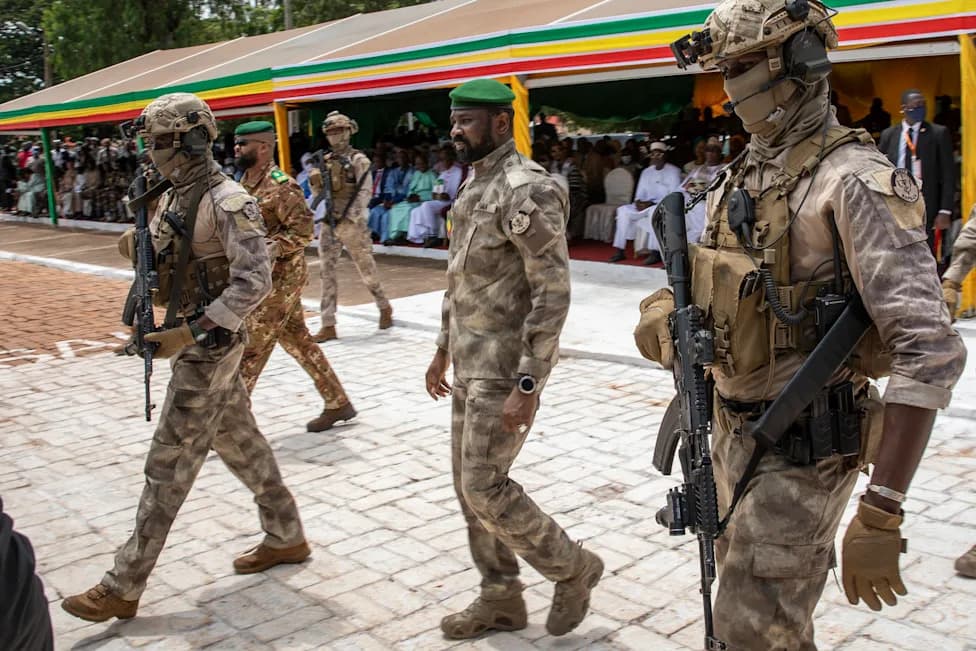
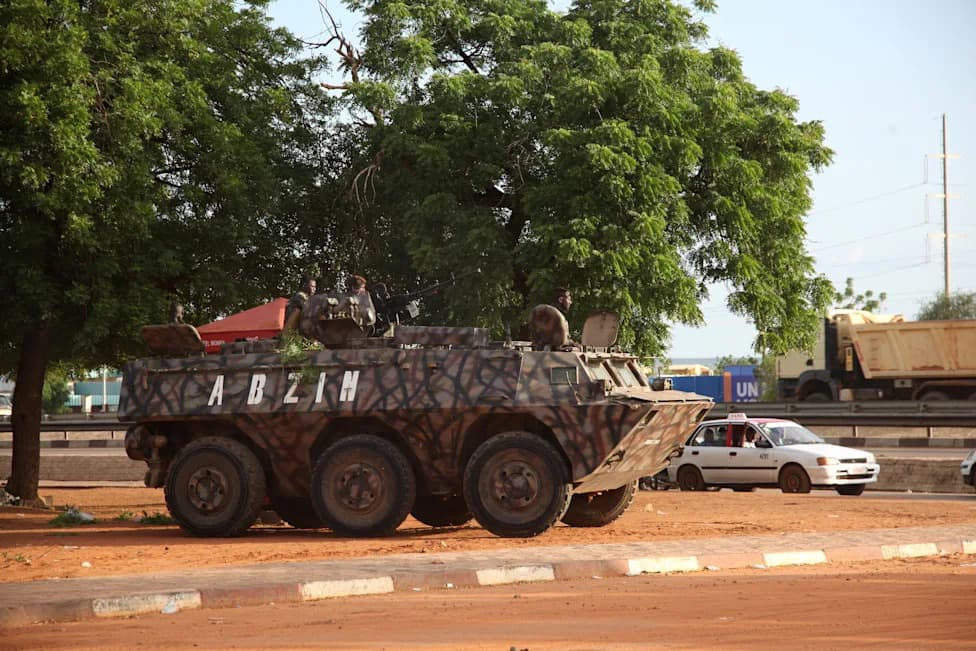
The July 18 ambush near Anefis — which killed at least 50 Malian soldiers and targeted a joint FAMa–Africa Corps convoy — underscores increasing tactical cooperation between the Tuareg-led Azawad Liberation Front (FLA) and al-Qaeda-affiliated JNIM. Analysts say the alliance is driven by a shared enemy rather than shared ideology. While Russia’s Africa Corps has improved Mali’s battlefield capabilities, it has not addressed the political and governance roots of the conflict, and the new FLA–JNIM cooperation risks spreading instability across the Sahel.
How New Alliances Between Armed Groups Are Rewriting Mali’s War — and Threatening the Sahel
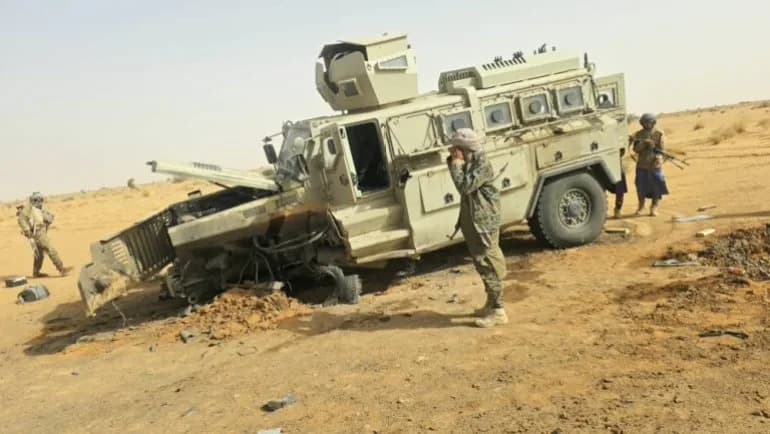
The wreckage of a vehicle in Mali, where years of fighting have taken a heavy toll on communities and security forces [Azaward Liberation Front via AP]
Bamako, Mali — The ambush on July 18 near Anefis that killed at least 50 Malian soldiers and struck a joint convoy of the Malian Armed Forces (FAMa) and Russia’s Africa Corps was more than a single battlefield setback. It highlighted a growing and dangerous trend: formerly separate armed factions are coordinating operations, exposing the limits of the military government’s security strategy despite expanded Russian military support.
The Malian military confirmed the assault and said it had launched counter-operations. Africa Corps later released footage it described as drone strikes against fighters involved in the ambush. The attack is the latest in a wave of coordinated offensives across northern Mali since April, raising urgent questions about why these groups are cooperating, how effective Bamako’s strategy is, what Moscow’s role has actually changed, and what the trend could mean for the wider Sahel.
A Tactical Partnership: FLA and JNIM
The July 18 ambush was jointly claimed by the Azawad Liberation Front (FLA), a coalition dominated by Tuareg separatists, and Jama'at Nusrat al-Islam wal-Muslimin (JNIM), an al-Qaeda affiliate active across the Sahel. Until recently, such cooperation would have seemed unlikely: the FLA seeks greater autonomy or independence for northern Mali, while JNIM pursues Islamist governance across the region.
Héni Nsaibia, a senior West Africa analyst at the Armed Conflict Location & Event Data Project (ACLED), says the alliance is driven less by ideology than by a shared battlefield enemy.
Analysts argue that FLA and JNIM fighters are coordinating because they view the Malian armed forces and their Russian partners as a common adversary. Coordinated operations let them pool intelligence, local knowledge, manpower and tactical experience — acting as force multipliers even while pursuing different long-term political goals.
Why Bamako’s Strategy Is Struggling
The junta’s decision to abandon the 2015 Algiers Peace Agreement, request withdrawal of the United Nations Multidimensional Integrated Stabilization Mission in Mali (MINUSMA), and deepen military cooperation with Russia reshaped the conflict environment. Removing the peace framework eliminated one of the few mechanisms that regulated relations with northern armed actors, while a more confrontational posture encouraged former rivals to coordinate against a shared threat.
Since Russia replaced the Wagner Group with Africa Corps as its primary military presence in Mali, Russian personnel, drones and aircraft have enhanced FAMa’s surveillance and strike capabilities, and Russian units have provided combat support on the ground. Those improvements have helped the army win tactical engagements and defend key positions.
Nimi Princewill, a regional analyst on West Africa and the Sahel, says Russia’s backing has strengthened Mali’s military capacity but has not resolved the conflict’s political and governance roots.
Recent events underscore that point. Convoys moving through northern Mali — especially along routes linking Gao, Anefis and other garrisons — remain vulnerable to ambushes. The withdrawal of MINUSMA removed a multilateral presence that provided logistics, monitoring and intelligence across vast areas, leaving a military that is on average better in direct combat but still unable to secure remote territory against adaptive armed groups.
Regional Consequences
The Anefis ambush has implications far beyond Mali. JNIM already operates across Mali, Burkina Faso and Niger, and the Sahel continues to see spreading violence. The evolving battlefield is also a test for the Alliance of Sahel States (AES): coordinated attacks suggest that while states try to deepen cooperation, non-state actors are matching that flexibility and may be forging cross-border tactical ties of their own.
Mali’s withdrawal from the Economic Community of West African States (ECOWAS) has also curtailed regional coordination at a time when neighbours face similar threats. If the FLA–JNIM tactical partnership proves durable, it could inspire similar alliances across the region and complicate efforts to contain groups that already operate transnationally.
Whether this tactical cooperation will last is uncertain. What is clear is that as Mali’s security strategy shifts toward militarised partnerships and away from international mediation, armed groups are adapting in ways that could extend instability well beyond Mali’s borders.
Help us improve.