Sheikh Hamad bin Khalifa Al Thani turned Qatar’s gas wealth into a deliberate strategy of optionality, embedding the country in global commercial, military and diplomatic networks that made it difficult to isolate. The model — long LNG contracts, the US base at Al Udeid, Al Jazeera, the Qatar Investment Authority and mediation channels — largely survived the 2017 blockade. But recent shocks (an Israeli strike in Doha in Sept 2025 and an Iranian strike on Ras Laffan in Mar 2026) exposed limits: Qatar must now convert bilateral optionality into operational resilience to withstand simultaneous crises.
Sheikh Hamad’s Real Legacy: Turning Gas Into Optionality — And The Test Ahead
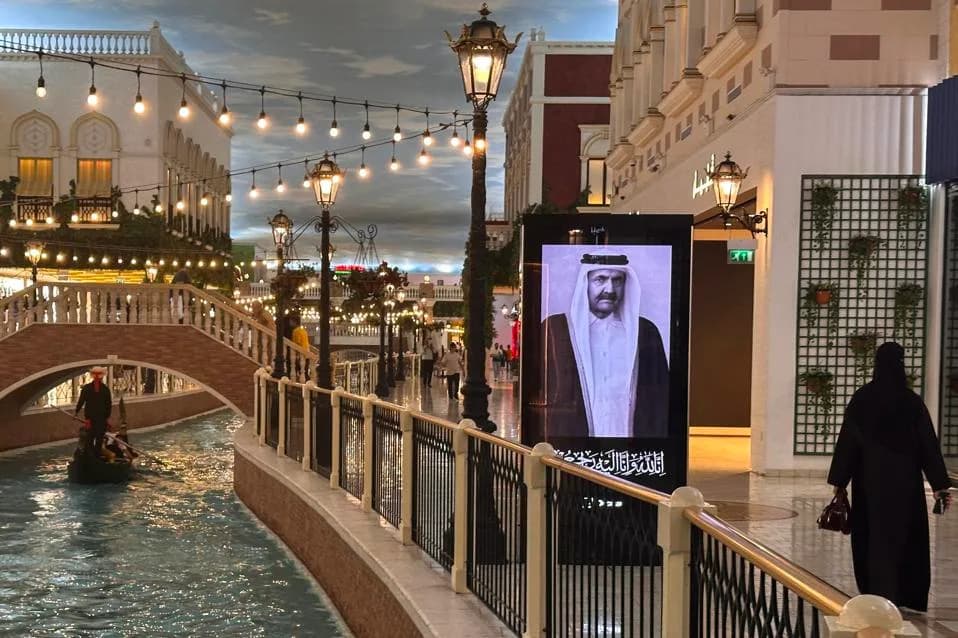
TOPSHOT - People ride in a gondola past a portrait of Qatar's former leader Sheikh Hamad bin Khalifa Al Thani at a mall in Doha on July 12, 2026, after the announcement of his death. Qatar's government on July 12 announced the death of Sheikh Hamad, who led the country from 1995 to 2013. He was 74, according to a government website. The former leader was seen as one of the key architects of modern Qatar and led the country during a period of rapid economic growth. He took power in June 1995, overthrowing his father in a bloodless coup while the latter was abroad. (Photo by Karim JAAFAR / AFP via Getty Images)AFP via Getty Images
Sheikh Hamad bin Khalifa Al Thani, who died on July 12, 2026 at age 74, is widely credited as the architect of modern Qatar. Between 1995 and 2013 he transformed a small Gulf peninsula into a state with global reach: an influential broadcaster, a sovereign wealth fund, a major airline, a world-class education hub and a prominent diplomatic role. But the thread that links these achievements was not prestige for its own sake; it was deliberate optionality — a strategy that made Qatar hard to isolate by giving many international actors a stake in its continued functioning.
Optionality As Statecraft
Qatar’s North Field preceded Sheikh Hamad, but his decisions — heavy investment, long-term contracts and political prioritization — industrialized that resource. The first Qatari LNG cargo sailed to Japan in 1997, when the market and technology were still nascent. By the early 2010s Qatar’s liquefaction capacity reached roughly 77 million tons per year, and for much of the following decade it was the world’s largest LNG exporter. More important than tonnage were the durable commercial links: long contracts, partnerships with majors and financiers made other countries’ energy security partly dependent on Doha.
Security and diplomacy followed the same logic. The Al Udeid air base, established from 1996, knitted US operational needs to Qatari security. Simultaneously, Doha maintained working channels to Tehran — necessary because of the shared North Field — while cultivating ties with Washington, Ankara and others. Media and cultural investments broadened Qatar’s constituency: Al Jazeera (1996) provided reach across Arab publics, and the Qatar Investment Authority (2005), Qatar Airways, Education City and the 2022 World Cup created practical interests in London, New York, Tokyo and within global institutions.
Mediation became Doha’s most distinctive tool of influence. By remaining willing to talk to actors that many states would not — from Hamas to the Taliban — Qatar turned the absence of hard power into leverage. That usefulness helped make isolation costly for other states.
Successes, Contradictions And Costs
The 2017 blockade by Saudi Arabia, the UAE, Bahrain and Egypt tested Qatar’s model. The embargo lasted three and a half years and ultimately failed to force Doha into submission; it did, however, push Qatar closer to Turkey and Iran and highlighted both the strengths and limits of optionality. The same openness that enabled mediation also produced contentious policy choices: Doha’s ties to Islamist movements during the Arab uprisings drew criticism, while Al Jazeera’s editorial approach strained relations with regional governments.
The 2022 World Cup crystallised the strategy’s contradictions: labor reforms were introduced and acknowledged by bodies such as the International Labour Organization, yet human-rights groups argued enforcement lagged, leaving contested casualty and death figures that fuel continuing debate about responsibility.
The Acute Test: Multiple Shocks
Recent events have sharpened the central challenge of Sheikh Hamad’s design. In September 2025 an Israeli strike hit Hamas negotiators in Doha despite Qatar’s security relationship with the United States, prompting Washington to convert informal assurances into a formal executive-order guarantee. In March 2026 an Iranian strike on the Ras Laffan industrial complex forced QatarEnergy to declare force majeure on some LNG contracts. These shocks raise a new question: it is no longer only how many partners Qatar has, but whether those partners remain usable simultaneously during a compound crisis.
Mediation remains indispensable for a small state without significant hard power, but the Doha strike showed that being an essential venue does not guarantee protection. The US guarantee arrived after the attack rather than before it, exposing the limits of optionality as a shield.
What Comes Next?
Sheikh Hamad’s key contribution was political permission, sequence and appetite for risk — not single-handedly building every institution credited to his era. If his doctrine is to endure, optionality must evolve into operational resilience: practical arrangements that make multiple lines of support usable at once. That could mean narrower, highly practical compacts — shared early-warning mechanisms, better-integrated air-defence information, agreed consultation triggers and maritime continuity plans — that preserve Qatar’s diplomatic autonomy while increasing collective reliability in crises.
Bottom line: Qatar’s strategy made it valuable and hard to isolate. The country’s future depends on turning a diverse portfolio of relationships into an operational, concurrent safety net when several stresses arrive together.
Help us improve.