Neurologists at UCLA and Johns Hopkins tested whether hand dominance is innate or learned by having right-handed volunteers write 'A' and '8' with hands and with elbows (a body part rarely used for fine writing). A neural network objectively scored produced shapes and found no advantage for the dominant elbow. After targeted training, both elbows improved similarly, suggesting dominance is driven by lifelong asymmetric practice with tools and handwriting rather than an innate hemisphere superiority.
Study Finds Handedness Is Learned — Practice, Not Brain Wiring, Drives Your Dominant Hand
(glamstock/Imazins/Getty Images)
Are you right-handed, left-handed, or ambidextrous? New research from neurologists at UCLA and Johns Hopkins challenges the idea that hand dominance is an innate, hard-wired property of the brain. Instead, the study provides evidence that dominance largely reflects years of asymmetric practice using tools and handwriting.
Study Design and Methods
The researchers recruited healthy, right-handed volunteers and asked them to write the letter 'A' and the number '8' eight times with each hand. They then repeated the task using a pen strapped to the elbow — a body part almost nobody normally uses for fine writing. A neural network was trained to classify the resulting shapes as 'good' or 'bad' to provide an objective measure of performance. The analysis also accounted for the time each character took to produce.
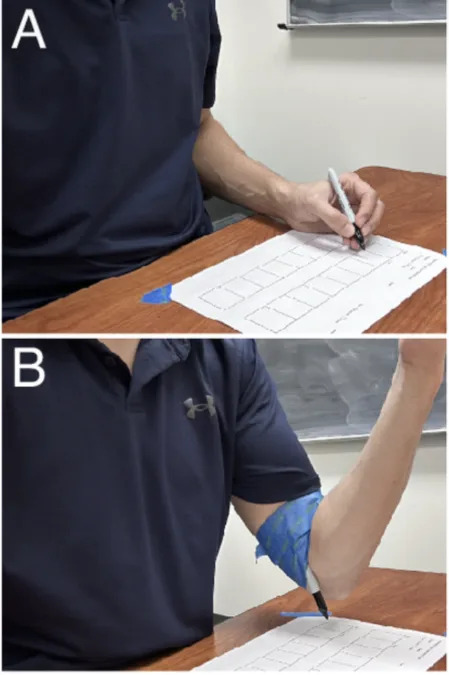
For elbow writing, the pen was securely attached to the elbow to prevent wobbling. (Arac et al.,PNAS, 2026)
Key Findings
Despite all participants being right-handed, there was no measurable advantage for the right elbow over the left: 'dominance disappeared' when using a body part with no lifetime history of the task. When participants were split into training groups — one trained the dominant elbow, the other the non-dominant elbow — both sides started at similarly poor quality and improved substantially and similarly with practice.
Interpretation and Implications

Subscribe to ScienceAlert's free fact-checked newsletter
The results support the hypothesis that hand dominance for skilled tasks like handwriting and tool use is built up through repeated, asymmetric practice rather than by an inherently superior motor control in one cerebral hemisphere. In plain terms: the hand you favor becomes dominant because you use it for complex tasks over and over. This finding has implications for motor learning and rehabilitation: targeted practice can build skill in less-used limbs or body parts.
Limitations
The study focused on a specific fine-motor task (handwriting shapes) in healthy, right-handed adults. While the findings are robust for this task, they do not rule out genetic or developmental influences on handedness more broadly, nor do they directly address population-level asymmetries such as the very high prevalence of right-handedness.
Publication
The study was published in the Proceedings of the National Academy of Sciences and was authored by Ahmet Arac, Nicolas Jeong Lee, and John Krakauer. The article was fact-checked and edited prior to publication.
Help us improve.