ESA's Euclid briefly reoriented to capture a bright, star-filled image of the Milky Way's galactic bulge. That snapshot will provide valuable pre-survey context for NASA's Nancy Grace Roman Space Telescope, which begins a five-year bulge survey later this summer. Combining Euclid's imaging with Roman's time-domain observations will improve mapping and boost the search for elusive objects like isolated black holes and rogue planets.
Euclid Captures the Star‑Packed Heart of the Milky Way, Laying Groundwork for NASA's Roman Telescope
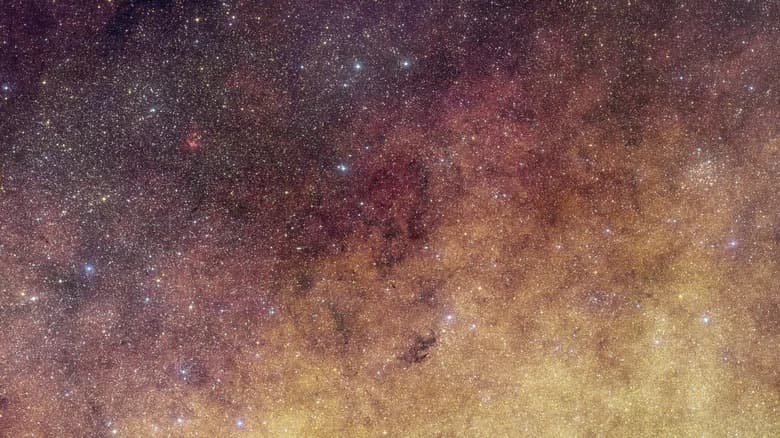
Photo of the galactic bulge, a densely packed region of stars at the center of the Milky Way - ESA/Euclid/Euclid Consortium/NASA, CFHT, image processing by J.-C. Cuillandre and E. Bertin (CEA Paris-Saclay)
The European Space Agency's Euclid telescope has produced a striking, star-dense image of the Milky Way's galactic bulge after a deliberate detour from its primary mission to study the dark universe. The bright, crowded patch is a crop from a larger exposure that highlights the extreme stellar density at our galaxy's core.
Beyond its visual appeal, this snapshot has clear scientific value: it provides advance context for NASA's Nancy Grace Roman Space Telescope, which is set to begin a five-year survey of a small region of the bulge later this summer. Having Euclid's observations of the same field before Roman starts collecting data will give researchers complementary information that neither mission could provide alone, improving mapping and enabling more sensitive searches for rare phenomena.
"Adding Euclid's snapshot to Roman's future survey will help us map our galaxy better and identify hard-to-find cosmic treasures like isolated black holes and rogue planets more easily," said Jason Rhodes, a senior research scientist at NASA's Jet Propulsion Laboratory and a member of the U.S. teams for both Euclid and Roman.
Recent investigations have flagged puzzling features in the bulge—sometimes called "bulge fossil fragments"—which point to a complex and difficult-to-study region. Euclid's image makes it immediately clear why: the core is extremely crowded, making it challenging to disentangle overlapping sources and detect transient microlensing events that reveal objects such as free-floating planets and solitary black holes.
By combining Euclid's pre-survey imaging with Roman's upcoming high-cadence observations, astronomers expect to improve astrometric precision, better characterize stellar populations, and more readily identify subtle or rare events. Together, the two missions will offer a more complete and powerful view of the Milky Way's center than either could alone.
Help us improve.