
Fifty years after a car bomb in Washington, D.C. killed Orlando Letelier and Ronni Karpen Moffitt, a Santiago court has sentenced three former DINA agents—Pedro Espinoza, José Zara and Raúl Iturriaga—to 15 years for Moffitt’s murder. The convictions link the attack to DINA chief Manuel Contreras’s campaign of extrajudicial killings abroad and follow earlier convictions and a 1978 confession by U.S.-linked collaborator Michael Townley. Relatives and former colleagues called the ruling long-awaited justice and urged continued efforts to hold all responsible parties accountable.
Decades Later: Three Former Pinochet Agents Sentenced for 1976 Washington DC Car Bomb Killing
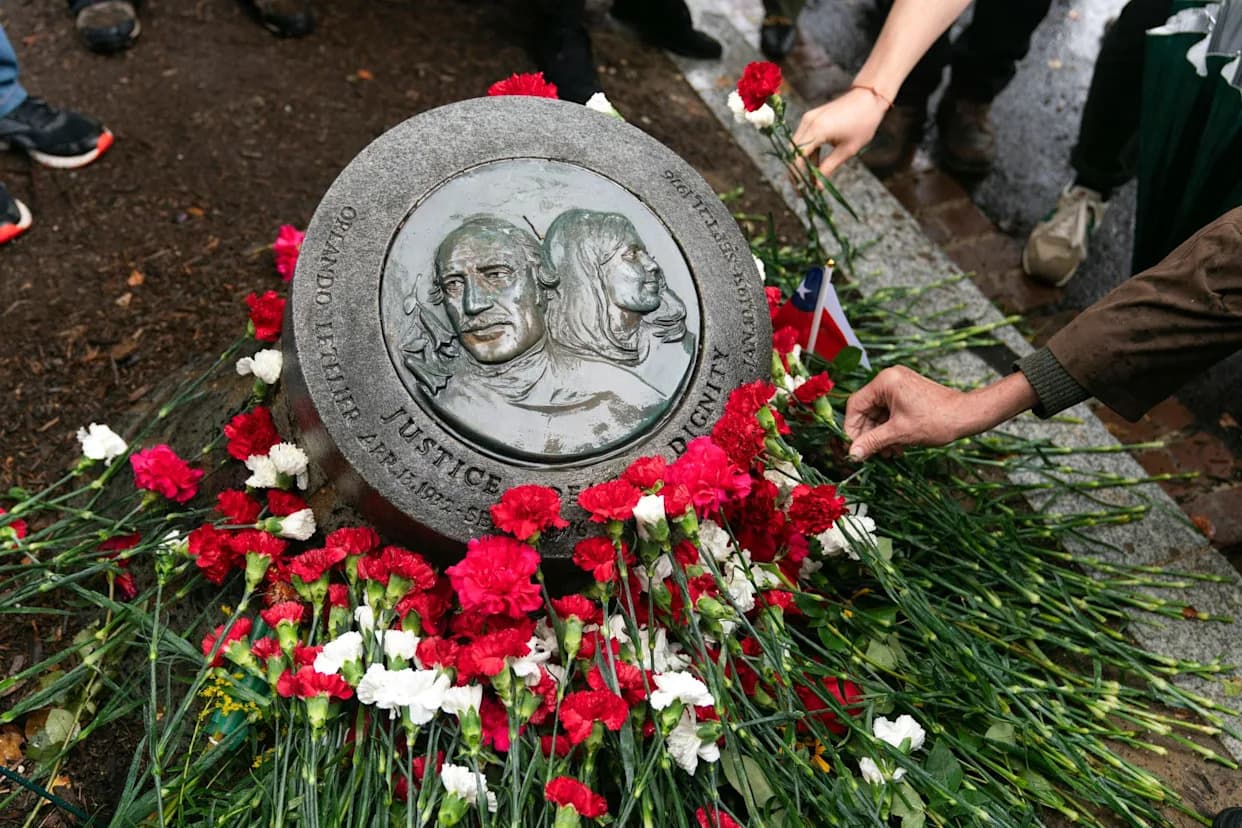
People leave flowers at a memorial for Orlando Letelier and Ronni Moffitt at Sheridan Circle in Washington DC on 23 September 2023.Photograph: José Luis Magaña/AP(Photograph: José Luis Magaña/AP)
Fifty years after a car bomb detonated in the heart of Washington, D.C., killing former Chilean minister Orlando Letelier and his American colleague Ronni Karpen Moffitt, a Santiago court has handed 15-year prison sentences to three former agents of General Augusto Pinochet’s secret police for Moffitt’s murder.
Judge Paola Plaza, a special minister for human rights, sentenced Pedro Espinoza, José Zara and Raúl Iturriaga for their roles in the 21 September 1976 attack that killed 25-year-old Ronni Karpen Moffitt as she and Letelier drove on Massachusetts Avenue NW toward their offices.
The three were members of the Dirección Nacional de Inteligencia (DINA), the notorious Chilean intelligence agency that targeted regime opponents at home and abroad. The court found their actions tied to a broader campaign of extrajudicial killings overseen by DINA chief Manuel Contreras.
Case Background and Past Rulings
The bombing strained relations between Chile and the United States. Several senior Chilean military officials were convicted in the 1990s in connection with the plot, and DINA collaborator Michael Townley, a U.S. national, confessed in 1978 to participating in the operation.
Although some perpetrators were prosecuted decades ago, Moffitt’s case remained unresolved for many years. In 2012 a Santiago appeals court ordered the case reopened on the basis that the primary perpetrators were Chilean nationals, leading to the recent convictions.
Reactions and Aftermath
Family members welcomed the ruling as long-delayed justice. Rebecca Karpen, Moffitt’s niece, described the sentences as a victory for the family and a reminder of the enduring pain caused by the Pinochet regime. Juan Pablo Letelier, Orlando Letelier’s son, urged U.S. authorities to continue pursuing accountability for all those responsible.
Orlando Letelier had been a prominent critic of the junta while living in exile in the United States after suffering imprisonment in Chile. On 10 September 1976 his Chilean citizenship was revoked; eleven days later the car bomb that killed him and Moffitt detonated in Washington, D.C.
The killings prompted a U.S. congressional investigation and an arms embargo on Chile, and they contributed to the eventual disbanding of DINA (which was later replaced by the Central Nacional de Informaciones, CNI).
“I was born a Chilean, I am a Chilean, and I will die a Chilean,” Letelier declared in a speech at Madison Square Garden days before his death, a testament to his outspoken opposition to the dictatorship.
The recent convictions close an important legal chapter in a case that highlighted the international reach of a repressive regime, but family members and human rights advocates say ongoing efforts are needed to hold all architects and collaborators accountable.
Help us improve.






















