The Chinese Academy of Sciences led an expedition that discovered a massive concentration of whale remains in the Diamantina Fracture Zone, about 700 miles west of Perth. Over 33 dives in early 2023, scientists recorded 476 fossils, five carcasses, and the deepest modern whale fall at ~6,700 meters. Most remains are beaked whales (family Ziphiidae), including a 5.3-million-year-old fossil and a newly named species, Pterocetus diamantinae. Researchers suggest deep-foraging behavior and the trench’s V-shaped topography may concentrate whale remains, making the site an exceptional fossil archive.
Scientists Uncover Massive Whale 'Necropolis' — 476 Fossils and the Deepest Whale Fall Recorded
The Whales Were Piling Up for Millions of YearsHearst Owned
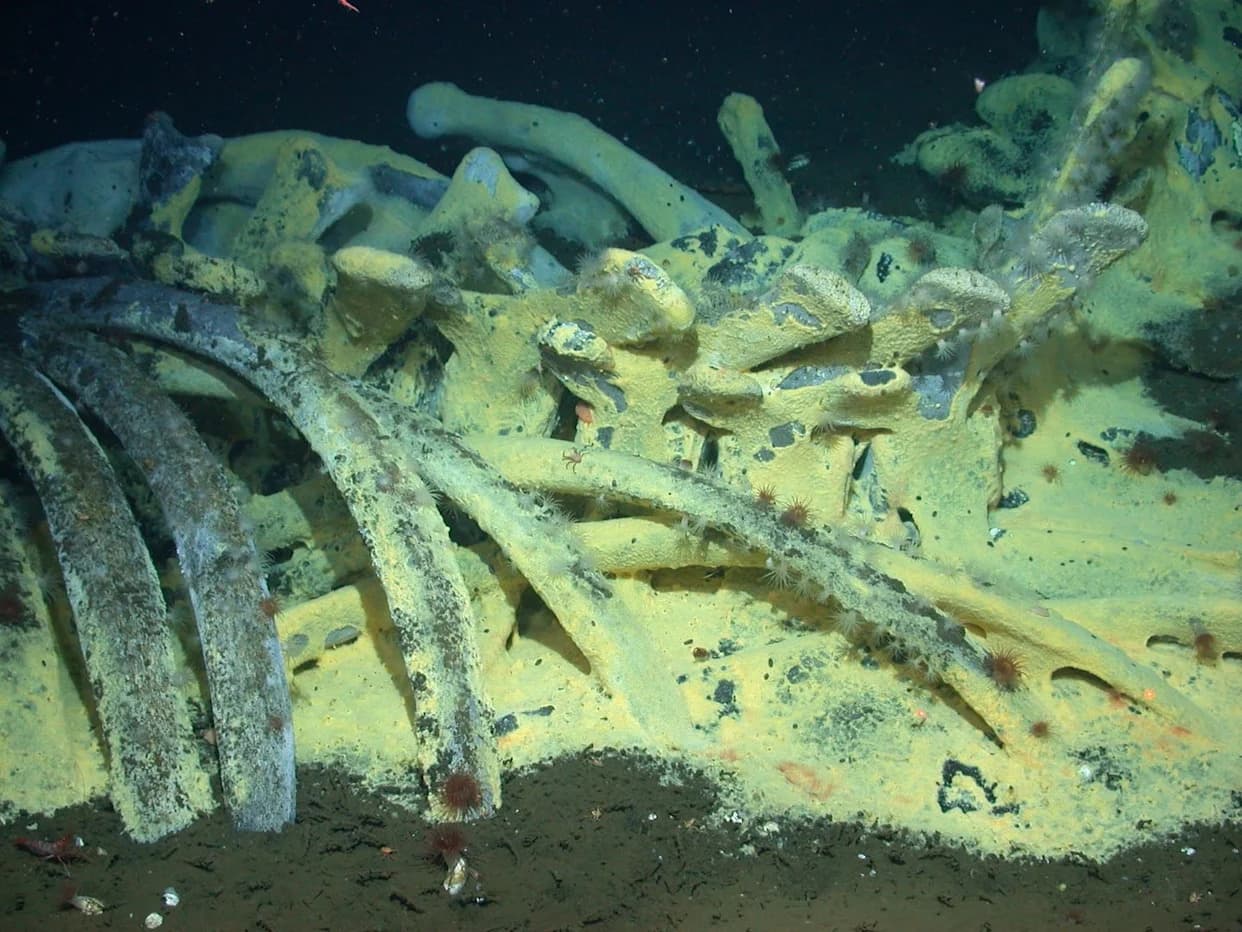
A team led by researchers at the Chinese Academy of Sciences has documented an unprecedented concentration of whale remains on the seafloor of the southeastern Indian Ocean, describing what they call the world’s largest whale “necropolis.” The findings were published in Nature and reveal a remarkable fossil archive that sheds new light on the evolution and ecology of deep-diving whales.
During an expedition from 8 February to 17 March 2023, scientists aboard the research vessel R/V Tan Suo Yi Hao made 33 dives into the Dordrecht Deep, a trench within the Diamantina Fracture Zone roughly 700 miles (about 1,100 km) west of Perth, Australia. That area formed as Australia and Antarctica separated 50–60 million years ago and is characterized by steep ridges and deep troughs.
Near the trench’s lowest reaches (the Dordrecht Deep bottoms out at about 7,079 meters / 23,225 feet), the team first observed a partially buried whale fossil. Over the course of 32 additional dives they identified 476 whale fossils, five modern carcasses, and recorded the deepest known modern whale fall at around 6,700 meters / 22,000 feet — far deeper than the previous record in the North Atlantic (~13,200 feet).
Extrapolating from survey densities, the authors estimate that each square kilometer of this necropolis could contain roughly 7–8 intact carcasses and about 760 fossilized individuals, indicating the site’s exceptional richness and potential as a long-term fossil archive.
Which Whales Were Found?
Most of the intact carcasses recovered belong to beaked whales (family Ziphiidae), a cryptic group of deep-diving cetaceans comprising about 24 species and regarded as among the least understood large mammals because they live offshore and rarely strand. The largest modern carcass recorded at the site was an Antarctic minke whale (Balaenoptera bonaerensis).
Fossils and a New Species
The necropolis also contains important fossils for understanding beaked whale evolution. The oldest specimen found dates to roughly 5.3 million years ago and belongs to an extinct ancestor in the genus Pterocetus. The team also described a previously unknown species, which they named Pterocetus diamantinae.
Why So Many Whales Here?
Lead author Xiaotong Peng and colleagues propose several, nonexclusive explanations. The Diamantina zone may be a productive deep-water foraging area that draws beaked whales into extreme depths. Individual whales could descend deeper than their typical maximum (~3,000 meters / 9,800 feet), risking exhaustion or decompression-related injury and death. Alternatively, the trench’s V-shaped topography could funnel sinking carcasses from a wide region into the same basin, concentrating remains.
“Whale falls are biodiversity oases at seabeds, yet their record from the oceans has remained sparse and fragmentary,” the authors write. “These findings reshape the understanding of the limits and biogeography of whale-fall ecosystems and establish some deep sea floors as a fossil archive for tracing cetacean evolution over geological time.”
This newly identified megasite — effectively a fossil deposit in formation — provides a rare window into the evolutionary history, paleoecology and population dynamics of beaked whales from the Pliocene to the present day. Because beaked whales are typically known only from rare strandings, the necropolis dramatically improves scientists’ ability to study these elusive deep-sea mammals.
Key Data At A Glance: 476 fossils; 5 modern carcasses; deepest modern whale fall at ~6,700 m (22,000 ft); Dordrecht Deep max depth ~7,079 m (23,225 ft); site ~700 miles west of Perth; new species Pterocetus diamantinae.
Help us improve.